What Is AI Lead Qualification? How Automated Lead Qualification Works
Learn what AI lead qualification is, how automated qualification works, what information it uses, where human judgment still matters, and how to measure whether it improves your sales process.
 Written by Dylan StottFounder of Kinetic AI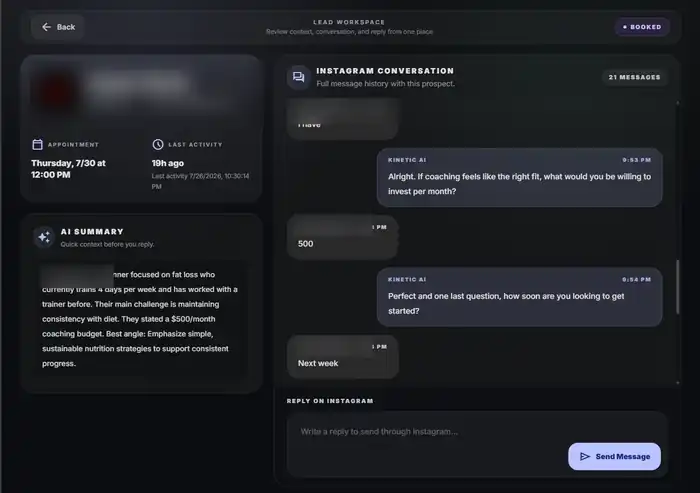
AI lead qualification is the use of artificial intelligence to help determine which leads are worth pursuing, what information is still missing, and what should happen next. Instead of treating every inquiry the same, an AI system can interpret what a prospect says, compare that information with the business's qualification criteria, and move the lead toward the appropriate next step.
That next step is not always a sales call. A lead may be ready to book, need one more question answered, belong in a later follow-up path, require a human review, or clearly fall outside the service the business provides.
The useful part of AI lead qualification is not simply that software can ask questions. It is that the system can turn lead information into a consistent decision while preserving context for the people who still need to sell, advise, estimate, or serve the customer.
AI lead qualification in one sentence
AI lead qualification uses AI to interpret lead information, apply business-defined fit criteria, identify missing context, and recommend or trigger the right next action.
The AI may work with structured information such as form fields, service area, company size, appointment type, or stated timeline. It may also work with unstructured information such as emails, chat messages, direct messages, call transcripts, or free-text form answers.
The quality of the outcome still depends on the business defining what a qualified lead actually means. AI can apply and interpret criteria, but it should not quietly invent the sales strategy for the company.
What problem does automated lead qualification solve?
Manual qualification becomes difficult when leads arrive faster than the team can review them, when different employees use different standards, or when useful information is buried inside conversations instead of stored in neat form fields.
Without a consistent process, strong leads can wait too long, weak-fit leads can consume expensive sales time, and the same prospect may be asked for information they already provided. The business also loses visibility into why one lead was advanced while another was not.
Automated qualification is designed to reduce those problems by making the first evaluation more consistent and by creating a clearer handoff between incoming interest and the next sales action.
- ✓Prioritize serious or time-sensitive opportunities faster
- ✓Apply the same basic fit rules across similar leads
- ✓Extract useful information from free-form conversations
- ✓Ask only for missing information instead of repeating known answers
- ✓Route leads to different next steps based on what the system learns
- ✓Preserve qualification context for the human who takes over
- ✓Track why leads advanced, paused, or were disqualified
How AI lead qualification works
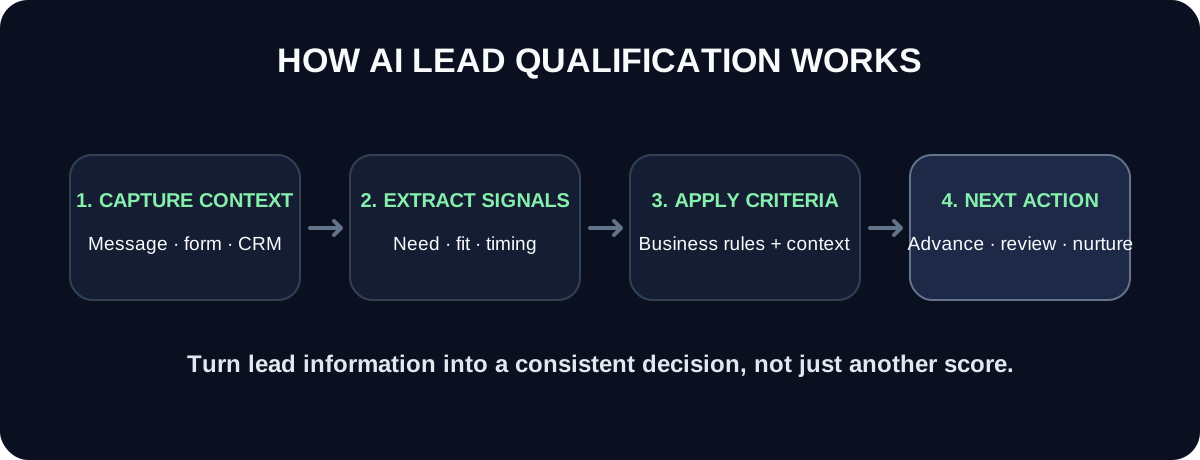
A practical AI qualification process has four layers: collect the lead's context, extract the important signals, compare those signals with the business's criteria, and choose the next action.
The software may complete those layers inside one conversation or across several connected systems. A website chatbot may collect the information directly. A CRM may receive a form submission and use AI to summarize the free-text answer. A social DM system may ask follow-up questions until it has enough context to decide whether booking is appropriate.
The important part is that the qualification decision is based on evidence from the lead, not on a generic label such as 'hot' or 'cold' with no clear definition behind it.
- ✓1. Capture context: source, message, form data, conversation history, or other relevant lead information
- ✓2. Extract signals: goal, problem, fit, timing, constraints, buying intent, or missing information
- ✓3. Apply criteria: compare the evidence with the business's approved qualification rules
- ✓4. Choose the next step: book, continue qualifying, nurture, route to a person, redirect, or close
AI qualification starts with business rules, not with a model
The first step is not choosing an AI model or writing a prompt. It is deciding what the business needs to know before spending more sales effort on a lead.
A qualified lead means different things in different businesses. A contractor may need service area, project type, timing, and enough scope to decide whether an estimate makes sense. A B2B agency may need a real business problem, relevant company fit, decision context, and a plausible timeline. A coaching business may need to understand the prospect's goal, current obstacle, timing, and whether they are actually looking for coaching.
If those standards are vague, AI can automate inconsistency rather than remove it. Clear qualification rules are the foundation the software operates on.
Related reading
The core qualification signals most businesses care about
The exact criteria vary, but most lead-qualification systems are trying to understand a small number of recurring questions. The goal is not to force every company into one framework. It is to identify the information that changes the next step in your own sales process.
- ✓Need: does the lead have a real problem, goal, request, or desired outcome?
- ✓Fit: can the business realistically serve this type of customer, project, location, or use case?
- ✓Timing: is there a realistic window for the purchase, project, appointment, or decision?
- ✓Economics: when relevant, is there a workable path around budget, project size, pricing range, or commercial value?
- ✓Decision path: does the lead know who is involved and what must happen before a decision can be made?
- ✓Readiness: is the person prepared to take the next reasonable action now, or should the opportunity be followed up later?
Structured data and unstructured data play different roles
Traditional qualification systems work best when every answer arrives in a predictable field. AI becomes more useful when the information is not perfectly structured.
A dropdown that says the customer is in the correct service area is easy for ordinary rules-based software to evaluate. A message that says, 'We're opening a second location in October and need the new system running before then,' contains useful timing and business context that may need to be interpreted from normal language.
A strong system uses simple rules where simple rules are enough and uses AI where interpretation adds value. Not every field needs an AI model.
- ✓Structured inputs: location, service selected, company size, product tier, date, budget range, appointment type
- ✓Unstructured inputs: emails, chat replies, social DMs, call notes, transcripts, open-ended form answers
- ✓Derived context: summarized goal, likely constraint, missing information, qualification status, or recommended next action
AI lead qualification is not the same as lead scoring
Lead scoring and lead qualification can work together, but they solve different problems.
A score usually assigns a number or category that helps prioritize leads. Qualification is broader. It determines whether the opportunity fits the business and what should happen next. A lead can have a high engagement score and still be a poor fit. A lead can also be a strong fit without generating many behavioral signals first.
Use scoring when ranking helps the team decide where to focus. Use qualification when the business needs a decision about fit, readiness, routing, or next action. A later guide in this series will compare these two systems in more depth.
AI lead qualification is not the same as appointment setting
Qualification determines whether a next sales step makes sense. Appointment setting handles the process of moving an appropriate lead into a meeting or consultation.
Those jobs often overlap because a qualified lead may be routed directly to scheduling. But qualification can also end with nurture, a request for more information, a referral, a checkout flow, an estimate process, or a human review instead of a calendar link.
This distinction matters because booking more appointments is not automatically an improvement if the qualification standard becomes weaker at the same time.
What can happen after an AI qualifies a lead?
Qualification should produce a useful outcome. If the AI gathers information but every lead still enters the same generic sales sequence, much of the value is lost.
The next action should reflect what the system learned. Keep the number of outcomes small enough that the team understands them and the CRM can track them consistently.
- ✓Qualified and ready: move to the appropriate sales, booking, quote, demo, or checkout step
- ✓Qualified but not ready: assign a future follow-up or nurture path
- ✓More information needed: ask the specific missing question before advancing
- ✓Human review needed: transfer the conversation or lead record with context
- ✓Poor fit: redirect, refer, or close the opportunity respectfully
- ✓Existing customer or non-sales inquiry: move out of the new-lead qualification flow
Where AI lead qualification can happen
AI qualification is not tied to one channel. The same underlying logic can be applied wherever the business receives enough information to make or support a qualification decision.
The user experience changes by channel, so the system should not force every channel into the same conversation. A form can gather structured answers efficiently. A chat or DM can ask follow-up questions interactively. Email may require summarizing a longer inquiry before deciding what is missing.
- ✓Website forms and lead forms
- ✓Website chat and conversational widgets
- ✓Email inquiries
- ✓Social media direct messages
- ✓SMS or messaging channels where the business has an appropriate communication basis
- ✓Call transcripts and sales notes
- ✓CRM records that combine several of these sources
AI qualification through forms
Forms are efficient when the business already knows the exact information it needs. AI can improve the process by interpreting open-ended answers, summarizing context, identifying contradictions, or deciding which follow-up question should be asked next.
A form is still often the better tool for stable facts such as location, company size, service selection, or preferred appointment date. The mistake is adding AI where a dropdown or validation rule would be simpler and more reliable.
The best setup may be hybrid: collect objective information with normal form fields, then use AI to interpret the free-text answers and decide whether more context is needed.
AI qualification inside chat and messaging
Conversational channels give AI more flexibility because the system can ask one question, read the answer, and adapt the next question to what the prospect already said.
That can reduce the feeling of filling out an intake form and allows the system to skip questions that have already been answered naturally. It can also create poor experiences if the AI ignores direct questions, repeats itself, or keeps qualifying after the next step is already obvious.
Conversation quality depends on context recognition and pacing as much as on the wording of the messages.
Related reading
AI qualification inside a CRM
A CRM can use qualification results to make the rest of the sales process more visible. The AI may summarize the lead, populate fields, recommend a status, create a task, or route the opportunity to the correct owner.
The important design rule is to keep the structured lead record and the original evidence connected. A salesperson should be able to understand why a lead was marked qualified without trusting an unexplained label generated by software.
When possible, preserve the source answers, conversation, or notes that support the qualification decision. This makes review and correction much easier.
Related reading
What AI does well in lead qualification
AI is strongest when the job is repetitive enough to define but flexible enough that simple branching logic becomes awkward.
It can process the same criteria across many conversations, remember information from earlier messages, extract meaning from free text, and identify which qualification detail is still missing. It can also provide coverage when a human is unavailable, as long as the workflow and platform allow it.
- ✓Interpreting normal-language answers
- ✓Summarizing long inquiries or conversations
- ✓Recognizing when a criterion has already been answered
- ✓Applying a defined qualification framework consistently
- ✓Asking for the next missing piece of information
- ✓Creating structured fields from unstructured conversations
- ✓Routing routine outcomes without waiting for manual review
- ✓Preserving context for follow-up and handoff
What AI should not decide on its own
Not every qualification decision belongs to automation. Some leads require judgment that depends on risk, professional standards, unusual commercial terms, or facts the AI cannot verify.
The system should have explicit boundaries around those situations. A human-review outcome is a valid qualification result, not a failure of the automation.
- ✓Complex custom pricing or contract exceptions
- ✓High-stakes medical, legal, financial, safety, or other professional judgments
- ✓Situations involving unclear policy or incomplete business information
- ✓Unusual high-value opportunities where an exception may be justified
- ✓Angry, distressed, or sensitive conversations
- ✓Requests that fall between two service categories and need human interpretation
- ✓Any decision the business cannot clearly explain or audit after the fact
Human handoff should be designed before automation goes live
A good qualification workflow knows when to stop asking questions and involve a person. That means the handoff rules should be defined at the same time as the qualification rules.
The human should receive more than a notification that says 'lead needs help.' A useful handoff includes the prospect's stated need, the relevant qualification signals, what is missing or unusual, the current status, and the original conversation or source material.
This keeps the customer from repeating everything and lets the team focus its judgment on the actual exception.
Do not over-qualify good leads
Automated qualification can become too efficient at collecting information. Just because the AI can ask twelve questions does not mean it should.
Every question should change a decision, routing path, or preparation step. If the information is merely nice to know, it may belong later in the sales call, onboarding form, estimate process, or customer intake.
The shortest reliable qualification process is usually better than the most detailed one because it reduces friction while still protecting the business from clearly poor-fit opportunities.
Use confidence and uncertainty carefully
AI systems can be useful at identifying likely interpretations, but a qualification workflow should not hide uncertainty behind a confident status.
If the lead's answer is ambiguous, the better action may be to ask one clarifying question or route the record for human review. Do not force the model to make a binary qualified-or-unqualified decision when the evidence is genuinely incomplete.
For important rules, use deterministic checks where possible. If a service only operates in specific states, a validated location rule is stronger than asking a language model to infer eligibility from vague context.
Keep business facts separate from AI interpretation
The AI needs a reliable source of truth for the information it is not allowed to invent. Service areas, product availability, pricing policy, minimum project sizes, appointment types, eligibility rules, guarantees, and company policies should come from maintained business data or explicit rules.
AI is better used to interpret the prospect's side of the conversation and decide which approved rule applies. It should not improvise a new rule because the lead's situation sounds persuasive.
This separation makes the system easier to maintain because factual changes can be updated without rewriting the entire qualification logic.
Privacy and data handling still matter
Lead qualification often involves personal or commercially sensitive information. Businesses should collect only what is useful, use appropriate access controls, and understand how their vendors store, process, and retain the data used by AI features.
Do not ask for sensitive information simply because the system can process it. If the data is not needed to decide the next sales step, leave it out of the early qualification process.
The business remains responsible for using its communication channels and customer data appropriately. AI does not remove consent, privacy, security, or professional obligations that already apply to the business.
How to measure AI lead qualification
A qualification system should be judged by what happens to the sales process after the decision, not by how many fields the AI fills in.
Start with operational metrics that show whether the system is making the path clearer and whether qualified leads actually become useful sales opportunities. Compare the same definitions before and after automation when possible.
- ✓Qualification completion rate
- ✓Qualified-lead rate
- ✓Percentage of leads requiring human review
- ✓Time from inquiry to qualification decision
- ✓Qualified lead to next-step conversion rate
- ✓Qualified lead to booked appointment, estimate, demo, or proposal rate
- ✓Show or completion rate for the next sales event
- ✓Close rate on qualified opportunities
- ✓False-positive rate: leads advanced that the sales team considers poor fit
- ✓False-negative review: leads rejected or paused that a human later believes were worth pursuing
Do not optimize the qualified-lead rate by itself
A higher qualified-lead rate can be good or bad depending on what happens afterward. The system can make the number rise simply by lowering the standard.
If more leads are being marked qualified but appointment quality, show rate, close rate, or sales-team acceptance declines, the qualification rule may be too loose. If very few leads advance and strong prospects are being filtered out, it may be too strict.
Qualification quality becomes visible downstream. Connect the decision to the next stage of the pipeline instead of treating 'qualified' as the final outcome.
A worked example of AI lead qualification
Imagine a small marketing firm receives an inquiry that says: 'We run two dental offices and get plenty of website leads, but our front desk takes hours to reply. We want to improve that before opening our third location in November.'
The AI can extract several useful signals without asking the prospect to restate the message: the company operates multiple locations, the stated problem is slow lead response, the business is planning growth, and the timeline is tied to a November expansion.
The system may still need one or two pieces of information before deciding the next step, such as whether the firm serves dental practices and whether the prospect is looking for the type of service it provides. If those conditions are met, the lead can move to the appropriate consultation. If the service does not fit that use case, the system can route the inquiry elsewhere instead of booking a weak call.
The value comes from using the original message as evidence, asking only for what is missing, and producing a clear action from the result.
A practical AI lead qualification setup sequence
The safest way to introduce automated qualification is to start with one lead source and one clearly defined next-step decision. Expand only after the business can explain why the system is making the correct decisions on real leads.
- ✓Document the current manual qualification process
- ✓Define hard disqualifiers separately from strong-fit signals
- ✓List the minimum information required before the next sales step
- ✓Separate structured facts from information that needs AI interpretation
- ✓Define the allowed qualification outcomes
- ✓Create human-review triggers
- ✓Connect the result to the CRM, owner, or next-step workflow
- ✓Test normal leads, ambiguous leads, poor-fit leads, and unusual edge cases
- ✓Review real decisions and downstream sales outcomes before expanding the system
Common AI lead qualification mistakes
Most poor implementations fail because the underlying sales process is unclear or because the business asks AI to make decisions it has not defined well enough to automate.
- ✓Using vague instructions such as 'find the best leads' with no qualification standard
- ✓Treating a lead score as proof that the lead is actually a fit
- ✓Asking too many questions before providing value or a next step
- ✓Using AI where a simple validation rule would be more reliable
- ✓Letting the system invent policies, pricing, availability, or eligibility
- ✓Forcing ambiguous leads into a qualified or disqualified status instead of allowing review
- ✓Failing to preserve the evidence behind the qualification decision
- ✓Sending every qualified lead to the same next step regardless of context
- ✓Measuring total qualified leads without checking downstream quality
- ✓Automating before the business has enough inbound demand to justify the workflow
When AI lead qualification is most useful
AI qualification is most valuable when the business already receives enough inbound interest that evaluating leads consistently has become a real operational problem.
It is especially useful when the information arrives in conversations or free text, when leads appear outside normal staff coverage, when several team members use inconsistent qualification standards, or when good leads are waiting because nobody knows who should respond next.
If the business receives very few relevant leads, fixing demand generation may create more value first. If qualified opportunities reach the sales team but rarely buy, the larger problem may be the offer, pricing, or sales process rather than qualification.
Related reading
How Kinetic AI uses lead qualification
Kinetic AI applies AI lead qualification to one specific workflow: inbound Instagram conversations for personal trainers and online fitness coaches.
When a prospect reaches the coach's Instagram inbox, the system can interpret the conversation, gather fitness-specific qualification context, preserve the lead record and AI summary, and send the connected booking link when the prospect reaches the appropriate point. It can also track whether the call was actually scheduled so the qualification decision remains connected to the next outcome.
Kinetic AI does not replace the coach's sales call, pricing decisions, coaching judgment, or sensitive health decisions. The qualification layer is there to handle repeatable lead-management work and give the coach better context before the human conversation.
Related reading
Final takeaway
AI lead qualification is not simply a chatbot asking sales questions. It is a decision system that turns lead information into a consistent next step.
The strongest implementations start with clear business criteria, use simple rules for objective facts, use AI where interpretation adds value, collect only the information that changes the decision, preserve the evidence behind the result, and send uncertain or high-stakes situations to a human.
When those pieces are in place, automated qualification can help a business respond more consistently, protect sales time, reduce repetitive intake work, and move the right leads forward without treating every inquiry exactly the same.
Build a more predictable online fitness coaching business
Kinetic AI's Growth Partnership helps online fitness coaches identify what is holding growth back, build the strategy and systems around it, and review the numbers so the next priority is clear.
DM “DOUBLE” on Instagram →