AI Appointment Setter for Instagram DMs: How It Turns Conversations Into Booked Calls
Learn how an AI appointment setter for Instagram DMs can respond, qualify leads, handle common questions, follow up, and move the right prospects toward booked calls.
 Written by Dylan StottFounder of Kinetic AI
An AI appointment setter for Instagram DMs is designed to do more than reply quickly. Its job is to take an inbound conversation, understand why the person reached out, determine whether a call makes sense, and guide the right prospect toward a booking without forcing every message into the same script.
That makes appointment setting different from basic DM automation. A keyword reply can start the conversation. A calendar link can end it. The difficult part is everything in between: context, qualification, timing, questions, follow-up, and deciding when the booking step has actually been earned.
For a personal trainer, consultant, agency, coach, or other service business, the goal is not simply more calendar events. The goal is more qualified appointments with people who understand why they are booking and what the next conversation is for.
What is an AI appointment setter for Instagram DMs?
An AI appointment setter is software that handles part of the conversation between an inbound Instagram lead and a booked appointment. It can interpret free-form replies, ask qualification questions, use previous answers as context, answer approved questions, follow up, and send the next step when the lead is ready.
The most useful systems are not trying to close the entire sale inside Instagram. They are trying to make one decision well: what should happen next with this lead?
That decision may be to book a call, keep the conversation going, follow up later, hand the conversation to a human, or stop because the lead is not a fit.
- ✓Respond to new inbound Instagram conversations
- ✓Understand the reason for the inquiry
- ✓Ask relevant qualification questions
- ✓Recognize when enough information has been collected
- ✓Answer approved factual questions about the offer or call
- ✓Send the correct booking link when appropriate
- ✓Follow up when a serious lead stops replying or does not book
- ✓Hand unusual or sensitive situations to a human
- ✓Keep enough context for the business to understand the lead before the appointment
The complete Instagram appointment-setting flow
A practical AI appointment-setting flow is: inbound DM, understand intent, qualify, resolve the next important question, decide whether the lead is ready, offer the booking, confirm the outcome, and preserve context for the human who takes the call.
The important part is the decision point before the calendar link. A good setter should have a reason to believe the call is useful for both sides before asking the prospect to schedule.
This is why appointment setting is not just calendar automation. The calendar is one step inside a larger conversation and qualification process.
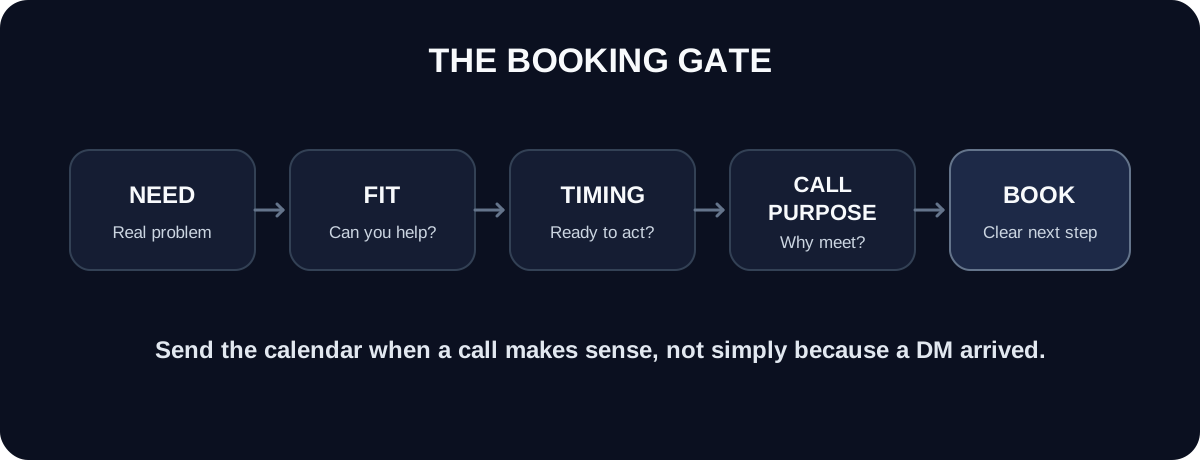
The booking gate: what should be true before a link is sent?
A booking link should usually appear after four things are reasonably clear: the prospect has a real need, the business appears to be a relevant fit, the timing makes sense, and the prospect understands what the call is for.
These are not rigid rules for every business. Some high-intent prospects already know exactly what they want and may be ready to book almost immediately. Others need a short conversation first.
The point of the booking gate is to prevent two common problems at the same time: sending the calendar too early to cold or unclear leads, and delaying the calendar after a strong-fit prospect is already ready to act.
- ✓Need: there is a real problem, goal, or reason for the inquiry
- ✓Fit: the business can reasonably help with that situation
- ✓Timing: the prospect is considering action within a relevant timeframe
- ✓Call purpose: the prospect understands why a conversation would help
- ✓Booking: the calendar becomes the logical next step rather than a random link
Step 1: Capture the context that brought the lead into the DM
The appointment-setting process should start with the context that already exists. A person who replied to a story about pricing entered differently from someone who sent a keyword for a free guide or asked, 'Do you offer coaching?'
That context can change the best first response. If the system ignores it, the conversation can feel disconnected from the action the prospect just took.
Whenever possible, preserve the source, trigger, campaign, post, keyword, or opening message that created the conversation. The setter can then start closer to the prospect's actual intent instead of treating every lead as identical.
- ✓Story reply
- ✓Post or Reel CTA
- ✓Comment-to-DM trigger
- ✓Profile message
- ✓Advertisement conversation
- ✓Lead-magnet keyword
- ✓Direct question about the service
- ✓Referral or returning prospect
Step 2: Respond while the conversation is still active
An inbound Instagram lead has already chosen to start a conversation. The first operational job is to acknowledge that interest and give the person an easy next step.
A fast automated acknowledgement can be useful, but speed alone is not appointment setting. The reply should connect to the inquiry and move the conversation forward.
A better first message usually confirms what the person asked for or why they reached out, then asks one simple question that helps the business understand what they need.
Related reading
Step 3: Separate sales intent from everything else in the inbox
Not every Instagram DM should become a sales conversation. Existing clients, customer support questions, partnerships, spam, casual followers, and people requesting a free resource may all appear in the same inbox.
The setter should determine what kind of conversation is happening before it starts qualifying for an appointment.
This prevents awkward situations such as asking a current client sales questions or sending a booking link to someone who only wanted a checklist.
- ✓New sales inquiry
- ✓Interested but early-stage lead
- ✓Resource request
- ✓Existing customer or client
- ✓Support question
- ✓Partnership inquiry
- ✓Unclear intent
- ✓Spam or irrelevant message
Step 4: Qualify before the calendar becomes the default answer
Qualification is the bridge between a conversation and a useful appointment. The setter needs enough information to decide whether a call is a sensible next step, but it does not need to conduct a full sales discovery inside the DM.
Good qualification focuses on decision-changing information. That usually means understanding what the person wants, what is getting in the way, whether the service is relevant, and whether the prospect is in a realistic position to take the next step.
The exact questions should come from the business's real qualification criteria. AI can execute a qualification process, but the business still needs to define what a good-fit lead actually looks like.
What should an AI appointment setter ask?
The best qualification questions depend on what the business needs to know before a call. The objective is not to ask the same questionnaire in every industry.
A fitness coach may care about the prospect's goal, current obstacle, timeline, and willingness to receive coaching. A marketing agency may care about business type, current acquisition problem, decision authority, and urgency. A local service business may mainly need service type, location, timing, and whether the requested work is within scope.
Ask one useful question at a time and stop once the booking decision is clear. Every extra question adds friction, so each one should change what the system knows or what it will do next.
- ✓What are you trying to accomplish?
- ✓What is the main problem or obstacle right now?
- ✓What have you already tried?
- ✓Why are you looking for help now?
- ✓When are you hoping to make a change?
- ✓Is this service relevant to your location, business, or situation?
- ✓Who is involved in the decision when that matters?
- ✓Would a call be useful as the next step?
Step 5: Use the prospect's answers instead of restarting the script
The setter should treat the conversation as one continuous thread. If a prospect already explained the goal, the next message should build on it. If they already mentioned timing, the system should not ask for the same information again two messages later.
This is where context matters more than clever wording. Repetition is one of the fastest ways to make an automated conversation feel automated.
The setter should also notice when the prospect answers more than one question at once. A single message may reveal the goal, obstacle, timeline, and previous attempts. A rigid flow would ask those questions anyway. A context-aware flow can skip what is already known.
Step 6: Handle common questions before asking for the appointment
Prospects often ask buying questions before they agree to a call. They may want to know how the process works, whether the service can help someone in their situation, what happens during the appointment, or what kind of support is included.
An AI appointment setter can answer approved factual questions when the business has provided reliable information. Answering a simple question can remove enough uncertainty for the prospect to continue.
The system should not improvise promises, negotiate custom pricing, give high-stakes advice, or pretend to know something the business has not defined. When the question requires judgment, the correct action is often a human handoff rather than a confident guess.
Step 7: Explain why the call is the right next step
A calendar link is easier to act on when the prospect understands what the appointment will accomplish.
Instead of abruptly saying 'book here,' the setter should connect the call to what the prospect just shared. The message can explain that the call is where the business will look at the situation in more detail, answer remaining questions, and determine whether working together makes sense.
This framing matters because the prospect is not really deciding whether to click a link. They are deciding whether the meeting is worth their time.
- ✓Reference the problem or goal they already described
- ✓State what the call is designed to help clarify
- ✓Keep the purpose specific and realistic
- ✓Avoid turning the invitation into a long sales pitch
- ✓Give one clear booking action
Step 8: Make the booking itself easy
Once the lead is ready, scheduling should require as little unnecessary work as possible. The appointment type, available times, timezone, duration, and any required information should be clear.
The setter should send the correct calendar for that type of prospect rather than offering every meeting the business has. A qualified sales inquiry should not accidentally end up on a customer-support calendar or a general networking link.
If the booking page asks for information the lead already provided in the DM, keep the repeated fields to the minimum the scheduling system genuinely needs. Re-entering the entire conversation creates avoidable friction.
Related reading
Step 9: Treat 'link sent' and 'appointment booked' as different stages
A common tracking mistake is assuming the job is finished when the booking link is delivered. A qualified lead can receive the link, open it, get distracted, dislike the available times, or intend to book later and forget.
The business should know which leads were invited to schedule and which ones actually completed the booking.
That difference creates a useful follow-up opportunity. If a serious prospect reached the booking stage but never scheduled, the next message can continue from that exact point instead of restarting qualification.
Step 10: Follow up with qualified leads who do not finish booking
The highest-value follow-up is often not with every person who ever sent a DM. It is with prospects who already demonstrated fit and intent but failed to complete the next step.
An AI setter can make that follow-up more consistent by remembering the stage of the conversation and referencing the unfinished action.
The goal is not to pressure someone indefinitely. Use a defined follow-up window, make the next action easy, and stop or change the cadence when the person clearly declines or becomes a poor fit.
Related reading
Step 11: Confirm the booking and preserve the lead context
Once an appointment is scheduled, the setting conversation should produce a clean handoff rather than disappearing into the inbox.
The sales person, coach, owner, or service provider should be able to understand why the prospect reached out, what they want, what problem they described, what has already been answered, and when the appointment is happening.
That context prevents the human from opening the call by asking the prospect to repeat the entire DM conversation. It also makes it easier to prepare for the specific situation instead of treating every appointment as identical.
What a good AI appointment-setting conversation sounds like
A strong conversation feels short, relevant, and progressive. Each message either learns something important, resolves uncertainty, or creates the next action.
For example, imagine a prospect replies to a fitness coach's story and says they have been trying to lose weight but keep falling off during busy workweeks. The setter could acknowledge that context, ask what they have tried, learn that the problem has been going on for months, clarify that they are looking for structured coaching, and then explain that a short call would be the best way to look at their routine and determine fit.
The point is not the exact script. The point is that the invitation to book comes from the information in the conversation. The prospect can see why the next step makes sense.
When should the AI not send the booking link?
A strong appointment setter protects the calendar as well as filling it. Some conversations should not become appointments.
The system should avoid booking when the service clearly cannot help, the person is asking for something outside scope, there is not enough information to know what they want, the conversation requires a human before proceeding, or the prospect has explicitly said they are not interested in the next step.
Booking everyone can make the top-line appointment count look better while reducing call quality, attendance, and the amount of useful selling time available to the team.
- ✓Clearly outside the target market or service area
- ✓Request is outside the service's scope
- ✓No meaningful problem or goal has been identified
- ✓Lead is only asking for support or free information
- ✓Sensitive or complex question needs a human first
- ✓Prospect directly declines a call
- ✓Qualification information is too incomplete to make a sensible decision
Where human handoff belongs in the workflow
Automation should have clear boundaries. A human should be able to take over when the conversation becomes unusual, sensitive, high-value, frustrated, or too complex for the approved rules.
The handoff should not erase the work the setter already did. The human needs the conversation history and a concise summary of why the lead is being escalated.
Good AI appointment setting is not defined by how rarely humans get involved. It is defined by whether routine work is handled consistently while human attention is preserved for situations that genuinely require judgment.
- ✓Custom pricing or negotiation
- ✓Complex objections
- ✓Requests for a person
- ✓Sensitive health, legal, financial, or other high-stakes questions
- ✓Unusual service requests
- ✓Angry or frustrated prospects
- ✓Situations outside the information the AI has been approved to use
What information does the AI need before it can set appointments well?
The AI cannot create a reliable setting process from vague instructions such as 'talk to leads and book good ones.' The business needs to define the rules that a strong human setter would also need to learn.
The most useful setup information is operational. It tells the system who to help, what to ask, what it can answer, when to book, when to follow up, and when to stop or hand off.
- ✓Ideal customer or client profile
- ✓Problems the service can reasonably solve
- ✓Common poor-fit situations
- ✓Qualification criteria
- ✓Approved offer information and FAQs
- ✓Booking eligibility rules
- ✓Correct appointment types and calendars
- ✓Follow-up rules
- ✓Human handoff triggers
- ✓Claims, advice, or decisions the AI is not allowed to make
How the appointment setter should connect to a CRM or lead pipeline
The DM conversation becomes much more useful when the business can see where the lead stands without rereading the entire inbox.
At minimum, track the lead's source, current status, qualification result, whether a booking link was sent, whether an appointment was scheduled, and what should happen next.
This turns appointment setting into a measurable sales process rather than a collection of isolated messages. It also exposes where leads are being lost after they reach Instagram.
- ✓New inbound conversation
- ✓Responded
- ✓Qualification in progress
- ✓Qualified
- ✓Not qualified
- ✓Booking link sent
- ✓Appointment scheduled
- ✓Human handoff
- ✓Follow-up needed
- ✓Closed or no longer active
Related reading
The metrics that show whether AI appointment setting is actually working
Do not evaluate the system by message volume. More automated messages do not automatically mean better appointment setting.
Measure the stages between the first inbound DM and the attended appointment. That makes it possible to identify whether the bottleneck is response speed, conversation engagement, qualification, booking, or attendance.
Define each metric consistently before comparing periods. A qualified lead, booking link sent, scheduled appointment, and attended appointment should be separate events.
- ✓New inbound lead conversations
- ✓Median first-response time
- ✓Lead reply rate
- ✓Qualification completion rate
- ✓Qualified-lead rate
- ✓Booking-link delivery rate
- ✓Qualified-lead booking rate
- ✓Appointment show rate
- ✓Human handoff rate
- ✓New customers or clients from attended appointments
Related reading
A worked funnel example
Assume a service business receives 120 relevant inbound Instagram conversations in one month. Ninety prospects reply, 60 complete enough qualification to make a decision, 36 are qualified, 34 receive the correct booking invitation, 22 schedule, and 18 attend.
The numbers make the weak stage visible. The business can now improve a specific part of the process instead of simply asking for more leads.
- ✓Lead reply rate: 90 divided by 120 = 75%
- ✓Qualification completion rate: 60 divided by 90 = 66.7%
- ✓Qualified-lead rate: 36 divided by 60 = 60%
- ✓Booking-link delivery rate: 34 divided by 36 = 94.4%
- ✓Qualified-lead booking rate: 22 divided by 34 = 64.7%
- ✓Show rate: 18 divided by 22 = 81.8%
Common AI appointment-setting mistakes
Most weak implementations do not fail because AI is incapable of sending a message. They fail because the process around the message is poorly defined.
The system needs a clear job, useful context, qualification rules, booking rules, and limits. Without those, automation can simply execute a bad sales process faster.
- ✓Sending the calendar link in the first message to every lead
- ✓Treating every DM as a sales inquiry
- ✓Asking too many qualification questions before giving value
- ✓Repeating questions the prospect already answered
- ✓Answering questions with information the business never approved
- ✓Booking poor-fit leads just to increase appointment count
- ✓Failing to track whether the link actually became a booking
- ✓Following up without using the previous conversation context
- ✓Giving the AI no clear human-handoff rules
- ✓Measuring message volume instead of qualified booked appointments
AI appointment setter vs. a human appointment setter
AI and human setters can perform overlapping parts of the same job, but the right choice depends on the type of conversation.
AI is useful for immediate responses, repetitive qualification, common FAQs, consistent follow-up, booking logic, and status tracking. Humans are stronger when the process requires negotiation, subtle judgment, relationship building, custom decisions, or handling unusual situations.
A practical model is often to automate the repeatable middle of the process while giving humans clear ownership of exceptions and higher-stakes conversations.
Who is a good fit for an Instagram AI appointment setter?
The strongest use case is a business that already receives real inbound Instagram interest and has a clear next step for qualified prospects.
If no one is starting conversations, the first problem is probably demand generation rather than appointment setting. If many qualified calls are happening but few people buy, the sales process may be the larger bottleneck.
AI appointment setting becomes especially useful when the inbox is active enough that slow replies, inconsistent qualification, forgotten follow-up, or poor tracking are already costing opportunities.
- ✓Personal trainers and online fitness coaches
- ✓Consultants
- ✓Agencies
- ✓High-consideration service businesses
- ✓Creators selling calls or services through Instagram
- ✓Businesses running Instagram ads into DM conversations
- ✓Teams that need to qualify before sharing a calendar
Related reading
When AI appointment setting will not solve the problem
An appointment setter cannot create demand from an empty inbox, fix an offer that the market does not want, or repair a weak sales call after the appointment is booked.
It also should not be used as an excuse to remove judgment from a process that genuinely needs it. Automation works best when the business can define the repeatable parts clearly.
Before adding AI, identify the actual constraint. If the business already has inbound interest but prospects are waiting too long, getting lost in qualification, or failing to reach the booking step, appointment-setting automation is addressing a real operational problem.
How Kinetic AI fits into Instagram appointment setting
Kinetic AI is built for inbound Instagram conversations for personal trainers and online fitness coaches. Its role begins after someone reaches the DM inbox, rather than sending cold outbound messages to strangers.
It can respond to inbound leads, gather qualification context, continue the conversation, send the coach's connected Calendly booking link when the next step makes sense, and track whether calls are scheduled.
The coach still owns the offer, pricing, sales call, coaching decisions, and the judgment required outside the defined setting process. The automation is there to make the path from inbound interest to a qualified booked call more consistent.
A simple implementation checklist
Before automating appointment setting, document the process on one page. If the rules are unclear to a human, they will also be unclear to the system.
Start with one inbound use case, one qualification path, and one appointment type. Test real conversations, review where the AI makes poor decisions, and improve the rules before adding more branches.
- ✓Define which Instagram conversations count as leads
- ✓Define the minimum qualification criteria
- ✓Write approved answers for the questions that repeatedly appear
- ✓Decide exactly when a booking link should be offered
- ✓Connect the correct calendar
- ✓Define what counts as a completed booking
- ✓Create follow-up rules for qualified non-bookers
- ✓Create human handoff rules
- ✓Track every stage from inbound DM to attended appointment
- ✓Review conversation quality and funnel metrics every week
Final takeaway
The value of an AI appointment setter for Instagram DMs is not that it can send a calendar link automatically. The value is that it can make the conversation before the link more consistent.
A strong system understands the inquiry, qualifies only as much as necessary, uses context, resolves simple uncertainty, identifies when a call makes sense, follows up when the booking is unfinished, and hands the human a better-prepared prospect.
If you measure the full path from inbound DM to qualified booked appointment, the setter becomes part of a real sales system rather than another inbox automation tool.
Build a more predictable online fitness coaching business
Kinetic AI's Growth Partnership helps online fitness coaches identify what is holding growth back, build the strategy and systems around it, and review the numbers so the next priority is clear.
DM “DOUBLE” on Instagram →