Small Business Lead Qualification: How to Know Which Leads Are Actually Worth Pursuing
A practical small business lead qualification guide covering fit, need, timing, budget, decision authority, scoring, disqualification, routing, automation, and qualification questions.
 Written by Dylan StottFounder of Kinetic AI
Not every inquiry deserves the same amount of time. One lead may be ready to buy, fit the service perfectly, and need help this week. Another may be outside the service area, looking for something the business does not provide, or gathering information for a project that may never happen.
Without a lead qualification process, those two people often receive the same treatment. The team spends valuable time on long calls, custom quotes, site visits, or proposals before learning that the opportunity was never a fit.
Lead qualification solves that problem. It gives a small business a consistent way to understand what the prospect needs, whether the business can help, how serious the opportunity is, and what next step makes sense before the sales process becomes expensive.
What is lead qualification?
Lead qualification is the process of deciding whether an inquiry is a realistic potential customer and how much sales effort it deserves. The goal is not to reject as many people as possible. It is to match the right lead with the right next step.
A qualified lead usually has a real problem the business can solve, fits the practical requirements of the service, has a reasonable path to making a decision, and has enough intent or urgency to justify continued attention.
- ✓The lead has a problem the business actually solves
- ✓The request fits the business's service area, scope, or customer type
- ✓The timing is compatible with the business's availability
- ✓The economics of the job make sense for both sides
- ✓The person can participate in or influence the buying decision
- ✓There is a clear next action that can move the opportunity forward
A qualified lead is not the same as a guaranteed sale
Qualification predicts fit and sales potential. It does not guarantee that the prospect will buy.
A highly qualified lead may still choose a competitor, delay the purchase, lose funding, change priorities, or decide not to proceed. The value of qualification is that the business can allocate attention more intelligently before those outcomes are known.
Likewise, a lead should not be labeled unqualified simply because they are not ready to buy today. Some opportunities are a strong fit but belong in a longer follow-up cycle rather than an immediate sales process.
Use six dimensions to qualify a small business lead
Most small businesses can qualify leads using six dimensions: problem, fit, timing, economics, decision process, and next-step readiness. The importance of each dimension depends on the business model.
A residential service company may care heavily about geography and urgency. A consultant may care more about problem severity, budget, and access to the decision-maker. A high-volume local business may only need two or three of these checks before scheduling.
- ✓Problem: What is the lead trying to solve or accomplish?
- ✓Fit: Does the business serve this type of customer, request, location, or scope?
- ✓Timing: When does the lead need a solution, and is that timing realistic?
- ✓Economics: Is the likely purchase within a range that makes sense for the prospect and the business?
- ✓Decision process: Who needs to approve or participate in the purchase?
- ✓Next-step readiness: Is the person willing and able to take the next reasonable action?
Start with fit before asking about budget
Many qualification scripts jump to budget too quickly. That can create friction when the business has not yet established whether the request is even something it can solve.
Begin with the fundamentals: the problem, scope, location, customer type, and timing. Ask about budget when it materially affects the recommendation or determines whether the service is realistic.
For some businesses, a minimum project size makes budget essential. For others, the prospect may not know what a reasonable budget is until the business explains the options. Qualification should reduce wasted effort, not force every buyer to know the answer to questions they are not equipped to answer yet.
The best qualification questions are questions that change the next step
A qualification question earns its place when the answer changes what the business does next. If the answer will not change routing, pricing, scheduling, scope, or sales priority, the question may not need to be asked at the beginning.
This keeps the process short enough that good leads do not feel like they are completing an application just to ask for help.
- ✓What are you trying to get fixed, changed, or accomplished?
- ✓Where is the property or business located?
- ✓When would you ideally like this completed?
- ✓Have you already tried to solve this another way?
- ✓Is there a specific scope, size, quantity, or service you need?
- ✓Who else will be involved in approving the decision?
- ✓Is there a target investment range we should design around?
- ✓What would need to happen for you to feel comfortable moving forward?
Qualification questions for local service businesses
Local service businesses usually need to determine whether the job can be serviced, how urgent it is, and what kind of appointment or estimate is appropriate.
- ✓What ZIP code or neighborhood is the property in?
- ✓What specifically is happening, and when did it start?
- ✓Is this an emergency, an active failure, or a planned project?
- ✓Is the property residential or commercial?
- ✓Do you own or manage the property?
- ✓Are there photos, measurements, or model numbers that would help us understand the job?
- ✓Is there a deadline we should know about?
Qualification questions for professional services
Professional services often need more context because the value of the engagement depends on the nature of the problem, the desired outcome, and the complexity of the decision.
- ✓What prompted you to look for help now?
- ✓What outcome are you trying to achieve?
- ✓What has already been done about the issue?
- ✓What happens if the problem is not solved?
- ✓Who will be involved in approving the engagement?
- ✓Is there a deadline or event driving the timeline?
- ✓What level of support are you expecting from the provider?
Qualification questions for consultants, agencies, and B2B services
B2B qualification usually needs to uncover both the business problem and whether the organization can realistically act on a solution.
- ✓What business result are you trying to improve?
- ✓What is happening today that makes the current situation unacceptable?
- ✓What have you already tried?
- ✓How are you measuring the problem now?
- ✓Who owns the outcome internally?
- ✓Who will be involved in the buying decision?
- ✓Is there a target date for making a decision or launching the work?
- ✓Has a budget already been allocated, or is the business still determining what the solution should cost?
Build an ideal-customer filter before building a lead score
A scoring model is only useful when the business knows what a good customer looks like. Start with the customers the business serves best and identify the characteristics that actually affect delivery, profitability, results, and sales probability.
Do not turn every preference into a hard requirement. Separate true disqualifiers from characteristics that simply make the opportunity more attractive.
- ✓Hard requirements: service area, legal eligibility, service type, minimum scope, technical compatibility, or capacity constraints
- ✓Strong-fit traits: problem severity, repeat-purchase potential, ideal project size, target industry, or preferred customer type
- ✓Neutral traits: characteristics that may be interesting but do not change the ability to serve the lead
- ✓Negative-fit traits: patterns associated with poor economics, unrealistic expectations, or delivery problems
Use a simple lead-scoring model when volume justifies it
A lead score can help when the business receives enough inquiries that the team cannot treat every opportunity with the same urgency. Keep the model simple enough that employees can understand why one lead is prioritized over another.
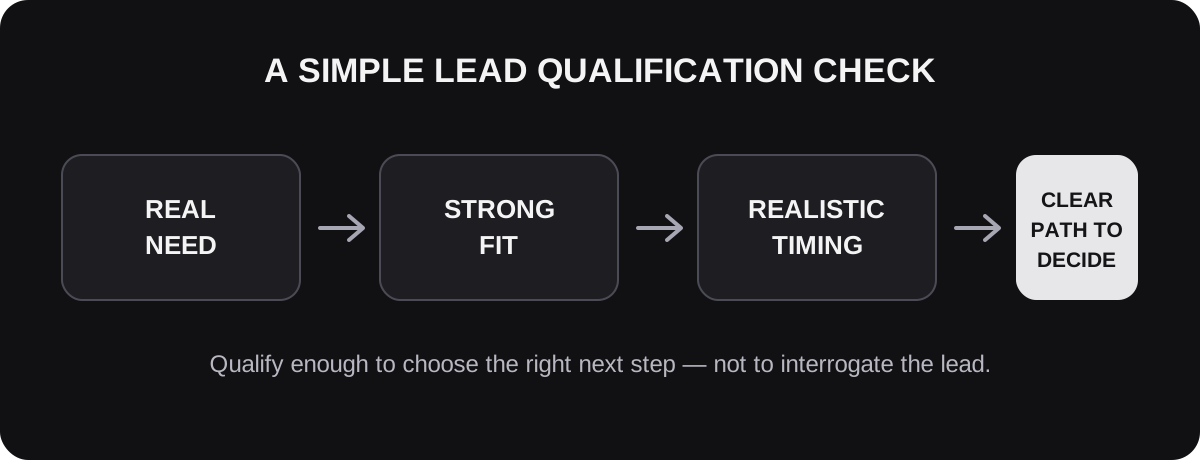
One practical model scores four categories from zero to two: fit, need, timing, and ability to proceed. The total score is less important than using the same definitions consistently.
- ✓Fit: 0 = outside scope, 1 = possible fit, 2 = strong fit
- ✓Need: 0 = vague interest, 1 = clear problem, 2 = meaningful problem with consequences
- ✓Timing: 0 = no foreseeable timeline, 1 = future project, 2 = active near-term need
- ✓Ability to proceed: 0 = major unresolved barrier, 1 = some uncertainty, 2 = clear path to a decision
- ✓7–8 points: high-priority lead
- ✓4–6 points: qualified but may need normal nurture or follow-up
- ✓0–3 points: disqualify, redirect, or place in a lower-priority path depending on the reason
Do not confuse urgency with quality
Urgent leads deserve fast attention, but urgency alone does not make a lead valuable. A same-day request outside the service area is still a poor fit. A highly profitable project planned for next quarter may deserve more attention than an urgent low-fit request.
Use urgency to determine response and scheduling priority after basic fit has been established.
Red flags that should trigger more qualification
A red flag is not always a reason to reject the lead immediately. It is often a reason to ask one more question before committing expensive time or resources.
- ✓The requested result is impossible or outside the business's control
- ✓The prospect refuses to provide information required to price or scope the work
- ✓The requested timeline is incompatible with safe or realistic delivery
- ✓The lead is focused only on price while comparing services that are not equivalent
- ✓The decision-maker is unavailable and nobody can explain the approval process
- ✓The project repeatedly changes scope before any agreement is reached
- ✓The prospect expects work outside the stated service or professional scope
- ✓The lead has had repeated conflicts with several previous providers and cannot explain what would need to be different
Know the difference between disqualified, not ready, and not now
These three outcomes should not be stored as the same status.
A disqualified lead cannot be served under the current conditions. A not-ready lead may fit but lacks an important prerequisite. A not-now lead may be an excellent fit whose timing is simply later.
- ✓Disqualified: outside service area, wrong service, below required scope, impossible expectation, or another hard mismatch
- ✓Not ready: missing information, internal approval, financing, prerequisite work, or another solvable dependency
- ✓Not now: strong fit but the project belongs in a future follow-up window
- ✓Qualified now: fit is established and the next sales step should happen immediately
Disqualify politely and preserve the relationship
Good qualification sometimes ends with a no. The business should make that outcome useful rather than making the prospect feel rejected for asking.
State the reason briefly, avoid arguing, and point the person toward a better path when a credible referral or alternative exists. A well-handled disqualification can still produce a future lead, referral, or positive impression.
- ✓Be specific: 'We only service properties within these counties' is more useful than 'We are not a fit.'
- ✓Avoid fake excuses or invented availability problems
- ✓Refer to another type of provider when the request belongs outside your scope
- ✓Leave the door open when the mismatch is temporary
- ✓Record the reason so the business can learn which lead sources create poor-fit inquiries
Route different leads to different next steps
Qualification is most valuable when it changes the workflow. If every person still receives the same appointment link, qualification has not reduced much friction or wasted effort.
Build a small number of next-step paths based on what the business learns from the lead.
- ✓High-fit, urgent lead: immediate human response or priority scheduling
- ✓High-fit, normal lead: standard consultation, estimate, demo, or appointment
- ✓Fit but future timing: scheduled follow-up or nurture path
- ✓Missing information: request the specific information needed before booking
- ✓Low-fit but serviceable: lower-cost offer, alternative package, or different process when appropriate
- ✓Unqualified: polite decline or referral
When should a lead get a call, quote, estimate, or booking link?
The next step should be expensive only when the lead has earned that level of effort. A custom proposal or site visit costs more than a short qualifying conversation. Match the cost of the sales step to the evidence of fit.
- ✓Booking link: use when fit can be established quickly and the appointment is the natural next step
- ✓Phone call: use when a short conversation can resolve important uncertainty
- ✓Estimate or site visit: use when physical inspection or detailed scope is necessary
- ✓Quote: use when the business already has enough information to price accurately
- ✓Proposal: use when the opportunity is sufficiently qualified to justify custom recommendations
- ✓Checkout or payment link: use when the product or service is standardized and little diagnosis is needed
What to automate in lead qualification
Automation works well when the qualification questions are stable, the answers are easy to interpret, and the next step can be determined from clear rules.
It is less appropriate when the answers require professional judgment, sensitive context, safety decisions, custom pricing, or nuanced interpretation.
- ✓Good automation: collecting location, service type, timing, basic scope, and scheduling preferences
- ✓Good automation: routing leads based on clear eligibility or service rules
- ✓Good automation: recording qualification answers and creating follow-up tasks
- ✓Good automation: sending the correct booking link after minimum fit is established
- ✓Human review: unusual requests, complex budgets, custom scope, escalations, legal or health issues, and ambiguous answers
Avoid over-qualifying inbound leads
Qualification has a cost. Every extra question creates friction and gives a good prospect another chance to abandon the process.
Ask enough to choose the correct next step, then continue learning during the sales conversation. A ten-question form may be appropriate for a complex professional service but unnecessary for a straightforward local appointment.
- ✓Remove questions that do not change routing or sales priority
- ✓Do not ask the lead to repeat information already provided
- ✓Collect sensitive information only when it is genuinely necessary
- ✓Avoid forcing precise budgets from buyers who reasonably do not know the market price
- ✓Save detailed diagnostic questions for the call when a conversation will produce better information
Track qualification metrics by lead source
Lead volume alone can hide a poor acquisition channel. One source may generate twice as many inquiries but half as many qualified opportunities.
Track qualification outcomes by source so the business can separate a marketing problem from a sales-process problem.
- ✓Total inquiries by source
- ✓Qualified leads by source
- ✓Qualification rate
- ✓High-priority leads
- ✓Most common disqualification reason
- ✓Percentage moving to the intended next step
- ✓Booked appointments, estimates, demos, or calls
- ✓Customers won from qualified leads
- ✓Revenue or gross profit by lead source when practical
Common small business lead qualification mistakes
Qualification becomes counterproductive when it is based on assumptions, inconsistent judgment, or unnecessary complexity.
- ✓Treating every inquiry as equally valuable
- ✓Rejecting leads based on vague intuition instead of defined fit criteria
- ✓Asking about budget before understanding the problem
- ✓Using a long form for a simple purchase
- ✓Confusing slow timing with poor fit
- ✓Sending every lead to the same next step
- ✓Failing to record why leads are disqualified
- ✓Allowing different employees to use completely different qualification standards
- ✓Automating nuanced decisions that require human judgment
- ✓Continuing to pursue leads after a clear hard disqualifier appears
A simple lead qualification checklist
Before spending significant sales time on an inquiry, the business should be able to answer a short set of questions.
- ✓Do we understand the actual problem or desired outcome?
- ✓Is this request inside our scope, service area, and capabilities?
- ✓Is the timing realistic?
- ✓Are there economic constraints that make the solution impossible or impractical?
- ✓Do we understand who is involved in the decision?
- ✓Is there a clear next step the prospect can take?
- ✓Should this lead be handled now, followed up later, redirected, or disqualified?
A seven-day implementation plan
A small business can build a useful qualification system in one week without purchasing new software. Start by defining fit and routing before adding scoring or automation.
- ✓Day 1: review recent customers and define the characteristics of strong-fit work
- ✓Day 2: write the true hard disqualifiers
- ✓Day 3: choose the five to eight questions that change the next step
- ✓Day 4: define qualified now, not now, not ready, and disqualified statuses
- ✓Day 5: map each status to a call, booking link, quote, estimate, follow-up, or decline
- ✓Day 6: create a simple scoring model only if lead volume makes prioritization necessary
- ✓Day 7: begin tracking qualification rate and disqualification reasons by source
Where Kinetic AI fits
Kinetic AI applies these qualification principles specifically to inbound Instagram conversations. It can ask a business's qualification questions, interpret the lead's answers, preserve the context, and move appropriate prospects toward a booked call.
The important part is not automating every conversation. It is having clear rules for what makes someone qualified before automation is introduced. A system cannot reliably route good leads if the business has never defined what a good lead is.
For businesses that use Instagram as an inbound lead channel, qualification can happen inside the conversation before the booking link is sent, which helps keep the calendar focused on prospects who actually fit the offer.
Final takeaway
Lead qualification is not about making the buying process harder. It is about using the smallest amount of information needed to decide where the lead should go next.
Define the customers and jobs the business serves best. Ask questions that change routing or priority. Separate qualified-now leads from future opportunities and true disqualifications. Then match the amount of sales effort to the evidence of fit.
When qualification is clear, the business spends less time chasing the wrong opportunities and more time helping prospects it can realistically serve well.
Build a more predictable online fitness coaching business
Kinetic AI's Growth Partnership helps online fitness coaches identify what is holding growth back, build the strategy and systems around it, and review the numbers so the next priority is clear.
DM “DOUBLE” on Instagram →