How to Set Up an AI DM Setter for Instagram: From First Message to Booked Call
Learn how to set up an AI DM setter for Instagram, including qualification rules, business context, booking logic, follow-up, human handoff, testing, and performance tracking.
 Written by Dylan StottFounder of Kinetic AI
Setting up an AI DM setter is not mainly a prompt-writing exercise. The hard part is deciding what the setter should know, what it should ask, when it should move a lead forward, when it should follow up, and when it should stop and involve a human.
A weak setup can make capable AI feel robotic because the system has no clear sales process underneath it. A strong setup gives the AI a defined job: understand why the person reached out, gather the minimum context needed to judge fit, answer safe and relevant questions, move qualified prospects toward a booking, and preserve the conversation for a human when judgment is needed.
This guide walks through that setup from the first Instagram message to a qualified booked call. The framework applies whether you use a dedicated AI setter, a social automation platform with AI, or a broader CRM with conversational AI.
The setup goal: build a decision system, not a long script
Traditional DM scripts are usually linear. Ask question one, send response two, ask question three, then send the calendar. Real Instagram conversations are not linear. Prospects answer two questions at once, ask about price early, disappear for a day, send a voice note, change topics, or ask to speak with the business owner.
An AI setter should therefore be configured around decisions rather than exact sentence order. It needs to know what information matters, which information is already known, what next action is allowed, and which situations require escalation.
The easiest way to design the system is to work backward from the booking. Define what must be true before a call is worth offering, then build the conversation to gather that information naturally.
The complete setup in nine steps
A reliable Instagram AI setter can be designed in nine practical steps. You do not need hundreds of rules. You need clear inputs, clear decision points, and a clear definition of success.
- ✓Define the ideal lead and disqualifiers
- ✓Define the qualification information you actually need
- ✓Give the AI accurate business and offer context
- ✓Set conversation rules and tone
- ✓Define the booking gate
- ✓Build follow-up around lead state
- ✓Define human handoff rules
- ✓Connect tracking, calendar, and lead status
- ✓Test edge cases before sending real traffic through the system
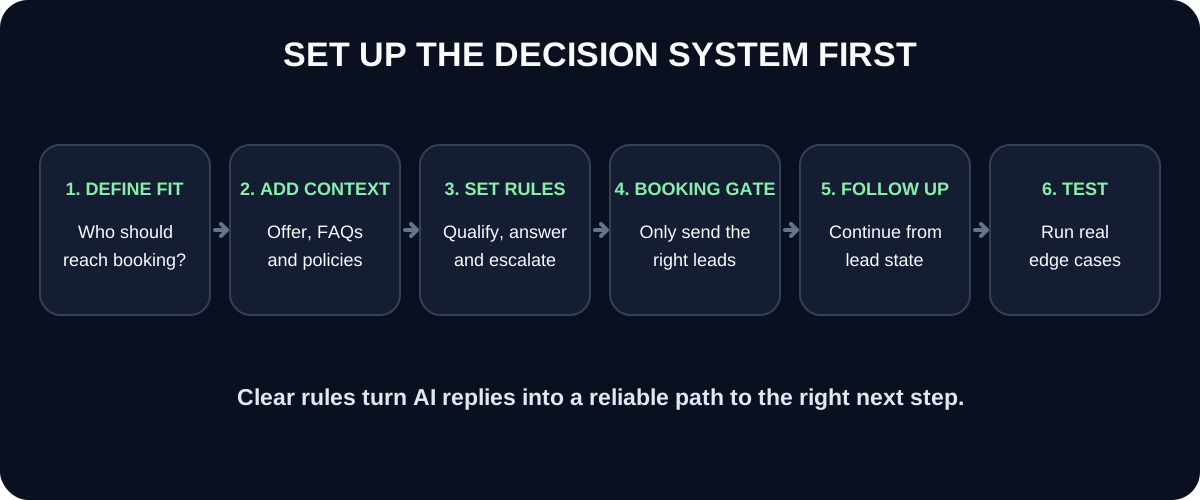
Step 1: define who should reach the booking stage
Before the AI can qualify anyone, the business needs a usable definition of a good lead. 'Someone interested in what we sell' is too vague. The setter needs criteria it can recognize from a conversation.
Start with the characteristics that actually affect whether the next sales step makes sense. For a service business, that may include the problem the prospect wants solved, whether the service can address it, location or service area, timing, practical constraints, and whether the person is open to the kind of solution being offered.
Do not turn this into a giant customer profile. The goal is not to score someone's worth. The goal is to decide whether a sales conversation is useful for both sides.
- ✓What problem or goal must the lead have?
- ✓Who is clearly outside the serviceable market?
- ✓What timing makes the opportunity realistic?
- ✓Which practical constraints matter before a call?
- ✓Which conditions should route the person somewhere other than sales?
Related reading
Step 2: reduce qualification to the minimum useful information
One of the easiest ways to ruin an AI DM experience is to make it feel like an intake form. If the setter asks seven disconnected questions before responding to anything the prospect says, the conversation may be technically organized but commercially weak.
Separate information into three groups: must know before booking, helpful to know before booking, and useful later. The AI should focus on the first group, gather the second group when it fits naturally, and leave the third group for the call, onboarding form, or human conversation.
A good qualification flow is usually shorter than the business first expects because many details do not change the decision to book.
- ✓Must know: changes whether the call should happen
- ✓Helpful to know: improves the call but does not decide whether it happens
- ✓Later: useful for sales or delivery but unnecessary inside the DM
Build qualification around categories, not memorized wording
The AI should know the information categories it needs, but it should not be forced to ask each category with the exact same sentence every time. That is where conversations start to sound scripted.
For example, the system may need to learn the prospect's goal, current obstacle, timing, and fit. If the prospect says, 'I want to lose 20 pounds before my wedding in November and I've been stuck for six months,' the AI already has useful goal, problem, and timing context. Asking those questions again would feel careless.
Configure the setter to recognize when a criterion has already been answered and move to the next missing piece instead of following a fixed checklist blindly.
Step 3: give the AI accurate business context
The AI cannot represent the business well if it does not know what the business actually does. Before worrying about clever prompt language, build a clean source of truth.
Give the system enough context to answer common questions without inventing information. This should include the offer, who it is for, what the process looks like, what the business does not provide, scheduling rules, relevant policies, common objections, and the situations where the AI should say it does not know and hand off.
Keep this information maintained. If the offer, availability, pricing policy, guarantee, or service area changes, the AI should not keep using old information.
- ✓What the business offers
- ✓Who the offer is designed for
- ✓What the service includes and excludes
- ✓How the next step works
- ✓Common questions and approved answers
- ✓Policies the AI is allowed to explain
- ✓Topics the AI must never guess about
Separate facts from persuasion
A useful setup distinguishes between factual business information and sales guidance. Facts should be precise. Persuasion should be flexible and contextual.
For example, the AI should not improvise a refund policy, create a new discount, promise a result, or make up an available appointment. Those are factual or operational claims. It can, however, explain why the next step may be useful based on what the prospect has already shared.
This separation reduces hallucination risk and makes human review easier because you know which parts of the conversation are allowed to vary and which must remain anchored to approved information.
Step 4: define the conversation rules
Tone instructions such as 'sound natural' are not enough. Give the setter behavioral rules that make the conversation feel natural.
The most important rules are usually about relevance and pacing: respond to what the person actually said, ask one clear next question when possible, do not repeat known information, do not force a booking too early, and do not keep selling after the prospect clearly declines.
The setter should also know the brand's preferred level of formality, message length, emoji use, and whether short multi-message replies are normal for the account. Those choices should match how the business already communicates rather than copying a generic internet sales style.
- ✓Use the prospect's previous answers before asking another question
- ✓Keep each message focused on one immediate purpose
- ✓Acknowledge direct questions before returning to qualification
- ✓Do not repeat questions whose answers are already clear
- ✓Do not manufacture urgency or scarcity
- ✓Do not argue with a prospect who says no
- ✓Escalate when the conversation exceeds the AI's authority
Do not optimize for sounding human at the expense of being useful
The objective is not to trick a prospect into believing a human typed every message. The objective is to create a useful, coherent conversation that moves at the right pace.
Overdone filler, fake typing quirks, excessive slang, or random emojis can make automation feel less trustworthy rather than more natural. Relevance matters more than imitation.
A concise answer that clearly uses what the prospect just said usually feels more human than a highly stylized reply that ignores the actual context.
Step 5: define the booking gate
The booking gate is the rule that decides when the AI is allowed to offer the calendar. This is one of the most important parts of the entire setup because an AI setter can easily increase appointment volume by lowering quality.
Do not make 'the lead replied' the booking rule. Define the minimum evidence that makes a call worthwhile. A simple service-business booking gate might require a real need, reasonable fit, workable timing, and a clear reason for a call.
Once those conditions are met, the AI should make the transition obvious: summarize the relevant context, explain why a call is the logical next step, and provide the approved booking path.
- ✓Need: the person has a problem or desired outcome the business can address
- ✓Fit: no clear disqualifier has appeared
- ✓Timing: the opportunity is realistic enough to act on
- ✓Purpose: there is a useful reason to continue on a call or appointment
Related reading
Decide whether the AI sends a link or books directly
There are two common scheduling patterns. The AI can send a connected booking link, or the system can create the appointment inside the conversation if the platform and calendar workflow support it.
A booking link is simple and gives the prospect control over availability. Direct scheduling can remove a step but requires more careful handling of time zones, appointment types, calendar conflicts, rescheduling, and confirmation.
Use the simplest option that is reliable in your stack. A slightly more manual booking path is better than an impressive automation that creates calendar errors.
What happens when someone asks for the price before qualification?
Price questions are a common stress test for DM setters. A bad system ignores the question and sends another qualification prompt. Another bad system invents a price or pushes the prospect to book without answering anything.
Define the business's actual pricing policy. If pricing is public and standardized, the AI can answer with the approved information and continue naturally. If pricing depends on scope or is intentionally discussed on a call, the AI should explain that accurately rather than pretending the question was never asked.
The important point is that qualification should not make the AI socially unaware. Direct questions deserve direct, approved responses.
Step 6: build follow-up around lead state
Follow-up should depend on where the conversation stopped. A prospect who never answered the first question is different from a qualified lead who received the booking link but did not schedule.
Create a small number of lead states and define the next action for each. This is more reliable than sending the same generic 'just checking in' message to everyone after the same delay.
The setter should stop automated follow-up when the prospect opts out, clearly says they are not interested, becomes a customer, or moves into a state that requires human ownership.
- ✓New inquiry: first response still needed
- ✓Qualification started: some required context is missing
- ✓Qualified: fit is established but the booking step has not happened
- ✓Booking link sent: prospect has not scheduled yet
- ✓Booked: appointment exists and sales follow-up should stop
- ✓Not ready: move to an appropriate nurture path
- ✓Disqualified or declined: close respectfully and stop sales pressure
Related reading
Follow-up should continue the conversation, not restart it
The best follow-up message is usually based on the last unresolved step. If the prospect already explained the goal and timing, the follow-up should not ask them to introduce themselves again.
Use the saved conversation context to make the next message specific. That could mean reminding a qualified prospect that the booking link is still available, asking the one missing qualification question, or offering to reconnect later when the timing improves.
State-aware follow-up is one of the biggest advantages of treating AI setting as a lead-management system instead of a text generator.
Step 7: define human handoff rules before launch
An AI setter needs a clear boundary around what it should not handle. Human handoff is not a failure of automation. It is part of a safe and commercially useful system.
Create explicit escalation categories so the AI knows when to stop advancing the normal flow. The human should be able to see the conversation history and the qualification context already collected, so the prospect does not have to start over.
- ✓The prospect explicitly asks for a person
- ✓The conversation involves a complex negotiation or exception
- ✓The prospect asks a high-stakes medical, legal, financial, or other professional question outside the AI's role
- ✓The AI is uncertain about a business policy or factual answer
- ✓The prospect is upset, confused, or reports a service problem
- ✓An existing customer enters a workflow intended for new leads
- ✓A technical error prevents the normal booking or lead-routing step
Decide what the human sees at takeover
A handoff is much more useful when the system gives the person taking over a short summary instead of only a wall of messages.
A strong handoff can include the prospect's stated goal, relevant problem, important constraints, qualification status, last question, and next expected action. The complete conversation should still remain available for context.
This is where a lead workspace or CRM becomes valuable. The conversation and the structured lead record should support each other rather than forcing the team to reread every message from the beginning.
Step 8: connect the calendar, lead record, and status tracking
A setter is difficult to improve if the conversation disappears after the booking link is sent. Track what happened after each major step.
At minimum, the system should be able to distinguish captured leads, qualification progress, qualified leads, booking-link events, scheduled appointments, and closed or handed-off conversations. If the sales process continues in a CRM, keep the status names simple enough that the AI and the human team mean the same thing by each stage.
The purpose of tracking is not to create a complicated dashboard. It is to answer practical questions such as: Are leads replying? Are qualified prospects booking? Are booked prospects showing up? Where are conversations getting stuck?
- ✓Lead source
- ✓Conversation status
- ✓Qualification outcome
- ✓Important qualification fields
- ✓Booking link sent or not sent
- ✓Appointment booked or not booked
- ✓Human owner when applicable
- ✓Next action or follow-up state
Use the calendar as an outcome, not the only outcome
A booked call is an important event, but it should not erase the earlier funnel. If bookings fall, you need to know whether the problem started with weak replies, poor qualification completion, too few qualified leads, or a weak transition from qualification to scheduling.
Track the steps before the appointment so you can improve the correct part of the system instead of rewriting the entire prompt every time performance changes.
Step 9: test the setter with edge cases before launch
Do not test only the perfect conversation where the prospect answers every question in order. The real quality of the setup appears when the conversation becomes messy.
Create a test set that represents the situations your business actually sees. Run the same scenarios after major prompt, offer, qualification, or integration changes so you can catch regressions before real leads experience them.
- ✓Strong-fit prospect who answers clearly
- ✓Weak-fit prospect who should not receive the booking link
- ✓Prospect who answers multiple qualification questions at once
- ✓Prospect who asks about price immediately
- ✓Prospect who changes the subject midway through qualification
- ✓Prospect who stops replying after one answer
- ✓Qualified prospect who receives the calendar but does not book
- ✓Prospect who asks to speak with a human
- ✓Existing customer who messages the account
- ✓Question the AI does not have authority to answer
- ✓Booking or calendar error
Review the conversation, the decision, and the system action separately
When a test fails, identify which layer failed. The wording can be awkward while the decision is correct. The conversation can sound great while the AI makes the wrong qualification decision. The decision can be correct while the calendar or CRM action fails.
Review those layers separately: conversation quality, decision quality, and workflow execution. That makes debugging much faster than treating every failure as a prompt problem.
A simple prompt structure for an AI DM setter
Different platforms use different prompt and workflow systems, but the underlying information can be organized into a consistent structure.
The exact wording matters less than making each category explicit. Keep business facts separate from behavioral rules, qualification logic, booking conditions, and escalation boundaries so updates are easier to manage.
- ✓Role: what job the AI performs and what outcome it is responsible for
- ✓Business context: approved facts about the company, offer, process, and policies
- ✓Ideal lead: fit criteria and disqualifiers
- ✓Qualification requirements: information needed before booking
- ✓Conversation behavior: tone, pacing, question style, and context rules
- ✓Booking rule: conditions required before offering the next step
- ✓Follow-up rules: what happens when each lead state goes quiet
- ✓Handoff rules: situations requiring a human
- ✓Prohibited behavior: claims, advice, discounts, guarantees, or actions the AI must not invent
Do not put everything into one giant prompt if the platform supports structured rules
A single huge prompt can work for a prototype, but it becomes difficult to maintain as the business changes. If the platform supports separate knowledge, qualification fields, workflow conditions, calendar actions, and follow-up rules, use those structures instead of relying on prose alone.
The more important a rule is, the less you should depend on the model remembering it from an unrelated paragraph buried deep inside a long prompt.
How to connect Instagram without creating unnecessary risk
Use a supported connection method provided by the platform you choose and follow the messaging and account rules that apply to your Instagram setup. Avoid tools that require fragile workarounds, credential sharing, or behavior that appears designed to bypass platform restrictions.
Also define how opt-outs, consent, and communication preferences are handled where they apply to your business. Automation does not remove the business's responsibility to use customer data and messaging channels appropriately.
If a vendor cannot clearly explain how the Instagram connection works, how messages are authorized, and what happens when the connection breaks, resolve that before routing real leads through it.
How much automation should you turn on at first?
Do not launch every possible automation on day one. Start with the smallest complete workflow that can create a useful outcome and that you can review closely.
For many businesses, that means one inbound lead source, one qualification path, one booking path, one follow-up sequence, and one human handoff route. Once those pieces are stable, add more triggers, campaigns, lead types, or branches.
A smaller system produces cleaner feedback because you can tell which change caused an improvement or problem.
The metrics to watch after launch
The setter should be judged on the complete path from conversation to business outcome. Total messages and total bookings are not enough on their own.
Review the funnel at a consistent interval and look for the biggest drop rather than changing everything at once. If leads reply but do not complete qualification, improve the conversation or reduce unnecessary questions. If many qualified leads do not book, examine the booking transition and scheduling friction. If bookings are high but quality is weak, tighten the booking gate.
- ✓Inbound conversations
- ✓First-response time
- ✓Lead reply rate
- ✓Qualification completion rate
- ✓Qualified-lead rate
- ✓Qualified lead to booked appointment rate
- ✓Booked appointment show rate
- ✓Human handoff rate and reason
- ✓Close rate on qualified attended appointments
- ✓Cost per qualified appointment
- ✓Revenue per inbound conversation when revenue tracking is available
Common setup mistake: asking too many questions
More qualification data does not automatically create better leads. Every extra question should earn its place by changing a decision, improving the next step, or materially helping the human who takes over.
If a question is only 'nice to know,' consider moving it out of the DM. The setter's job is to create clarity and momentum, not finish the entire sales discovery process before the appointment.
Common setup mistake: sending the booking link too early
Fast booking can look successful in a dashboard while creating a worse calendar. If every person who says 'I'm interested' receives a scheduling link, the AI is functioning as a link sender rather than a setter.
Require enough context to make the appointment meaningful. The exact threshold depends on the business, but the system should be able to explain why this prospect has reached the booking stage.
Common setup mistake: making the AI finish every conversation
Trying to automate 100 percent of conversations usually creates unnecessary risk. Some conversations should be transferred because the prospect is valuable, upset, unusual, or asking for something outside the AI's authority.
A good system knows when automation is useful and when continuing to automate would make the experience worse.
Common setup mistake: optimizing wording before fixing the workflow
Teams often spend hours changing greetings while the real problem is a weak qualification rule, broken calendar connection, or follow-up logic that treats every lead the same.
Fix the decision system first. Then improve wording. A beautiful message cannot repair the wrong next action.
A practical launch checklist
Before turning the setter on for real leads, review the system as one complete journey from the first DM to the final status update.
- ✓Ideal-lead criteria and disqualifiers are documented
- ✓Required qualification fields are limited to what changes the booking decision
- ✓Business facts and approved answers are current
- ✓Tone and conversation rules are defined
- ✓Booking conditions are explicit
- ✓Calendar or scheduling flow has been tested
- ✓Follow-up changes based on lead state
- ✓Opt-out and stop conditions are defined
- ✓Human handoff routes to a real owner
- ✓Lead status and conversation history are visible
- ✓Edge-case tests have passed
- ✓The team knows which metrics will be reviewed after launch
How Kinetic AI applies this setup for fitness coaches
Kinetic AI applies this framework specifically to inbound Instagram leads for personal trainers and online fitness coaches. The product is not a generic omnichannel CRM or a replacement for the coach's sales process.
Its role is to respond to inbound Instagram conversations, gather fitness-specific qualification context, preserve the conversation and lead record, send the connected booking link when the prospect reaches the appropriate point, track scheduled calls, and give the coach context before the human sales conversation.
The coach still controls the offer, pricing, qualification standards, calendar, sales call, complex judgment, and coaching advice. That boundary is intentional because the setter should automate repeatable lead-management work without pretending every business decision belongs to the AI.
Related reading
What to improve first after the first week
Do not judge the system from one unusual conversation. Review a meaningful sample of real DMs and group issues by pattern.
Fix the highest-leverage pattern first. If the AI repeatedly asks a question prospects already answered, improve context recognition. If weak-fit leads reach the calendar, fix qualification or the booking gate. If qualified prospects disappear after the booking link, improve that transition or follow-up. If humans are constantly taking over the same question, improve the approved knowledge or intentionally make that question a standard handoff.
The goal is continuous simplification: fewer unnecessary questions, clearer decisions, cleaner handoffs, and a more reliable path from real interest to the right next step.
Final takeaway
The best AI DM setter setup is not the one with the longest prompt or the most automation. It is the one with the clearest decision system.
Define who should book, identify the minimum qualification information, give the AI accurate business context, set conversation and safety rules, create a real booking gate, follow up based on lead state, define human handoffs, connect tracking, and test the messy cases before launch.
Once those pieces are in place, the AI has a much simpler job: carry the conversation forward without losing context and move the right prospect to the right next action. That is what turns Instagram DM automation into a setting system rather than a collection of automatic replies.
Build a more predictable online fitness coaching business
Kinetic AI's Growth Partnership helps online fitness coaches identify what is holding growth back, build the strategy and systems around it, and review the numbers so the next priority is clear.
DM “DOUBLE” on Instagram →