Conversational AI Lead Qualification vs. Forms: Which Is Better?
Compare conversational AI lead qualification with traditional forms across friction, data quality, adaptability, structure, routing, compliance, and the best use case for each approach.
 Written by Dylan StottFounder of Kinetic AI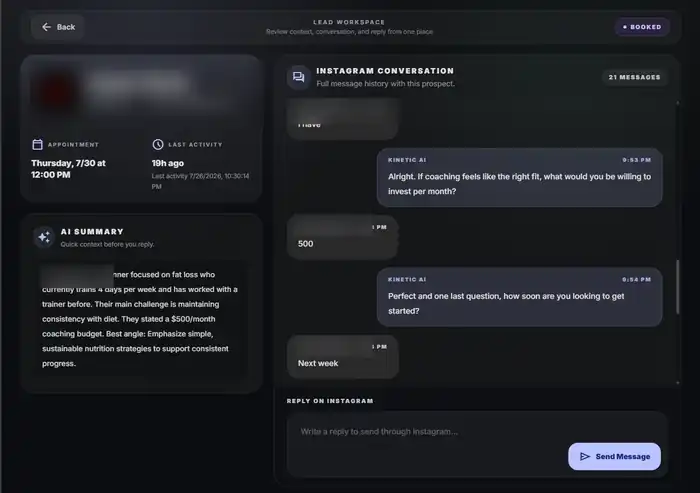
Conversational AI lead qualification and traditional forms solve the same broad problem in different ways: they collect enough information to decide what should happen next with a lead.
Forms are strong when the business knows exactly which facts it needs and can ask for them in a predictable structure. Conversational AI is stronger when prospects arrive with messy context, ask questions along the way, or provide useful information naturally instead of filling in fixed fields.
Neither approach is universally better. The strongest lead systems often use both: structured fields for objective facts and conversational AI for context, clarification, qualification, and routing.
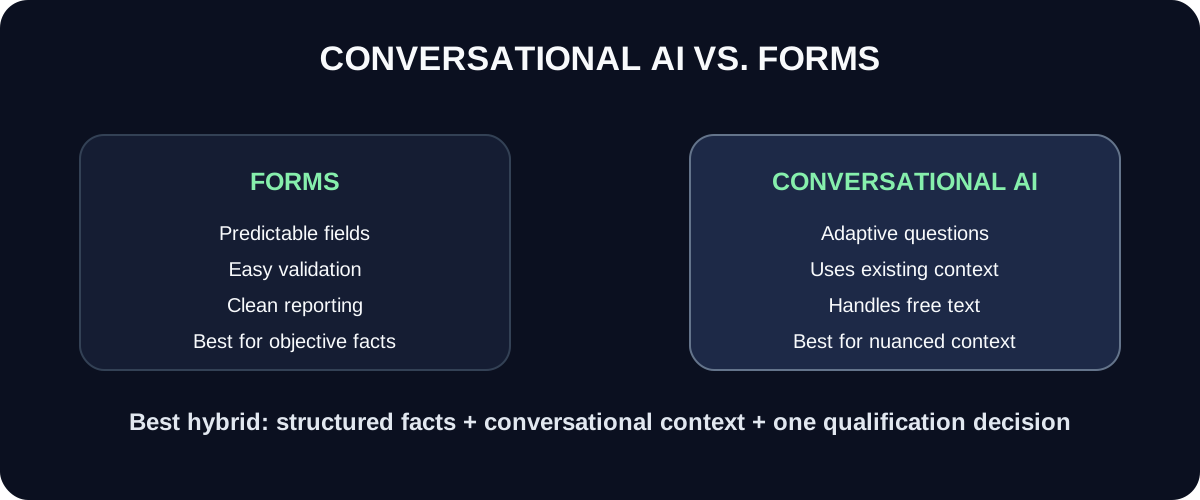
The short answer: forms structure data, conversational AI adapts to context
A form asks the business's questions in a fixed order. Conversational AI can decide which question to ask next based on what the lead already said.
That difference creates the main tradeoff. Forms are predictable and easy to validate. Conversational AI can feel more natural and avoid unnecessary questions, but it requires stronger guardrails because the workflow is less rigid.
- ✓Choose forms when the required inputs are stable, objective, and easy to express as fields
- ✓Choose conversational AI when useful information arrives in normal language and the next question depends on the previous answer
- ✓Use both when some facts should be structured but the qualification decision still needs context
What is form-based lead qualification?
Form-based lead qualification collects information through predefined fields such as dropdowns, multiple-choice questions, checkboxes, dates, numbers, and open-text responses.
The business decides the questions in advance and usually applies rules after submission. A form may send qualified leads to a calendar, score the submission, route it to a salesperson, or reject entries that fail a required condition.
Forms work especially well when the business needs comparable information from every lead and when the answers can be represented cleanly as structured data.
What is conversational AI lead qualification?
Conversational AI lead qualification gathers and interprets lead information through a back-and-forth conversation. The system can use what the prospect already said, identify which important detail is missing, ask a targeted follow-up question, and adjust the next step based on the answer.
The conversation may happen in website chat, social DMs, messaging apps, or another channel where prospects naturally communicate in free text. The AI can also extract structured information from the conversation so the CRM still receives useful fields and statuses.
The value is not simply making a form look like a chat bubble. The value comes from using context to avoid irrelevant questions and to make the qualification path responsive to the lead.
Related reading
The biggest difference is question order
A traditional form usually asks the same questions in roughly the same order regardless of what the lead has already shared. Conditional logic can create branches, but those branches must be designed in advance.
Conversational AI can make the order more dynamic. If the lead's first message already explains the problem, timeline, and desired outcome, the system can skip those questions and ask only for the missing fit information.
That can reduce repetition, but only if the AI can reliably recognize that the information has already been provided. A poorly configured conversational system can be more frustrating than a form because it may ask the same question twice in different words.
Forms are better at collecting objective facts
When a fact has a small number of valid answers, a form is usually the cleaner tool.
Service area, appointment date, number of locations, company size range, selected service, preferred contact method, or a yes-or-no eligibility requirement do not need an AI model to interpret them if the business can collect the answer directly.
Structured inputs make validation easier, reduce ambiguity, and simplify reporting later.
- ✓Location and service area
- ✓Date or scheduling preferences
- ✓Company size or team size ranges
- ✓Product or service selection
- ✓Budget ranges when the business chooses to ask them
- ✓Consent checkboxes or required acknowledgments
- ✓Contact details
- ✓Any field with a finite, stable set of valid options
Conversational AI is better at interpreting messy context
Prospects rarely think in database fields. They describe problems, goals, frustrations, timing, prior attempts, and constraints in normal language.
A message such as 'I keep getting leads from Instagram but by the time I reply they have already disappeared, and I want to fix it before I start running ads next month' contains several qualification signals at once. The lead has described a problem, source, urgency, and near-term trigger without being asked four separate questions.
Conversational AI can extract those signals and ask only for what is missing. That is where it can provide more value than a fixed form.
Forms usually create cleaner reporting
Structured form fields are easy to filter, compare, export, and report on because every response follows the same schema.
Conversational data is less predictable. If the business wants reliable reporting from AI conversations, the system should convert useful information into normalized fields rather than leaving everything buried in transcripts.
For example, the AI may interpret a prospect's timeline from free text but still write the result into a structured field such as '0 to 30 days,' '1 to 3 months,' or 'later.' That keeps the conversational experience while preserving usable data.
Conversational AI can reduce unnecessary questions
Long forms create friction because every lead has to answer every visible field unless conditional logic removes it. Conversational AI can potentially shorten the process by recognizing information the prospect already volunteered.
The best conversational qualification flow asks the minimum number of questions needed to choose the next action. It should not turn a natural DM or chat into a disguised twelve-question intake form.
If a question does not change qualification, routing, booking, or preparation, it may belong later in the sales or onboarding process instead.
Forms can be faster when the lead already knows what to do
Conversation is not always lower friction. A motivated prospect who expects a simple application may prefer to complete five fields at once instead of waiting for five separate chat exchanges.
This is especially true for repeatable workflows such as requesting a quote, choosing an appointment type, uploading required information, or applying for a program with clear criteria.
The right user experience depends on the lead's intent. If the person arrives ready to submit structured information, forcing a conversational sequence can make the process slower rather than easier.
Conversational AI handles questions during qualification better
Forms are mostly one-directional. They ask for information, but they do not naturally answer the prospect's questions in the middle of the process.
Conversational AI can pause qualification, answer an approved question about the offer or process, then continue from the correct point. That matters in channels such as Instagram DMs where prospects often ask about price, process, availability, or fit before they are willing to book.
The AI should still use maintained business facts rather than improvising answers. Flexibility is useful only when the source of truth is reliable.
Forms are more deterministic
A form is easy to reason about. If a required field is empty, the submission is incomplete. If a dropdown value is outside the accepted set, the rule can reject it. If the lead selects a specific service, the workflow can route to a known destination.
Conversational AI introduces interpretation. The system has to decide what the lead meant, whether a criterion has been satisfied, and whether another question is needed.
That does not make conversational AI unreliable by default, but it means important decisions should include confidence handling, human-review states, and deterministic rules where objective facts can be checked directly.
Conversational AI is more flexible when answers do not fit neat boxes
Some qualification criteria are difficult to reduce to a single dropdown without losing useful context.
A prospect's main problem, why the problem matters now, what they have already tried, or what is preventing a decision can require explanation. A free-text form can collect that information, but the form cannot naturally ask a targeted follow-up when the answer is incomplete or unexpected.
Conversational AI can ask for clarification without requiring the business to design every possible branch in advance.
Forms and conversational AI create different abandonment patterns
A long form exposes the total amount of work up front. That can discourage weak-intent leads quickly, which is sometimes useful. It can also cause strong prospects to abandon before the business has created any value or answered their concerns.
Conversational qualification spreads the effort across smaller exchanges. That can make each step feel easier, but it can also create more opportunities for the prospect to stop replying between questions.
The correct metric is not simply completion rate. The business should compare the quality and downstream conversion of the leads who complete each process.
When a form is the better qualification tool
Forms are usually the better choice when the business needs a fixed set of objective inputs and does not gain much from adapting the questions in real time.
- ✓The lead already understands the offer and expects an application or request form
- ✓Most required answers are structured facts rather than nuanced context
- ✓The business needs document uploads or several validated fields
- ✓Legal, consent, or policy acknowledgments need explicit checkboxes or records
- ✓The same information is required from nearly every lead
- ✓The lead volume is low enough that a person can review open-text responses manually
- ✓The workflow must be highly deterministic and easy to audit
When conversational AI is the better qualification tool
Conversational AI is usually stronger when the lead arrives through a conversation and the business needs to interpret context before deciding what to ask next.
- ✓Leads arrive through DMs, chat, or messaging rather than a dedicated application page
- ✓Prospects often ask questions before they are ready to book
- ✓Useful information is commonly volunteered in free text
- ✓The next question depends heavily on the previous answer
- ✓The business wants to avoid asking for information the lead already provided
- ✓Human teams currently spend time reading messages and manually extracting the same qualification details
- ✓Different lead types need different qualification paths
The best system is often hybrid
A hybrid system uses each tool for the type of information it handles best. Structured facts stay structured. Contextual information stays conversational until the system can convert it into a useful status or field.
For example, a website may collect name, email, company size, and service interest through a short form. The AI can then interpret the open-text problem description, ask one missing follow-up question, and route the lead to the correct next step.
On Instagram, the sequence may work in the opposite direction. The conversation starts naturally in the DM, then the qualified prospect moves to a booking form or calendar for structured scheduling details.
A useful hybrid framework: facts, context, decision, action
Instead of choosing a tool first, separate the qualification system into four jobs.
- ✓Facts: collect objective information with structured fields when possible
- ✓Context: use conversation or open text to understand goals, problems, timing, and constraints
- ✓Decision: apply qualification rules using both the structured facts and interpreted context
- ✓Action: route the lead to booking, sales, nurture, human review, or another appropriate next step
Related reading
Do not use conversational AI as a decorative form replacement
A common mistake is turning every field into a chat message without changing the logic. The prospect still answers the same ten questions in the same order, only one message at a time.
That approach creates the cost and complexity of AI without gaining the main benefit of conversation: adaptation.
If the system cannot skip known information, answer relevant questions, change the next question based on context, or route differently based on what it learns, a normal form may be the simpler experience.
Do not use a giant form when the lead has already told you the answer
The opposite mistake is forcing a prospect to repeat information from a conversation because the CRM expects a form submission before the next step.
If a lead has already explained their goal, problem, timing, and current situation in a DM, the system should preserve that context rather than asking them to type it all again on a separate page.
A short booking or contact form can still collect information that genuinely needs structure, but the qualification conversation should remain useful instead of being discarded.
How lead routing differs between forms and conversations
Forms usually route based on field values. Conversational systems can route based on both explicit facts and interpreted meaning.
For example, a form may route every lead who selects 'enterprise' to one sales team. A conversational system may also recognize that a prospect asking for a custom security review, multi-location rollout, or unusual contract structure should go to a specialist even if they never selected an enterprise label.
Important objective rules should still remain explicit. AI interpretation should add context, not replace simple logic that the business can define precisely.
Human handoff matters more in conversational qualification
A traditional form usually ends before a human interaction begins. Conversational AI operates inside the same space where the lead may ask for a person, raise an exception, become frustrated, or enter a sensitive topic.
That means the human boundary needs to be designed as part of the conversation system. The AI should know when to stop, who should take over, and what context needs to transfer.
Compliance and consent are easier to structure in forms
Some information should be collected through explicit interfaces rather than inferred from conversation. Consent acknowledgments, terms acceptance, required disclosures, document uploads, and other formal records often benefit from a clear form step.
Conversational AI can explain why the information is needed or guide the prospect to the correct form, but it should not blur a formal acknowledgment into casual chat if the business requires a specific record.
The business should understand its own legal, privacy, and industry requirements. The choice of AI or form does not remove those obligations.
Privacy matters in both approaches
Forms and conversational systems can both collect personal or commercially sensitive information. The business should collect only what is needed, restrict access appropriately, and understand how each vendor stores and processes the data.
Conversational systems deserve extra attention because prospects may volunteer more information than the business explicitly requested. The workflow should avoid encouraging unnecessary sensitive disclosures and should have clear escalation rules for high-stakes topics.
How to compare data quality
Form data often looks cleaner because it is structured, but clean structure does not guarantee truthful or useful answers. A prospect can choose the closest dropdown option without feeling that any option really fits.
Conversational data can capture more nuance, but the AI can misinterpret an ambiguous answer if the business does not validate important fields.
The best comparison asks whether the collected information actually improves the next sales decision, not whether the database simply has more populated fields.
How to measure forms vs. conversational AI fairly
Do not compare only submission rate with conversation completion rate. The two systems may attract different levels of intent and create different lead quality downstream.
Use the same qualification definitions and compare what happens after the process is complete.
- ✓Start rate: how many eligible leads begin the qualification process
- ✓Completion rate: how many reach a usable decision
- ✓Time to qualification decision
- ✓Average number of questions or fields required
- ✓Qualified-lead rate using the same criteria
- ✓Human-review rate
- ✓Booking, demo, estimate, or proposal rate after qualification
- ✓Show or completion rate for the next sales step
- ✓Sales-team acceptance of qualified leads
- ✓Close rate on qualified opportunities
- ✓False-positive and false-negative review
A/B testing forms against conversational AI
If the business has enough lead volume, the cleanest comparison is to test both approaches on similar traffic and evaluate downstream quality.
Keep the qualification criteria as consistent as possible. If the form asks for five facts but the AI asks for only two, the test is really comparing two different qualification standards.
Record not just how many leads complete the process, but whether the sales team considers the leads useful and whether those leads progress afterward.
Worked example: B2B agency website
A B2B agency wants to know company size, service need, timeline, and the main growth problem before offering a strategy call.
Company size and service category work well as structured fields. The growth problem is more useful as open text because the answer can vary widely. A hybrid system can collect the first two facts in a short form, use AI to interpret the problem statement, ask a follow-up only if timing or fit remains unclear, then route qualified leads to the correct calendar.
This gives the sales team structured reporting without forcing every prospect through a long static application.
Worked example: local service business
A local contractor receives website leads for several project types. The business must know the service address, project category, and approximate timing before deciding whether an estimate makes sense.
The address and project category should stay structured because they control service-area and routing rules. Conversational AI may add value if the prospect describes an unusual project, has questions about feasibility, or provides a long free-text explanation that needs to be summarized before a person reviews it.
The AI should not replace simple location validation with guesswork.
Worked example: online fitness coaching on Instagram
A fitness coach receives an inbound Instagram DM saying, 'I've been training for a year but can't lose the last 20 pounds and I'm tired of guessing with food.'
A form-first process might send the prospect to an application immediately and ask them to repeat their goal and struggle. A conversational approach can recognize those details from the original message, ask about the missing context that actually changes fit or readiness, answer reasonable questions, and send the booking link when a call makes sense.
The calendar can still collect structured scheduling details. The conversation handles qualification; the booking form handles booking.
Related reading
Common form-based qualification mistakes
Forms usually fail because the business asks for too much information too early or collects information that does not change a decision.
- ✓Long applications before the prospect understands the value of the next step
- ✓Requiring information the lead has already provided elsewhere
- ✓Using vague open-text questions that nobody reviews consistently
- ✓Collecting fields because they are interesting rather than because they change routing or preparation
- ✓Sending every completed form to the same next step regardless of fit
- ✓Using a form to replace a conversation the prospect clearly needs before deciding
Common conversational AI qualification mistakes
Conversational systems fail when the business adds flexibility without defining boundaries.
- ✓Asking the same fixed questions one at a time with no adaptation
- ✓Repeating questions the prospect already answered
- ✓Letting the AI invent pricing, policies, eligibility, or availability
- ✓Using AI where a simple validated field would be more accurate
- ✓Failing to create a human-review state for ambiguous leads
- ✓Continuing to qualify after the lead is clearly ready for the next step
- ✓Failing to convert useful conversation data into structured CRM fields
- ✓Ignoring questions because the system is too focused on completing its qualification script
A practical decision checklist
Before choosing forms, conversational AI, or a hybrid model, map the information the business actually needs and classify each item by how it is best collected.
- ✓Is this answer an objective fact or a contextual explanation?
- ✓Does the answer have a small number of valid options?
- ✓Will the next question change based on this answer?
- ✓Does the prospect often provide this information naturally before being asked?
- ✓Does this field need strict validation or explicit acknowledgment?
- ✓Would asking this question again create unnecessary repetition?
- ✓Does the business need this information for qualification, routing, booking, or only later onboarding?
- ✓Can the result be written into a structured field for reporting?
- ✓What happens if the answer is ambiguous?
- ✓When should a human take over?
How Kinetic AI fits into the comparison
Kinetic AI uses the conversational side of this model for inbound Instagram leads for personal trainers and online fitness coaches. The prospect already begins in a DM, so the system can use the conversation itself as qualification context instead of forcing every interested person into a separate application first.
The lead workspace keeps the Instagram conversation, qualification details, AI summary, status, and booking outcome connected. When the prospect is appropriately qualified, the system can send the coach's connected booking link, where scheduling information is handled in a more structured format.
That is a practical hybrid pattern: conversation for understanding and qualification, structured booking for the appointment itself. Kinetic AI is not intended to replace every form a coaching business may use, especially onboarding, consent, or detailed client intake forms that belong later in the customer journey.
Final takeaway
Forms are not outdated, and conversational AI is not automatically better. Forms are excellent at collecting predictable facts, validating inputs, and creating structured records. Conversational AI is excellent at using context, adapting the next question, handling free-text answers, and continuing naturally when the prospect has questions.
The best qualification system usually assigns each tool the job it is best at. Use structured fields for facts that should be structured. Use conversation for information that benefits from interpretation. Connect both to the same qualification and routing rules so the business still makes one consistent next-step decision.
If the choice becomes 'form or AI,' the business may be asking the wrong question. A better question is: which information should be structured, which information needs conversation, and what is the simplest path that gives the business enough confidence to act?
Related reading
Build a more predictable online fitness coaching business
Kinetic AI's Growth Partnership helps online fitness coaches identify what is holding growth back, build the strategy and systems around it, and review the numbers so the next priority is clear.
DM “DOUBLE” on Instagram →