AI Lead Handoff: When Should AI Transfer a Lead to a Human?
Learn when an AI should hand a lead to a human, which handoff triggers matter most, what context should transfer with the lead, and how to avoid broken AI-to-human sales experiences.
 Written by Dylan StottFounder of Kinetic AI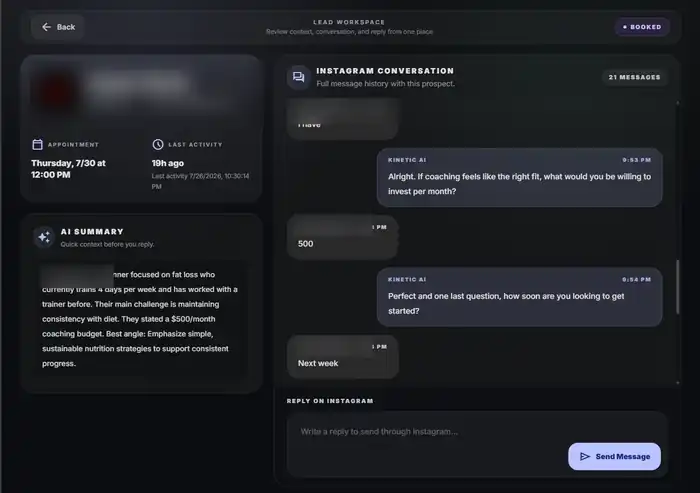
AI lead handoff is the point where an automated system stops owning the conversation and transfers the lead to a person who can handle the next step better. A good handoff does not happen because the AI failed. It happens because the conversation has reached a point where human judgment, authority, empathy, or flexibility creates more value than continued automation.
The mistake is treating handoff as an emergency exit. If a business waits until the AI is confused, the prospect is frustrated, or an employee has to reconstruct the entire conversation manually, the handoff is already late.
A strong AI lead system defines handoff rules before launch, knows which situations require a person, and passes enough context that the human can continue naturally without making the prospect repeat everything.
Related reading
What is AI lead handoff?
AI lead handoff is the transfer of ownership, context, and next-step responsibility from an automated qualification or conversation system to a human.
The transfer can happen inside the same inbox, through a CRM assignment, as a task for a salesperson, or through another workflow that alerts the correct person. The channel matters less than the outcome: the human should know why the lead was transferred, what the lead has already said, what still needs to happen, and who owns the next action.
A handoff is complete only when responsibility is clear. Merely tagging a conversation as 'needs human' is not enough if nobody is assigned to respond.
The simple rule: automate repeatable work and transfer judgment-heavy work
AI is strongest when the business can define the task clearly and apply the same rules across many leads. Humans are strongest when the right response depends on context that cannot be safely reduced to a fixed rule.
That does not mean every unusual question needs a person. The useful dividing line is whether the system has enough approved information and authority to handle the situation correctly without improvising.
- ✓Keep AI in control when the task is repetitive, well-defined, and low risk
- ✓Transfer to a human when the decision needs judgment, exception approval, negotiation, or sensitive context
- ✓Ask one clarifying question when the issue is merely ambiguous and can still be resolved safely
- ✓Escalate immediately when delay could create a poor customer experience or meaningful risk
The most important AI-to-human handoff triggers
Most businesses do not need dozens of escalation rules. They need a small set of triggers that reliably identify conversations where human involvement improves the outcome.
The exact triggers depend on the business, but the categories below cover most practical sales and qualification workflows.
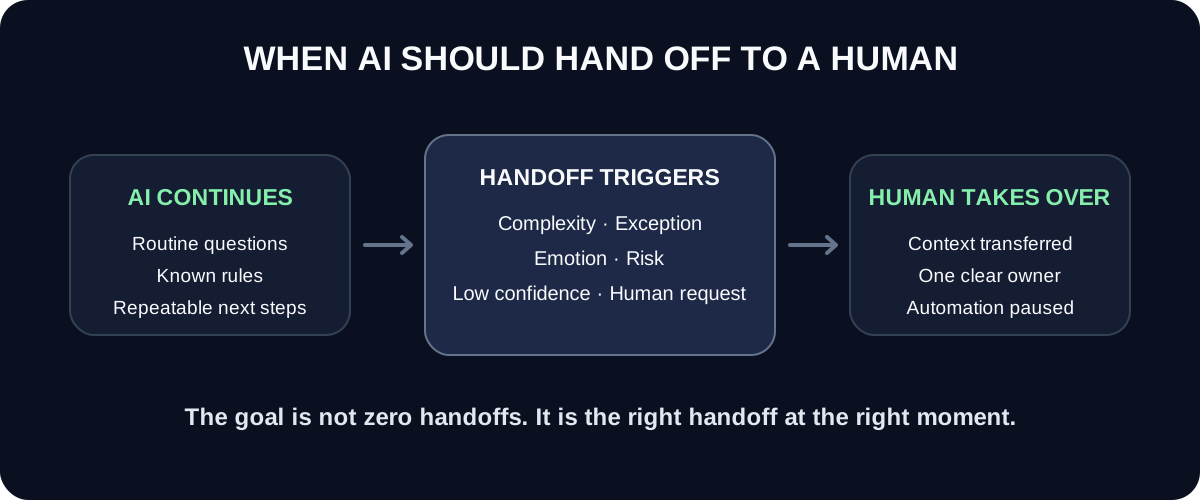
- ✓Complexity: the request cannot be handled with the approved offer, policy, or qualification logic
- ✓Exception: the lead wants something outside normal pricing, terms, service area, eligibility, or process
- ✓Authority: only a person can approve the next step, quote, discount, contract change, or custom arrangement
- ✓Emotion: the prospect is angry, confused, distressed, skeptical, or clearly asking for a real person
- ✓Risk: the conversation touches a high-stakes medical, legal, financial, safety, or policy issue
- ✓High value: the opportunity is important enough that a person should review it even if the AI could continue
- ✓Low confidence: the AI cannot interpret the lead reliably enough to choose a safe next action
- ✓Direct request: the prospect explicitly asks to speak with a person
1. Handoff when the lead needs an exception
Exceptions are one of the clearest reasons to transfer a lead. Automation works by applying known rules consistently. Once the prospect asks the business to break or modify one of those rules, the system is no longer operating inside its normal authority.
Examples include requesting a custom payment plan, asking for a service outside the normal scope, wanting a deadline the team does not usually support, or asking whether an eligibility requirement can be waived.
The AI can still gather the relevant facts before the transfer. What it should not do is invent an exception or imply that the exception has already been approved.
2. Handoff when pricing or terms require negotiation
AI can explain approved pricing information when the business has defined exactly what may be shared. Negotiation is different.
If the lead asks for a discount, custom package, contract change, special guarantee, unusual scope, or a tradeoff that affects margin or delivery, a human should usually make the decision. The AI can summarize the request and transfer it, but it should not create new commercial terms on its own.
This is especially important for high-ticket services where one small concession can affect delivery obligations or profitability later.
3. Handoff when the prospect becomes frustrated or emotional
A prospect does not need to be angry before a human steps in. Repeated confusion, skepticism, irritation, or a clear loss of trust can all be good escalation signals.
The goal is not to detect emotion perfectly. The goal is to recognize patterns where continuing the automated conversation is likely to make the experience worse.
If the person says they want a human, complains that the system is not understanding them, or repeatedly asks the same unresolved question, the safest response is usually to transfer rather than defend the automation.
4. Handoff when the AI is uncertain about intent or fit
Not every unclear lead should be forced into a qualified or unqualified category. A human-review state is often the better outcome.
For example, a lead may partly fit two service categories, describe a need in unusually vague language, or provide conflicting information across several messages. The system can ask one clarifying question, but if uncertainty remains and the decision matters, escalation protects both the business and the prospect.
Confidence should influence the workflow, not merely the wording of the AI response.
Related reading
5. Handoff when the lead is unusually valuable
Some opportunities deserve manual attention because the downside of mishandling them is larger than the time saved by automation.
A high-value account, referral from an important customer, strategic partnership, enterprise opportunity, or unusual deal size may justify a human review even when the AI has already qualified the lead successfully.
This is not an argument for manually handling every good lead. It is a reminder that routing logic can include commercial importance, not just qualification status.
6. Handoff when the conversation enters a high-stakes domain
AI qualification systems should have explicit boundaries around advice or judgments that the business is not comfortable automating.
For a fitness coach, that may include medical symptoms, injury concerns, medication questions, eating-disorder signals, or other sensitive health issues. For another business, the boundary may involve legal interpretation, lending decisions, insurance coverage, safety incidents, or regulated financial guidance.
The AI can acknowledge the message and route it appropriately. It should not turn a sales qualification conversation into professional advice outside its role.
7. Handoff when the lead directly asks for a person
This rule should be simple. If a prospect clearly asks for a human, the system should not make them prove that they deserve one.
The AI may confirm that someone will take over and preserve the conversation context, but continuing to ask qualification questions after an explicit request for a person usually creates unnecessary friction.
A human-request trigger is one of the easiest escalation rules to implement and one of the most important for maintaining trust.
Do not hand off too early either
Over-escalation can make automation almost useless. If the AI transfers every pricing question, every unusual phrase, or every lead that does not match a perfect script, the team ends up doing nearly the same manual work as before.
The system should distinguish between uncertainty that can be resolved with one reasonable clarification and uncertainty that requires judgment. It should also know the approved answers to common objections, FAQs, booking questions, and qualification details before treating them as exceptions.
The goal is not maximum automation. It is the highest level of automation that remains reliable and useful.
The handoff packet: what context should transfer to the human?
A handoff is only as good as the context that arrives with it. The human should not need to reopen five systems and reread an entire thread just to understand why the lead appeared in their queue.
A concise handoff packet should summarize the decision while preserving access to the original evidence.
- ✓Lead identity and source
- ✓Stated goal, problem, or reason for reaching out
- ✓Important qualification signals already confirmed
- ✓Relevant constraints such as timing, service area, budget range, or eligibility
- ✓Questions the prospect has already asked
- ✓Answers or information the AI has already provided
- ✓Current qualification or pipeline status
- ✓Exact reason for escalation
- ✓Recommended next action when appropriate
- ✓Link or access to the original conversation
The human should never have to ask, 'So what can I help you with?'
That question is a common sign of a broken AI-to-human transition. The prospect has already explained why they reached out, but the human behaves as if the conversation is starting from zero.
A better handoff lets the person begin with context: they know the lead's goal, what has already been discussed, and why they were brought in.
This makes the automation feel connected to the business rather than like a separate bot the prospect had to get past before reaching a real person.
Live handoff vs. asynchronous handoff
Not every transfer needs to happen instantly. The correct handoff speed depends on the reason for escalation and the business's staffing model.
A live handoff is useful when the conversation is active, the lead is high intent, and someone is available to take over immediately. An asynchronous handoff is reasonable when the issue requires review or when the business does not promise real-time human coverage.
- ✓Live handoff: active sales conversation, urgent exception, high-value lead, or immediate human request
- ✓Asynchronous handoff: custom quote review, policy question, specialist review, or non-urgent follow-up
- ✓Either way: tell the lead what will happen next instead of leaving the conversation silent
Assign one owner after the handoff
A shared inbox can create the illusion that everyone owns the lead when nobody actually does. Once the AI escalates a conversation, the workflow should assign responsibility clearly.
Ownership can be determined by territory, service type, account owner, round robin, specialty, capacity, or a simple single-owner rule for smaller businesses.
The system should also define what happens if the assigned person does not respond within the expected window. Otherwise, the handoff can become another place where leads disappear.
What should the AI say during a handoff?
The transition message should be short and accurate. It should not pretend the human is already typing if nobody is available, and it should not promise a response time the business cannot reliably meet.
A useful message usually does three things: acknowledges the reason for the transfer, tells the prospect that a person will take over, and explains what happens next.
There is no need to expose internal routing labels or technical details. The prospect only needs a clear next step.
- ✓Acknowledge: confirm that the request needs a person or specialist
- ✓Transition: state that the conversation is being handed over
- ✓Expectation: explain whether the person will reply here, call, email, or review the request first
When should the human give control back to AI?
Handoff does not always need to be permanent. After a human resolves the exceptional part of the conversation, routine follow-up or scheduling may be automated again if the workflow supports it safely.
For example, a salesperson may answer a custom scope question, then allow the automation to handle reminders or booking follow-up. The key is to make ownership state explicit so the AI does not interrupt an active human conversation.
The system should know whether the conversation is AI-owned, human-owned, paused, or returned to automation.
Avoid AI and human messages colliding
One of the worst handoff failures is when the AI keeps sending automated messages while a person is actively responding. The prospect sees two different voices, repeated questions, or conflicting instructions.
A takeover should pause automated conversation logic immediately. Follow-up timers, qualification prompts, and booking nudges should respect the ownership state of the lead.
If automation resumes later, it should resume from the updated state rather than from the point where it was interrupted.
How handoff should work with lead qualification
Human review should be treated as one legitimate qualification outcome, not as a failure category.
A lead can be clearly qualified, clearly unqualified, not ready, missing information, or uncertain enough to require review. Keeping that review state separate prevents the business from forcing ambiguous opportunities into the wrong pipeline stage.
The human can then confirm the qualification, change the routing decision, or gather the missing information manually.
Related reading
A practical AI handoff rule hierarchy
When several conditions are true at once, the system should know which rule wins. A clear hierarchy keeps routing predictable.
- ✓1. Safety, compliance, or high-stakes trigger: immediate human review
- ✓2. Explicit request for a person: transfer
- ✓3. Active human ownership: keep automation paused
- ✓4. Commercial exception or negotiation: route to authorized owner
- ✓5. Low-confidence or ambiguous fit: human review
- ✓6. High-value opportunity: priority review if the business has defined one
- ✓7. Routine qualified lead: continue the normal automated next step
Worked example: B2B service lead
A prospect tells an agency they need help across three business units and asks whether the agency can create a custom contract with different billing terms for each unit.
The AI can recognize that the company appears to fit the target market and can summarize the scope, timeline, and requested structure. But the contract and billing exception require authority the AI does not have.
The system should mark the lead as qualified with a commercial exception, route it to the appropriate salesperson or owner, and transfer the relevant context instead of trying to negotiate the terms itself.
Worked example: local service business
A homeowner asks for a project estimate but mentions that the property is just outside the normal service area. The company sometimes accepts nearby projects when capacity allows.
A strict rule could reject the lead. A loose AI system might promise service without checking. A better handoff recognizes that this is an approved exception category and routes the lead to a human who can evaluate travel distance, project value, and schedule capacity.
The AI still adds value by collecting the address, project type, timing, and basic scope before the person reviews the exception.
Worked example: online fitness coaching
A prospect reaches out to a fitness coach, explains a clear body-composition goal, and appears to fit the coaching offer. During qualification, the prospect then asks whether the coach can adjust training around a recent medical diagnosis and specific medication side effects.
The lead may still be commercially relevant, but the conversation has moved into a health question that should not be improvised by a sales automation system.
The AI can preserve the prospect's stated goal and qualification context, stop the automated sales conversation, and hand the lead to the coach for appropriate human judgment before any next step is offered.
How to measure AI-to-human handoff quality
Handoff quality should be measured as part of the full sales workflow. A low handoff rate is not automatically good if the AI is keeping conversations it should escalate. A high handoff rate is not automatically bad if the business intentionally reserves important decisions for people.
- ✓Handoff rate by trigger type
- ✓Time from escalation to human response
- ✓Percentage of handoffs accepted by the assigned owner
- ✓Percentage of handoffs the human considers unnecessary
- ✓Qualified-opportunity rate after handoff
- ✓Booking, proposal, or close rate after handoff
- ✓Prospect repetition rate: how often the human asks for information already provided
- ✓Collision rate: how often AI continues messaging after a human takes over
- ✓Missed-handoff rate: escalations with no timely owner response
Common AI handoff mistakes
Most handoff problems are operational rather than technical. The business has not defined when the AI should stop, who should take over, or what context the person needs.
- ✓Escalating only after the prospect is already frustrated
- ✓Treating every unusual sentence as a reason for human takeover
- ✓Failing to pause automation after a person enters the conversation
- ✓Sending a generic 'someone will get back to you' message with no owner or workflow behind it
- ✓Passing only a lead name and status instead of the conversation context
- ✓Letting the AI negotiate pricing or approve exceptions it is not authorized to make
- ✓Failing to create a human-review state for ambiguous leads
- ✓Requiring the prospect to repeat information after transfer
- ✓Measuring handoff volume without measuring downstream outcomes
A practical AI lead handoff setup checklist
Before an AI qualification or conversation system goes live, define the human boundary as carefully as the automated path.
- ✓List the situations the AI is allowed to handle completely
- ✓List the situations that always require a person
- ✓Define explicit prospect-requested handoff language
- ✓Create low-confidence and ambiguous-review rules
- ✓Define who owns each type of escalation
- ✓Specify the context packet that transfers with the lead
- ✓Pause automated messages as soon as human ownership begins
- ✓Set an expected response window for each handoff type
- ✓Define when automation may resume after a human resolves the exception
- ✓Review real handoffs regularly and remove unnecessary escalation rules
How Kinetic AI handles the human boundary
Kinetic AI is built for inbound Instagram lead conversations for personal trainers and online fitness coaches. Its role is to handle repeatable DM work such as understanding the conversation, gathering qualification context, following up, and moving appropriate prospects toward the connected booking flow.
The coach still owns the parts of the process that require coaching judgment, sales judgment, custom pricing, sensitive health decisions, or a direct human conversation. The lead workspace keeps the Instagram thread, lead details, AI summary, qualification context, and booking status together so the coach can see what happened before taking over.
That separation is intentional. The goal is not to remove the coach from every conversation. It is to let automation handle predictable lead-management work while preserving a clear human path when judgment matters.
Related reading
Final takeaway
The best AI lead handoff happens before the automation becomes a problem. Define the human boundary in advance, transfer when judgment or authority is genuinely needed, and preserve enough context that the person can continue the conversation instead of restarting it.
A strong system does not measure success by how rarely humans get involved. It measures whether routine work stays automated, important exceptions reach the right person quickly, and the prospect experiences one connected process from first message to next step.
When handoff is designed as part of qualification and routing, AI and humans stop competing for ownership and start doing the parts of the sales process each is better suited to handle.
Build a more predictable online fitness coaching business
Kinetic AI's Growth Partnership helps online fitness coaches identify what is holding growth back, build the strategy and systems around it, and review the numbers so the next priority is clear.
DM “DOUBLE” on Instagram →