Best AI Lead Qualification Software in 2026: 7 Tools Compared
Compare seven AI lead qualification tools in 2026 across conversational qualification, scoring, enrichment, routing, CRM fit, human handoff, and the best use case for each platform.
 Written by Dylan StottFounder of Kinetic AI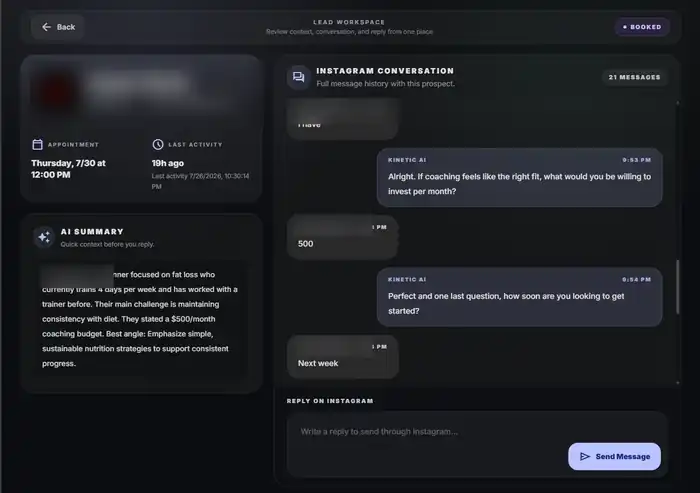
The best AI lead qualification software depends on what your business means by qualification. Some platforms talk directly with inbound leads and decide whether to book, nurture, or hand off. Others score accounts from behavioral and firmographic data. Others enrich records so a sales team can make a better decision without asking the prospect more questions.
Those systems can all improve qualification, but they do different jobs. Buying the wrong category usually creates more software without fixing the actual bottleneck.
This guide compares seven strong options by the qualification mechanism they are built around, the channels and data they use, the handoff they create, and the business they fit best. Kinetic AI is our own product, so its section is clearly labeled as first-party information rather than presented as an independent recommendation.
Product details in this guide were checked on August 20, 2026. AI software changes quickly, so confirm current capabilities, integrations, and pricing on each vendor's official site before purchasing.
Quick answer: the best AI lead qualification tools by use case
Start with the job you need the software to perform. These seven products are strongest in different parts of the qualification market.
- ✓Kinetic AI: best fit for personal trainers and online fitness coaches qualifying inbound Instagram leads before booking calls
- ✓HubSpot Breeze: best for teams that want conversational qualification, scoring, routing, and handoff inside one CRM ecosystem
- ✓Qualified Piper: best for larger B2B teams using Salesforce that want an AI SDR to qualify website visitors in real time
- ✓6sense: best for B2B account-level intent, predictive scoring, and prioritizing which accounts appear most likely to enter a buying cycle
- ✓Clay: best for enrichment-driven qualification and custom fit scoring built from external data
- ✓Landbot: best for no-code website and messaging qualification flows that combine AI conversation with explicit workflow logic
- ✓CloseBot: best for businesses and agencies that want AI conversations inside an existing CRM to qualify leads and book appointments
How we evaluated AI lead qualification software
A platform does not become a strong qualification tool simply because it has AI, a chatbot, or a lead score. We looked at whether the software can help a business make a better decision about the lead and preserve enough context for the next step.
We also separate vendor claims from product capabilities. A published case study can show what happened for one customer, but it does not guarantee the same result for every business. The more useful comparison is whether the product gives you the inputs, controls, routing, and visibility needed to test qualification quality in your own funnel.
- ✓Qualification mechanism: conversation, rules, predictive scoring, enrichment, or a combination
- ✓Inputs: what data can the system actually use to make the decision?
- ✓Adaptability: can it ask for missing context or only evaluate pre-existing fields?
- ✓Routing: can the result trigger a useful next action instead of producing an isolated score?
- ✓Human handoff: can a person take over with the original evidence and context intact?
- ✓CRM fit: does the qualification result stay connected to the lead record and pipeline?
- ✓Transparency: can the team understand why a lead was advanced, deprioritized, or routed elsewhere?
- ✓Setup burden: how much workflow design, data preparation, prompting, and maintenance is required?
- ✓Channel fit: does it work where your leads actually arrive?
The most important distinction: qualification software does not all qualify the same way
Most comparisons mix several categories together. That can make two products look interchangeable even when one speaks with the buyer and the other never interacts with the buyer at all.
A conversational qualifier gathers evidence directly from the lead. A predictive platform infers likely buying intent from account and behavioral data. An enrichment platform adds information from external sources. A CRM-native system may combine several of these approaches and use the result to route the lead.
Before choosing software, decide which missing information is actually blocking your sales process. If the problem is that prospects arrive with too little context, conversation may help. If the problem is that thousands of B2B accounts need prioritization, predictive intent may be more useful. If records are incomplete, enrichment may be the first problem to solve.
- ✓Conversational qualification: ask, interpret, clarify, and decide
- ✓Predictive qualification: infer fit or readiness from historical and behavioral signals
- ✓Enrichment-driven qualification: add missing company or contact data before applying criteria
- ✓CRM-native qualification: combine data, scoring, conversation, routing, and handoff in one system
1. Kinetic AI: best for fitness coaches qualifying inbound Instagram leads
Kinetic AI is the product we build, so this section is first-party information. It is included because it represents a narrow form of conversational qualification that the broader B2B platforms in this list are not designed around.
Kinetic AI is built for personal trainers and online fitness coaches who receive inbound leads through Instagram. It can interpret the conversation, gather fitness-specific qualification context, keep the lead record connected to the DM history, send the coach's booking link when the lead reaches the appropriate point, and track whether the call was actually scheduled.
Its advantage is focus. The coach does not need to turn a generic CRM or chatbot builder into an Instagram qualification workflow from scratch. That same focus is also the limitation: a company that needs website chat, enterprise account scoring, WhatsApp, or a large multi-channel service desk should choose a broader platform.
- ✓Best for: personal trainers and online fitness coaches
- ✓Qualification style: conversational qualification inside inbound Instagram DMs
- ✓Primary inputs: the DM conversation, lead context, and fitness-specific qualification information
- ✓Next actions: continue the conversation, follow up, send the connected booking link, or leave the lead for human attention
- ✓Tracking: conversation history, qualification context, lead status, AI summary, and booked-call visibility
- ✓Human role: the coach still owns the sales call, pricing decisions, coaching judgment, and sensitive health decisions
- ✓Not ideal for: general B2B account scoring, broad omnichannel support, or enterprise sales operations
Related reading
2. HubSpot Breeze: best CRM-native qualification system
HubSpot's current Breeze qualification workflow combines several jobs that businesses often buy separately. Its Customer Agent can engage inbound visitors, answer questions, qualify them against criteria you define, route qualified leads, and book meetings. HubSpot also provides Lead Scoring, Buyer Intent, enrichment, Prospecting Agent, and Customer Handoff Agent capabilities around the same CRM data.
That makes HubSpot one of the strongest choices when the business already wants HubSpot to be the operating system for marketing and sales. The qualification result can stay connected to the contact, company, conversation, scoring, routing, and sales handoff instead of being passed between several disconnected tools.
The tradeoff is that HubSpot is a broader platform purchase. A small business that only needs one narrow qualification workflow may find it heavier than a purpose-built conversational tool. Teams should also confirm which AI features are included in their specific HubSpot products and tiers because availability differs by feature.
- ✓Best for: teams already using or planning to use HubSpot as the CRM
- ✓Qualification style: conversational qualification plus scoring, intent, enrichment, routing, and handoff
- ✓Channels: HubSpot currently describes Customer Agent deployment across website chat, email, WhatsApp, Facebook Messenger, and voice beta
- ✓Strong point: qualification context can remain attached to the CRM record and handoff
- ✓Watch for: feature availability, credits, and product-tier requirements across the broader HubSpot suite
Related reading
3. Qualified Piper: best for enterprise B2B website qualification on Salesforce
Qualified's Piper is an AI SDR built around converting B2B website traffic into pipeline. The platform can use visitor and account context, qualification criteria, website behavior, CRM data, and live conversation to decide how to engage a buyer and what action should happen next.
Qualified currently supports real-time website conversations across text, voice, and video, along with email and meeting-booking workflows. Its platform is built especially closely around Salesforce, which makes it a strong fit for larger B2B organizations that already use Salesforce and care about target accounts, routing, pipeline attribution, and enterprise data connections.
This is a different purchase from a lightweight website chatbot. The value is strongest when inbound website traffic is commercially important enough to justify a dedicated AI SDR and the business already has the account data, routing logic, and sales organization to use the platform well.
- ✓Best for: mid-market and enterprise B2B companies using Salesforce
- ✓Qualification style: AI SDR conversation combined with visitor, account, intent, and CRM context
- ✓Channels: website conversations, email, meetings, and related inbound pipeline workflows
- ✓Strong point: deep Salesforce orientation and real-time qualification of valuable website visitors
- ✓Human handoff: the system can route or transfer appropriate conversations with context
- ✓Watch for: enterprise implementation and complexity may be unnecessary for smaller sales motions
Related reading
4. 6sense: best for predictive account intent and prioritization
6sense approaches qualification from the data side rather than by interviewing every lead. Its predictive models use account fit, engagement, first-party activity, web behavior, search and third-party intent signals to estimate which accounts appear most likely to enter or progress through a buying cycle.
The platform's intent and buying-stage scores are especially useful for B2B organizations where one account may include several contacts and where much of the buying journey happens before anyone fills out a form. Instead of waiting for a single person to declare intent, the system helps revenue teams prioritize accounts showing a combination of fit and research behavior.
That makes 6sense powerful for account prioritization, but it is important not to confuse predictive intent with conversational qualification. A high-intent account can still require human discovery or additional qualification before a meeting, proposal, or opportunity makes sense.
- ✓Best for: B2B revenue teams managing many target accounts and buying committees
- ✓Qualification style: predictive fit, intent, buying-stage, and engagement scoring
- ✓Primary inputs: CRM, marketing automation, web activity, search and third-party intent signals
- ✓Strong point: account-level prioritization before or beyond direct form fills
- ✓Watch for: predictive scores should guide prioritization rather than silently replace explicit sales qualification
Related reading
5. Clay: best for enrichment-driven qualification and custom fit scoring
Clay is strongest when the problem is incomplete data. It can enrich people and companies from many data sources, use formulas and AI to normalize information, and build custom lead or account scores from the attributes that matter to the business.
Clay's own lead-scoring documentation separates customer or account fit, engagement, and overall lead grade. Teams can also use AI to standardize messy fields such as job titles before applying a scoring or qualification rule, then sync the result into a CRM or downstream workflow.
Clay is not primarily a conversational qualifier. It is better thought of as a flexible data and research layer for deciding which prospects fit an ICP and deserve attention. Businesses that need the software to ask a live lead follow-up questions will need another conversational layer.
- ✓Best for: B2B prospecting and RevOps teams that need richer data before they can judge fit
- ✓Qualification style: enrichment, research, formulas, fit scoring, and AI-assisted data normalization
- ✓Strong point: highly customizable qualification inputs from external data
- ✓CRM role: scores and enriched fields can be synced into downstream sales systems
- ✓Watch for: enriched fit data is not the same as live buyer intent or a discovery conversation
Related reading
6. Landbot: best no-code conversational qualification builder
Landbot is a strong fit for teams that want to design their own qualification experience without building a custom application. Its AI lead-generation tooling is built around engaging website visitors in conversation, detecting intent, collecting structured information, qualifying against criteria, and routing the lead to the appropriate destination.
The key advantage is the combination of AI conversation and explicit workflow control. A team can define required fields and qualification logic, let the AI adapt the conversation when answers are not perfectly structured, then connect the result to CRM, calendar, notifications, or nurture paths.
That flexibility requires more design responsibility than a vertical product. Landbot gives you the builder, but the business still needs to define what qualifies a lead, which questions matter, when to stop asking, and what each routing path should do.
- ✓Best for: marketing and operations teams that want a no-code conversational qualification workflow
- ✓Qualification style: AI conversation plus workflow rules and structured fields
- ✓Channels: website plus supported messaging experiences such as WhatsApp and Facebook Messenger
- ✓Strong point: customizable qualification and routing without custom software development
- ✓Watch for: workflow quality depends on how well the team defines its qualification and routing system
Related reading
7. CloseBot: best for AI qualification inside an existing CRM conversation stack
CloseBot is designed around AI agents that work through supported CRM conversation sources such as HighLevel and HubSpot. Instead of replacing the CRM, the agent listens to the conversations flowing through that system, qualifies leads, updates information, and can move qualified prospects into appointment booking.
Its workflow model is useful for agencies and service businesses that already receive conversations through a CRM and want AI to perform the repetitive setter work. CloseBot also lets workflows restrict tools by stage, so an unqualified lead can be prevented from accessing booking actions until the qualification step is complete.
The main consideration is architecture. CloseBot depends on the channels and data available through the connected CRM source, so evaluate the entire conversation stack rather than the AI agent in isolation.
- ✓Best for: agencies and service businesses already operating conversations through HighLevel or HubSpot
- ✓Qualification style: conversational AI inside CRM-connected workflows
- ✓Next actions: update contact information, change stages or tags, qualify, and book appointments
- ✓Strong point: stage-specific agent tools can keep booking gated behind qualification
- ✓Watch for: channel coverage depends on what the connected CRM source supports
Side-by-side: which qualification mechanism are you actually buying?
The tools become easier to compare when you ignore the AI label and focus on the evidence each system uses to make a decision.
- ✓Kinetic AI: direct Instagram conversation evidence for a narrow fitness-coaching workflow
- ✓HubSpot Breeze: conversation plus CRM records, scoring, intent, enrichment, routing, and handoff
- ✓Qualified Piper: live website conversation plus B2B visitor, account, CRM, and intent context
- ✓6sense: predictive account and contact signals from first-party and third-party activity
- ✓Clay: external enrichment, research, normalization, and custom scoring inputs
- ✓Landbot: lead answers gathered through AI conversation plus explicit workflow fields and rules
- ✓CloseBot: CRM conversation data plus configurable AI workflows and stage-specific actions
Conversational qualification vs. predictive scoring
Conversational qualification is strongest when the missing evidence exists in the prospect's head. The system can ask why the person reached out, what they need, when they need it, or another business-specific question that is not available in a database.
Predictive scoring is strongest when the business already has enough historical, behavioral, and account data to infer which opportunities deserve attention. It can prioritize thousands of accounts without asking each one a new question.
Many mature teams use both. Predictive data can decide who deserves proactive attention, while direct qualification confirms whether the specific opportunity is actually ready for the next sales step.
Related reading
Which tool is best for a small business?
Small businesses usually get more value from a system that solves one real workflow with little maintenance than from an enterprise platform with dozens of unused capabilities.
If leads arrive in conversations and the owner needs to know whether they are worth booking, a conversational tool such as Landbot or CloseBot may be more practical than predictive account intelligence. A fitness coach with Instagram inbound leads has an even narrower use case, which is where Kinetic AI fits.
HubSpot can also be a strong choice if the business already uses HubSpot broadly enough that keeping qualification, CRM records, routing, and sales handoff in one ecosystem reduces complexity rather than adding it.
Which tool is best for B2B sales teams?
B2B qualification gets more complex as account size, buying committees, traffic volume, and CRM structure increase. That is where Qualified, HubSpot, 6sense, and Clay become more compelling for different reasons.
Qualified is strongest when the website itself is an important pipeline channel and Salesforce is central to the revenue stack. HubSpot is strongest when the company wants an integrated CRM-native qualification system. 6sense is strongest when account intent and buying-stage prediction matter before direct contact. Clay is strongest when better external data is needed to judge account fit or build a custom qualification layer.
Do not choose based on the most impressive AI demo
A polished demo conversation can hide a weak production workflow. The important questions start after the AI produces a reply.
Ask what evidence the system stores, what happens when the answer is ambiguous, whether the lead can be routed to several outcomes, how a human sees the original context, and whether the qualification decision can be measured against downstream sales results.
The best system is not the one that sounds the most human in a five-minute demo. It is the one that makes repeatable decisions your sales process can explain, review, and improve.
Seven buying questions to ask every AI qualification vendor
These questions reveal more than a generic feature checklist because they force the vendor to explain how the qualification decision actually works in your workflow.
- ✓What exact information can the AI use when deciding whether a lead is qualified?
- ✓Can it ask a clarifying question when the evidence is incomplete?
- ✓Can we define hard disqualifiers separately from softer fit signals?
- ✓What happens when the AI is uncertain or the conversation becomes sensitive?
- ✓Can the system show the salesperson why the lead was advanced or routed?
- ✓Can qualification outcomes trigger different CRM, nurture, booking, or human-review paths?
- ✓Can we connect the qualification decision to show rate, opportunity quality, close rate, or another downstream result?
How to test AI lead qualification software before committing
Do not judge a qualification tool only on the vendor's sample conversation. Give it representative leads from your actual funnel and see whether it makes decisions your sales team agrees with.
A useful pilot includes obvious good fits, obvious poor fits, incomplete inquiries, unusual edge cases, leads that ask questions before answering yours, and situations that should trigger human review. Track both false positives and false negatives rather than celebrating every automated booking.
- ✓Define the qualification standard before the test starts
- ✓Use the same lead definitions for the AI and the human benchmark
- ✓Review why each lead was advanced, paused, or rejected
- ✓Check whether the next-step routing actually occurred
- ✓Measure sales-team acceptance of qualified leads
- ✓Connect the result to appointments, opportunities, or customers rather than stopping at the qualified label
- ✓Review failure cases and adjust criteria before increasing volume
What metrics matter after launch?
The goal is not to maximize the number of leads marked qualified. It is to improve the quality and speed of the sales process without filtering out valuable opportunities.
- ✓Time from inquiry to qualification decision
- ✓Qualification completion rate
- ✓Qualified-lead rate
- ✓Human-review rate
- ✓False-positive rate
- ✓False-negative review rate
- ✓Qualified lead to booked meeting, demo, estimate, or proposal rate
- ✓Sales-team acceptance rate
- ✓Show or completion rate for the next sales event
- ✓Close rate and revenue from qualified opportunities
Common red flags in AI lead qualification software
Most red flags appear when the product hides the decision behind an impressive AI label instead of giving the business control over what qualification means.
- ✓The vendor cannot explain what inputs influence qualification
- ✓Every lead is forced into a qualified or disqualified status with no uncertainty or review path
- ✓The AI can invent policies, eligibility, pricing, or other business facts
- ✓The system produces a score but cannot explain the evidence behind it
- ✓Qualified leads cannot be routed differently based on context
- ✓The salesperson receives a handoff with no original answers or conversation history
- ✓The platform optimizes booked meetings without showing whether those meetings are actually good
- ✓The tool requires significantly more data or lead volume than the business currently has
Best AI lead qualification software: final recommendations
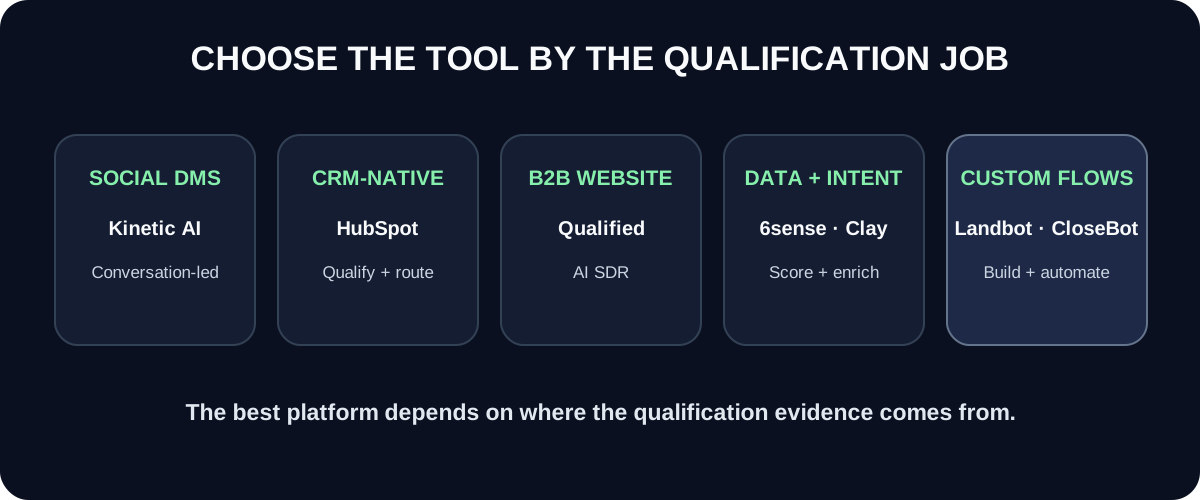
There is no single best platform for every qualification problem. The right tool depends on where the evidence comes from and what decision the business needs to make next.
Choose Kinetic AI for inbound Instagram qualification in personal training and online fitness coaching. Choose HubSpot Breeze when qualification should live inside a broader HubSpot CRM workflow. Choose Qualified Piper for enterprise B2B website conversion on Salesforce. Choose 6sense for predictive account intent and prioritization. Choose Clay for enrichment-driven fit models. Choose Landbot for a customizable no-code conversational flow. Choose CloseBot when AI qualification needs to operate inside an existing CRM conversation stack.
Whichever platform you choose, define the qualification standard before you automate it. A clear rule for what makes a lead worth advancing will create more value than a more advanced model operating on a vague sales process.
Build a more predictable online fitness coaching business
Kinetic AI's Growth Partnership helps online fitness coaches identify what is holding growth back, build the strategy and systems around it, and review the numbers so the next priority is clear.
DM “DOUBLE” on Instagram →