AI DM Setter Pricing: What Does an AI Appointment Setter Cost?
Learn what AI DM setters cost in 2026, how pricing models differ, which fees to watch for, and how to compare cost per qualified appointment instead of subscription price alone.
 Written by Dylan StottFounder of Kinetic AI
AI DM setter pricing can look confusing because products that appear to do the same job are often sold in completely different ways. One platform may charge a small monthly software fee, another may charge by messages or active contacts, and a done-for-you provider may charge four figures because setup and ongoing optimization are included.
That means the question is not simply, 'How much does an AI appointment setter cost?' The better question is, 'What am I paying for, what will make the bill grow, and what does the system cost for each qualified appointment it actually creates?'
This guide breaks down the main pricing models, current public examples, hidden cost drivers, and the calculations that make different AI setters easier to compare. Public vendor pricing was checked on August 16, 2026. Software prices and plan availability can change, so confirm the current price with the vendor before purchasing.
Related reading
Quick answer: how much does an AI DM setter cost?
There is no single market price because the category includes lightweight automation tools, dedicated AI setters, managed implementations, and full CRM platforms.
At the lower end, businesses can start with free or low-cost social automation plans and add AI features as needed. Dedicated self-serve AI setters are commonly priced around a monthly software subscription plus message or usage limits. Managed AI setters can reach $1,000 per month or more when onboarding, prompt design, workflow building, and ongoing optimization are part of the service. Broader CRM platforms may require both a base subscription and separate AI or channel charges.
The sticker price matters, but it is only one part of the cost. A $50 tool can become expensive if it requires several paid integrations and hours of weekly maintenance. A $1,000 managed system can be economical if it replaces meaningful operational work and consistently creates qualified appointments for a high-ticket business.
The four costs that make up the real price
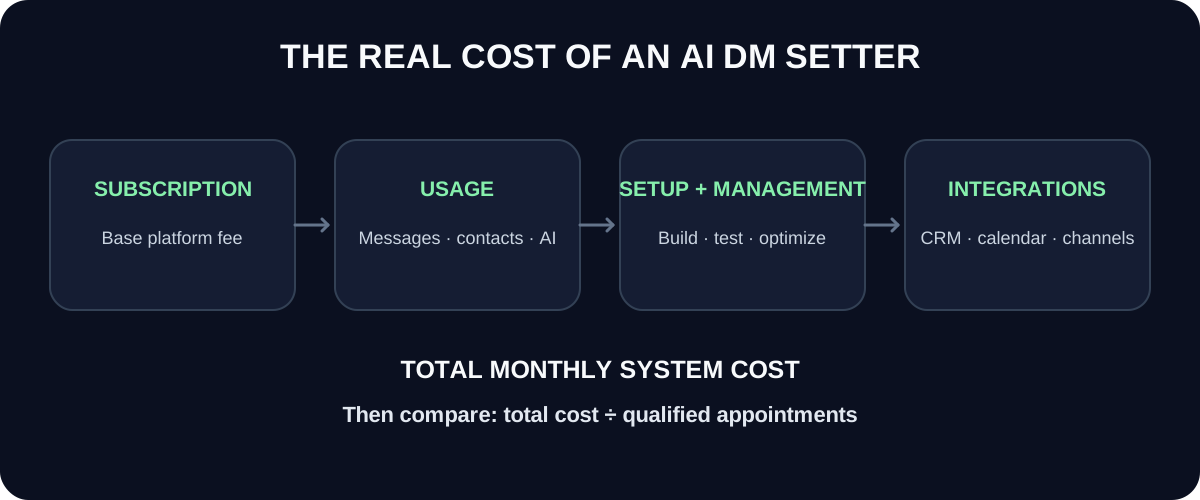
A useful way to compare AI DM setter pricing is to separate the monthly bill into four buckets: the software subscription, variable usage, setup or management, and the integrations required to make the workflow complete.
Two vendors can advertise very different monthly prices while ending up much closer after those four costs are included. The opposite can also happen: a higher subscription may already include features that would require several add-ons elsewhere.
Calculate the total system cost first. Only then compare the economics of the outcomes it produces.
- ✓Subscription: the recurring platform or account fee
- ✓Usage: messages, active contacts, AI consumption, phone, email, or other variable charges
- ✓Setup and management: onboarding, implementation, prompt work, optimization, or internal staff time
- ✓Integrations: calendar, CRM, automation platform, messaging channel, or other tools needed for the full workflow
1. Flat monthly subscription pricing
The simplest model is a recurring monthly subscription. You pay a set amount for access to the product, usually with some level of included usage.
This model is easy to budget when lead volume is stable. The important detail is whether the plan is truly flat or whether usage charges begin after a message, contact, or AI allowance is reached.
A flat monthly price is most useful when the vendor clearly explains what is included and what causes the bill to increase.
2. Message-based or usage-based pricing
Some AI setters include a fixed number of AI messages and then charge for additional usage. This can keep the entry price low, but the monthly cost rises as conversations get longer or lead volume increases.
Message-based pricing is not automatically bad. It can align cost with actual use. The risk is estimating volume from the number of leads instead of the number of messages required to qualify, answer questions, follow up, and book those leads.
A lead who sends one question and books immediately may use very little AI. Another lead may exchange twenty messages, disappear, return two days later, and need several follow-ups. Both count as one lead, but their usage costs can be very different.
3. Active-contact pricing
Some social automation and customer-conversation platforms price around the number of people who interact with the business during the billing period rather than the raw number of messages sent.
ManyChat's newer pricing model is a good example. It uses monthly Active Contacts for newer accounts, with limits and overage pricing that vary by plan. respond.io also uses Monthly Active Contacts on plans where contact volume is part of the allowance.
Contact-based pricing can make costs easier to forecast when each prospect tends to have a long conversation. It can become more expensive when a large number of people interact briefly but only a small percentage become real sales opportunities.
4. Done-for-you or managed pricing
A managed AI setter is closer to buying an implementation service than purchasing a piece of software. The provider may configure the prompts, qualification rules, follow-up logic, booking flow, integrations, voice, and ongoing optimization for you.
That is why a managed setter can cost many times more than a self-serve tool. You are paying for software plus execution and support.
The right comparison is not a $1,000 managed setter versus a $99 software subscription. It is the managed system versus the software, implementation time, maintenance, and expertise required to make the cheaper platform perform the same job.
Current AI DM setter pricing examples in 2026
The examples below show how different the pricing models can be even when the products overlap around qualification and appointment setting. These are public prices or pricing structures checked on August 16, 2026, not permanent quotes.
- ✓Kinetic AI: the current public offer gives personal trainers and online fitness coaches their first five booked calls free with no credit card required; a fixed post-trial monthly price is not displayed publicly on the homepage
- ✓SetSmart: its main public pricing currently shows a seven-day trial followed by roughly $99 per month for Pro with 1,000 AI messages included; other SetSmart landing pages show slightly different plan prices, so verify the exact checkout offer
- ✓Setor AI: $1,000 per month after a 14-day free trial, with onboarding, setup, support, qualification, follow-up, booking, and ongoing optimization included
- ✓dmset.ai: public pricing is described as a flat monthly fee per account with no setup fee, commission, per-conversation charge, or long-term contract, but the exact monthly amount is provided during the sales process rather than published
- ✓ManyChat: newer-plan monthly pricing currently lists Free at $0, Essential at $17, Pro at $39, Business at $99, and Advanced at $199, with Active Contact limits and overages; older accounts may still use legacy contact-based Pro pricing starting at $15 per month
- ✓Chatfuel: Chatfuel Light is currently free and AI Pro is listed at $49 per month, with usage limits applying
- ✓respond.io: Starter is $79 per month, Growth is $159, and Advanced is $279; AI Agents are included on Growth and above, and respond.io says AI usage on those self-service AI plans is included subject to its fair-use policy
- ✓HighLevel: base subscriptions currently start at $97 per month, while HighLevel separately lists AI Employee Growth at $50 per month per enabled sub-account and AI Employee Unlimited at $97 per month per enabled sub-account; other communication and usage charges can apply
Why a $39 platform and a $1,000 setter can both make sense
A low-cost platform and a premium managed setter are not necessarily competing for the same buyer.
A business owner who enjoys building workflows, has a simple sales process, and only needs a few hundred conversations may get excellent economics from a self-serve platform. A high-ticket business with hundreds of inbound conversations may care more about launch speed, tuning, monitoring, and not having the owner manage the system personally.
The value of implementation rises with the cost of mistakes. If sending a booking link too early, missing follow-up, or mishandling a high-value lead has a meaningful revenue impact, a more managed system can be worth more than its software features alone.
The hidden cost most buyers miss: setup time
Cheap software is not free if it takes ten hours to configure and two hours every week to maintain. Your time has an economic cost even if the vendor never sends an invoice for it.
Estimate the work required to create the prompt, define qualification criteria, connect the calendar, build follow-up, test edge cases, train a team, review conversations, and fix the system when the offer changes.
If you will manage the setup yourself, assign a realistic value to those hours. If an employee or agency will do it, use their actual cost. This gives you a more accurate total than comparing subscriptions in isolation.
- ✓Initial workflow design
- ✓Prompt and knowledge-base setup
- ✓Qualification-rule configuration
- ✓Calendar and CRM connections
- ✓Testing and edge-case review
- ✓Ongoing conversation QA
- ✓Prompt or rule updates
- ✓Team training and handoff procedures
The second hidden cost: the tools around the setter
An AI setter rarely operates in a vacuum. Depending on the platform, the final system may also require a calendar, CRM, social automation layer, integration tool, messaging account, or other paid service.
For example, an AI product that sits on top of ManyChat should be evaluated with the ManyChat cost included. A CRM-first platform may include the pipeline and calendar but charge separately for AI, messaging, WhatsApp, phone, email, or premium workflow actions.
List every product the setter needs in order to complete the workflow from new inquiry to booked appointment. That stack, not one subscription line item, is the true software cost.
How to calculate total monthly AI setter cost
Use a simple formula: subscription fees + expected usage + required integrations + setup or management cost = total monthly system cost.
For one-time setup fees, spread the cost across a reasonable evaluation period instead of pretending the setup disappears. If implementation costs $1,200 and you expect to evaluate the system over six months, you can treat that as $200 per month during the evaluation period.
This does not need to become complicated accounting. The purpose is to compare systems on the same basis.
The most useful metric: cost per qualified appointment
Once you know the total monthly cost, divide it by the number of qualified appointments created by the system. This is more informative than cost per message or total bookings because it connects the expense to a meaningful sales opportunity.
If a system costs $600 in total and produces 20 qualified appointments, the cost per qualified appointment is $30. If another system costs $300 and produces six qualified appointments, its cost per qualified appointment is $50 even though the subscription looks cheaper.
Use your own definition of qualified. A calendar full of people who cannot buy, do not fit the offer, or never intended to take the call is not a successful setting system.
- ✓Total monthly setter cost ÷ qualified appointments booked = cost per qualified appointment
- ✓Total monthly setter cost ÷ qualified appointments attended = cost per qualified attended appointment
- ✓Total monthly setter cost ÷ customers acquired from setter-generated opportunities = setter cost per acquired customer
Why cost per booked call is not enough
A booked call is only useful when the prospect is a realistic opportunity. An aggressive setter can make its booking numbers look good by sending the calendar to almost everyone.
That creates a misleadingly low cost per booked call while increasing no-shows, weak-fit appointments, and wasted sales time. A more selective system can book fewer calls and still create more customers.
Track qualification, booking, attendance, and sales together. The setter should be judged on the quality of the pipeline it creates, not the size of the calendar alone.
How to estimate message-based pricing before you buy
If a platform charges by AI messages, estimate the complete conversation rather than the opening reply.
Take a sample of real sales conversations and count how many AI messages would typically be required from first response through qualification, questions, follow-up, and booking. Then multiply that by your expected monthly lead volume and add a buffer for longer conversations.
This gives you a much better estimate than assuming one lead equals one or two messages. It also helps you compare a message-based plan against a contact-based or flat-fee product.
How to estimate active-contact pricing
For Active Contact pricing, estimate how many unique people will interact with the automation during a normal month, not how many followers you have.
Then test a growth scenario. If a campaign, viral Reel, or paid ad doubles the number of people entering the DMs, what happens to the plan or overage cost? A system that is inexpensive at 200 monthly contacts may have different economics at 5,000.
The goal is not to avoid usage-based pricing. The goal is to understand the slope of the cost before the business grows into it.
Related reading
AI setter pricing vs. a human setter
Do not compare AI software only with a human setter's base pay. Compare the complete cost of each operating model.
A human setter may be paid through hourly wages, salary, a retainer, commission, bonuses, or a combination. There may also be recruiting, training, management, coverage, software, and turnover costs. AI has different expenses: subscriptions, usage, integrations, setup, monitoring, and human escalation.
Use the actual numbers available to your business instead of relying on a generic claim that a human setter always costs a certain amount. Then compare cost per qualified attended appointment and cost per customer under both systems.
Related reading
When a low-cost AI setter is the better buy
A lower-cost self-serve platform is usually attractive when lead volume is still modest, the owner can manage setup, the qualification process is simple, and the business does not need many channels or team controls.
At this stage, the goal is often to prove that automation can reliably improve response, qualification, and follow-up before adding a large recurring expense.
Paying for enterprise infrastructure or white-glove implementation before the business has enough inbound volume can produce poor economics even if the software works perfectly.
When a premium managed AI setter can be worth it
A higher-cost managed setter becomes more defensible when lead volume is high, the offer is valuable, the workflow is already proven, and the owner's time is better spent selling or delivering the service than maintaining automation.
The premium can also make sense when the sales conversation has many edge cases and the provider genuinely handles implementation, testing, ongoing optimization, and support that the business would otherwise need to perform itself.
The key is utilization. A $1,000 monthly setter serving ten low-value inquiries is expensive. The same system serving hundreds of high-value conversations can have very different economics.
Pricing questions to ask every AI setter vendor
Before buying, ask for the billing mechanics in plain language. You should be able to explain what you will pay in a quiet month and what you will pay if lead volume doubles.
- ✓What is the base monthly subscription?
- ✓Is there an onboarding or setup fee?
- ✓How many messages, contacts, conversations, or AI actions are included?
- ✓What happens when I exceed the included usage?
- ✓Can I set a hard cap on overages?
- ✓Are calendar, CRM, messaging, or integration tools included?
- ✓Does the product require another platform such as ManyChat?
- ✓Is human takeover included or does it require another inbox seat?
- ✓Are support and optimization included?
- ✓Is there a minimum term or long-term contract?
- ✓What does cancellation look like?
- ✓Will I still have access to my lead and conversation data if I leave?
Red flags in AI DM setter pricing
Pricing becomes risky when the buyer cannot tell what actually drives the bill or what has been excluded from the advertised price.
A clear vendor should be able to explain the base fee, variable costs, required tools, contract terms, and the workflow included in the purchase without hiding the important details behind a demo.
- ✓A very low headline price with unclear message or contact overages
- ✓Required third-party tools are not mentioned until onboarding
- ✓The vendor quotes savings against a human setter without explaining the assumptions
- ✓A long contract is required before you can test real conversations
- ✓Setup or optimization is described as included but the actual scope is vague
- ✓The platform charges for bookings without defining whether the lead was qualified
- ✓The vendor cannot show how usage is measured inside the product
- ✓You cannot estimate the bill at your current lead volume
How long should you test an AI setter before judging the price?
The system needs enough real conversations to reveal whether it is improving the pipeline. One perfect demo conversation proves very little.
Before the test begins, write down the baseline metrics you already have and the outcomes you expect the setter to influence. Then compare the same funnel after the system has processed a meaningful sample of your normal leads.
Look at response consistency, qualification completion, qualified bookings, show-ups, human takeover frequency, sales outcomes, and the total hours you still spend managing the inbox. A system that costs slightly more but removes significant manual work can be the better economic choice.
Related reading
How Kinetic AI approaches pricing
Kinetic AI is our product, so this section is first-party information rather than an independent review.
Kinetic AI is built specifically for personal trainers and online fitness coaches using inbound Instagram DMs. The current public offer lets a coach connect Instagram and Calendly and receive the first five booked calls free, with no credit card required. The idea is to let the workflow prove that it can move real conversations toward the calendar before the coach pays to keep using it.
Kinetic AI is not positioned as a general CRM for every small business or every messaging channel. Its value should be judged on the narrower job it is built to perform: respond to inbound Instagram leads, gather fitness-specific qualification context, send the connected booking link when appropriate, track booking status, and give the coach visibility into the conversation before the sales call.
A simple AI setter budget framework
Match the level of spending to the maturity of the lead system. A business should not buy more setting infrastructure than it can productively use.
- ✓Low or inconsistent inbound volume: prioritize proving the offer, lead source, and basic automation before paying for a large managed system
- ✓Consistent inbound volume with a simple process: compare dedicated self-serve AI setters and focused automation tools based on qualified appointments created
- ✓High inbound volume with an established sales process: consider managed implementation if owner or team time is becoming the constraint
- ✓Multi-channel team operation: evaluate broader CRM and omnichannel platforms when shared inboxes, routing, permissions, and reporting are genuinely required
Final takeaway
AI DM setter pricing ranges from free entry-level automation to four-figure managed systems because the products include very different amounts of software, usage, implementation, and support.
Do not choose the cheapest subscription. Calculate the complete monthly system cost, understand what makes the bill grow, and measure what the setter produces. Cost per qualified appointment, cost per qualified attended appointment, and cost per acquired customer are far more useful than the headline monthly fee.
The right AI appointment setter is the one that solves the current lead-management bottleneck at an economic cost your business can support. If the system creates better sales opportunities while reducing repetitive inbox work, the subscription becomes a business input rather than just another software expense.
Build a more predictable online fitness coaching business
Kinetic AI's Growth Partnership helps online fitness coaches identify what is holding growth back, build the strategy and systems around it, and review the numbers so the next priority is clear.
DM “DOUBLE” on Instagram →