AI DM Setter vs. Human DM Setter: Cost, Speed, Quality, and Control
Compare AI DM setters and human DM setters across response speed, qualification, follow-up, judgment, cost, management, scalability, and booked-call quality.
 Written by Dylan StottFounder of Kinetic AI
An AI DM setter and a human DM setter can both move inbound conversations toward booked calls, but they solve the job in very different ways.
AI is strongest when the work is repetitive, rules-driven, time-sensitive, and easy to evaluate. Humans are strongest when the conversation requires judgment, persuasion, emotional intelligence, negotiation, or a decision the business has not defined in advance.
That means the useful question is not simply, ‘Which one is better?’ The better question is, ‘Which parts of our DM setting process should be automated, which parts should stay human, and what system produces the best qualified appointments for the least operational friction?’
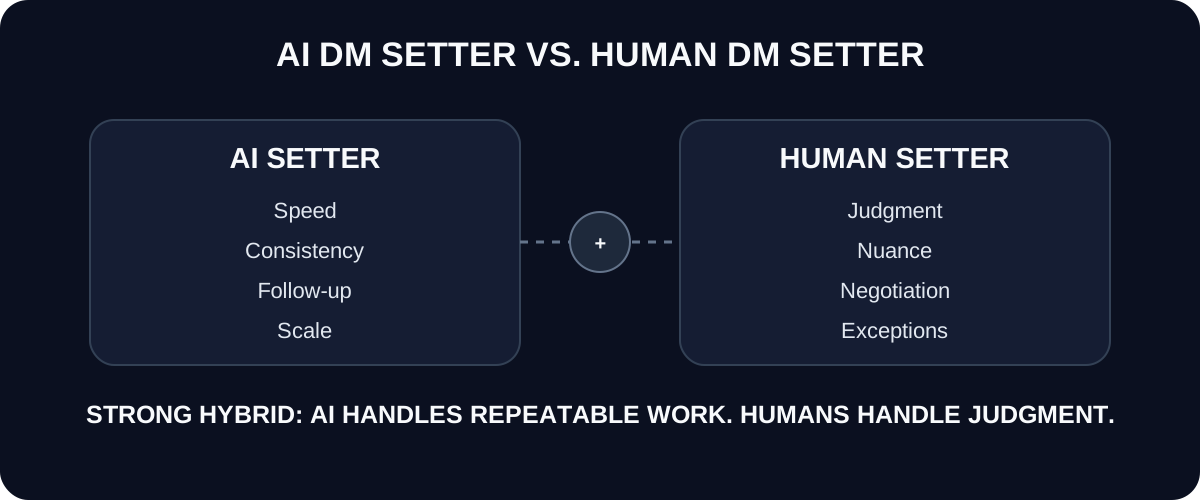
The short answer: AI is better at consistency, humans are better at judgment
Most DM setting work can be separated into two categories: repeatable execution and situational judgment.
Repeatable execution includes responding to new leads, asking approved qualification questions, remembering previous answers, following up after silence, sending a booking link when predefined criteria are met, updating statuses, and recording context. Those tasks are well suited to automation because the desired behavior can be defined before the conversation happens.
Situational judgment includes interpreting ambiguous intent, handling unusual objections, negotiating, managing emotionally sensitive conversations, deciding whether an exception should be made, and building a deeper relationship with a high-value prospect. Those tasks are where a capable human still has an advantage.
- ✓AI advantage: speed, availability, consistency, memory, repeatable follow-up, process adherence
- ✓Human advantage: nuance, judgment, negotiation, exceptions, relationship depth, creative problem solving
- ✓Hybrid advantage: use AI for predictable work and humans for conversations that genuinely need human judgment
What does a human DM setter actually do?
A human DM setter manages direct-message conversations with the goal of identifying serious prospects and moving the right ones toward a sales call or another next step.
Depending on the business, the setter may respond to inbound leads, start outbound conversations, ask qualification questions, answer basic offer questions, follow up, send calendar links, confirm appointments, update a CRM, and hand qualified opportunities to a closer or business owner.
The quality of a human setter depends heavily on training, incentives, experience, communication skill, workload, supervision, and how clearly the business has defined the process. A great setter can add judgment and relationship skill that automation cannot fully reproduce. A poorly trained setter can create inconsistent qualification, delayed follow-up, weak documentation, and a calendar full of low-quality calls.
What does an AI DM setter do differently?
An AI DM setter performs the repeatable parts of the same workflow through software. It can read a prospect's messages, use conversation context, ask approved questions, apply qualification logic, answer defined FAQs, follow up, and move qualified leads toward booking.
The main operational difference is that the process does not depend on one person's memory, schedule, energy, or inbox discipline. If the system is configured correctly, the same rules can be applied across every eligible conversation.
That consistency is valuable, but it can also expose bad process design. If the qualification criteria are weak, the AI can apply weak criteria very consistently. Automation does not remove the need to define the offer, lead criteria, escalation rules, booking logic, and boundaries first.
Related reading
AI vs. human DM setter: response speed
AI has a structural advantage in response speed because it does not need to notice a notification, finish another task, wake up, or return to the inbox later.
A human setter can still respond quickly during working hours, especially when lead volume is manageable and inbox coverage is a primary responsibility. The problem appears when several conversations arrive at once, leads message after hours, or the setter is also responsible for calls, admin, content, or other sales tasks.
Speed should not be confused with value. A fast irrelevant message is not better than a slightly slower useful one. The advantage of AI appears when it can respond quickly while still using the prospect's actual context and moving the conversation forward.
- ✓AI: can respond as soon as the configured workflow receives the conversation
- ✓Human: response time varies with coverage, workload, time zone, and availability
- ✓Best practice: measure meaningful first-response time, not just whether an automatic acknowledgement was sent
Related reading
AI vs. human DM setter: qualification quality
Qualification quality depends more on the framework than on whether the setter is human or AI.
A human can notice subtle signals, ask an unplanned follow-up question, and recognize context that was not included in the original process. An AI system can apply defined qualification rules consistently, remember every answer in the conversation, and avoid skipping steps because the inbox is busy.
The best qualification process is usually short. It confirms enough about the prospect's need, fit, timing, and next-step readiness to decide whether a call makes sense. Neither a human nor an AI should turn the DM into a long application form unless the business truly needs that information before booking.
- ✓Human strength: flexible follow-up questions and interpretation of unusual situations
- ✓AI strength: consistent criteria and complete memory of the conversation
- ✓Shared risk: poorly defined qualification criteria create poorly qualified calls regardless of who executes them
AI vs. human DM setter: conversation quality
Conversation quality is where the comparison becomes more nuanced.
A skilled human can use humor, empathy, timing, personality, and judgment in ways that are difficult to define as rules. They can recognize when the prospect wants a direct answer instead of another question, when a conversation needs more patience, and when it is better to stop setting and simply be helpful.
AI can still create useful conversations when it has strong context, clear boundaries, and a narrow job. The risk comes when businesses ask the AI to sound endlessly persuasive, pretend to know things it does not know, or keep the prospect talking after the next step is already obvious.
Good AI DM setting should feel efficient and relevant, not impressive for the sake of sounding human.
AI vs. human DM setter: follow-up consistency
Follow-up is one of the clearest advantages for automation because the hardest part is often not writing the message. It is remembering exactly who needs a message, when they need it, and where the previous conversation stopped.
Human setters can follow up extremely well when the CRM, task system, workload, and incentives are strong. But manual follow-up creates more places for leads to be forgotten as volume increases.
An AI system can schedule follow-up based on a lead's stage and continue from the existing context. It should also know when to stop, such as after a prospect declines, opts out, becomes unqualified, books, or requires human help.
Related reading
AI vs. human DM setter: cost
The cost comparison should include the full operating cost of each model, not only the most obvious monthly number.
A human setter may involve wages or contractor fees, commissions, recruiting time, onboarding, training, management, software access, replacement cost when someone leaves, and the owner's time reviewing performance. The exact structure varies widely by company and geography.
An AI setter may involve a software subscription, usage charges, setup or implementation, integrations, maintenance, monitoring, and staff time for exceptions. Software can usually handle additional eligible conversations without hiring another full-time person, but costs can still rise with usage or service level.
The most useful comparison is cost per qualified appointment and cost per acquired customer, because a cheap setter that fills the calendar with poor-fit leads can be more expensive than a higher-cost system that produces fewer, better calls.
- ✓Human total cost = compensation + recruiting + training + management + tools + turnover + mistakes
- ✓AI total cost = software + usage + setup + integrations + monitoring + human exception handling
- ✓Economic comparison = total setting cost divided by qualified appointments, then divided by customers acquired
Do not compare cost without comparing output
A fair comparison needs the same definition of success on both sides.
If one setter books 40 calls and another books 25, the first one is not automatically better. You need to know how many were qualified, how many showed up, how many became customers, and how much staff time was required to produce those outcomes.
This is especially important when incentives reward appointment volume. A system can make its booking number look strong by lowering the qualification bar. That may increase calendar activity while reducing sales-team productivity.
- ✓Qualified leads created
- ✓Qualified appointments booked
- ✓Show rate
- ✓Sales accepted lead rate
- ✓Close rate on attended qualified calls
- ✓Revenue or gross profit from acquired customers
- ✓Human time required per qualified appointment
AI vs. human DM setter: scalability
Human capacity scales by adding people, improving productivity, or extending coverage. Each option adds management complexity.
A setter can only manage so many active conversations before response times, follow-up quality, and attention begin to degrade. Higher lead volume eventually requires another person, different shifts, or a team lead who manages the setters.
AI capacity is more elastic because the software can handle many conversations under the same rules. The limiting factors become platform access, software capacity, integration reliability, model quality, and how many exceptions need human intervention.
That makes AI particularly useful when lead volume is uneven. A human team must be staffed for expected demand. Software can handle a sudden increase in eligible conversations without scheduling additional shifts first.
AI vs. human DM setter: control and management
A human setter is managed through hiring, training, coaching, scripts, call reviews, inbox reviews, scorecards, incentives, and direct feedback.
An AI setter is managed through configuration: knowledge, qualification rules, approved answers, escalation logic, booking rules, follow-up rules, test conversations, and performance review.
Neither model is ‘set it and forget it.’ Humans need coaching as the offer and market change. AI needs updated information and periodic review of conversations that went wrong or required intervention.
The difference is where management effort goes. Human management focuses heavily on behavior and consistency. AI management focuses heavily on process design, boundaries, data quality, and exception handling.
AI vs. human DM setter: reliability and coverage
A human setter can be excellent and still have normal human constraints: scheduled hours, vacations, illness, competing priorities, turnover, and variable performance from day to day.
AI can provide more continuous coverage, but software has its own failure modes. Integrations can break, permissions can change, message delivery can fail, a platform can impose limits, or the AI can misunderstand an unusual conversation.
Reliability should therefore be designed, not assumed. The business needs monitoring, clear ownership, alerts for failed workflows, and a way for a human to see conversations that need intervention.
Where a human setter clearly has the advantage
Some conversations are worth human attention precisely because they are unusual.
A high-value prospect may ask for a custom implementation, compare several complex options, challenge a policy, negotiate commercial terms, reveal sensitive information, or ask a question that changes the deal structure. Those conversations can require judgment beyond a predefined setting workflow.
A human setter also has more freedom to build a relationship over time with prospects where trust itself is part of the sale. If the business sells a complex, high-ticket, highly customized service, removing humans too aggressively can reduce the quality of the buying experience.
- ✓Negotiation and custom pricing discussions
- ✓Sensitive or emotionally complex situations
- ✓Unusual objections with no approved answer
- ✓High-value enterprise or custom deals
- ✓Relationship-driven sales where the setter is expected to build deep rapport
- ✓Situations where an exception to normal qualification or booking rules may be appropriate
Where an AI setter clearly has the advantage
AI has the strongest advantage when the business already knows what a good setting conversation should accomplish and the same operational steps repeat across many leads.
If most inbound conversations need the same basic discovery, qualification, FAQ handling, booking logic, and follow-up, software can execute that workflow without relying on manual memory.
This is especially useful for businesses where response delays and forgotten follow-up are a bigger problem than complex persuasion.
- ✓Immediate inbound response
- ✓High volumes of similar inquiries
- ✓Consistent qualification rules
- ✓Routine FAQ handling
- ✓Follow-up after no response
- ✓Booking-link delivery after defined criteria are met
- ✓Lead status updates and conversation summaries
- ✓Coverage outside normal staff hours
The hybrid model is often stronger than choosing one side
The most useful comparison is often not AI versus human. It is AI plus human versus a fully manual process.
In a hybrid system, AI handles the work that is easy to define and expensive to repeat manually. Humans step in when the conversation crosses a boundary, reaches a high-value stage, or requires judgment that the system should not make on its own.
That keeps human attention focused on situations where it creates the most value instead of spending that attention on every first reply, reminder, status update, and repeated qualification question.
- ✓AI responds to the inbound message
- ✓AI identifies intent and asks the first qualification questions
- ✓AI answers approved factual questions
- ✓AI follows up after routine silence
- ✓AI offers booking when predefined criteria are met
- ✓Human takes over for complex objections, negotiation, sensitive issues, or explicit requests for a person
- ✓Human closer conducts the sales call when the business still sells by consultation
A practical decision matrix
Use the complexity and repeatability of the conversation to decide where each model belongs.
The more repeatable the work is, the more attractive automation becomes. The more ambiguous and high-stakes the work is, the more valuable human judgment becomes.
- ✓High volume + repetitive questions + clear qualification rules: strong AI use case
- ✓Moderate volume + clear process + occasional complex exceptions: strong hybrid use case
- ✓Low volume + very high deal value + custom sales process: human-led setting may make more sense
- ✓No clear qualification or booking process yet: define the sales process before automating it
- ✓Few or no inbound leads: fix demand generation before optimizing the setter
How to compare an AI setter with your current human process
Do not replace a human based on a demo. Compare both models against the same business outcomes.
Start by documenting your existing baseline for a meaningful period. Then test the new workflow on a defined set of eligible inbound leads while keeping qualification criteria and downstream sales handling as consistent as possible.
Review both aggregate numbers and individual conversations. The numbers tell you whether the funnel improved. The conversations explain why.
- ✓Median meaningful first-response time
- ✓Lead reply rate
- ✓Qualification completion rate
- ✓Qualified-lead rate
- ✓Qualified-lead booking rate
- ✓Show rate
- ✓Close rate on attended qualified calls
- ✓Human intervention rate
- ✓Cost per qualified booked appointment
- ✓Customer acquisition cost attributable to the setting layer
Related reading
What to test before trusting an AI DM setter
A polished demo is not enough. The system should be tested against the messy conversations your business actually receives.
Use real-world test cases with misspellings, vague answers, interruptions, pricing questions, people who answer two questions at once, people who change their mind, existing customers, poor-fit leads, and prospects who ask for a human.
The goal is not to prove that the AI never makes a mistake. The goal is to know how it behaves when the conversation leaves the ideal path and whether the handoff system prevents a small mistake from becoming a bad customer experience.
- ✓Can it identify non-sales conversations?
- ✓Does it remember information already provided?
- ✓Does it stop asking questions when the next step is clear?
- ✓Does it avoid sending a booking link to obvious poor-fit leads?
- ✓Does it escalate when it lacks enough information?
- ✓Does it stop follow-up after a decline or booking?
- ✓Can a human understand the conversation immediately after takeover?
Common mistakes when replacing a human setter with AI
The biggest mistakes usually happen when businesses automate the person instead of automating the process.
If the existing workflow is unclear, inconsistent, or built around one talented employee's intuition, there may be nothing reliable for the software to execute yet.
Document the business rules first. Then automate the portions that can be described clearly enough to test.
- ✓Trying to automate the entire sales process at once
- ✓Giving the AI vague instructions such as ‘book as many calls as possible’
- ✓Optimizing calendar volume instead of qualified-call quality
- ✓Removing human takeover paths
- ✓Letting the AI make pricing, policy, health, legal, or other high-stakes decisions it should not make
- ✓Failing to update the system when the offer or qualification criteria change
- ✓Comparing software cost with salary while ignoring management, usage, setup, and downstream lead quality
- ✓Assuming automation will fix a lack of inbound demand
When should you keep a human DM setter?
Keep a human-led setting process when the setter's judgment is a major part of the value being created.
That can be the case when deal values are high, every opportunity is materially different, the setter is expected to negotiate or deeply nurture relationships, or lead volume is low enough that automation would remove little operational burden.
A strong human setter can also be the right choice while the business is still learning what good qualification looks like. Their conversations can help define the process that may later be partially automated.
When should you use an AI DM setter?
AI becomes attractive when the business already generates inbound conversations and the setting process has become repetitive enough to standardize.
The strongest signals are slow response times, inconsistent qualification, forgotten follow-up, too much owner time in repetitive conversations, poor visibility into lead status, or the need for coverage beyond one person's working hours.
The business should still have a person responsible for the system. AI can own execution of defined steps, but accountability for the customer experience stays with the business.
Where Kinetic AI fits
Kinetic AI applies the AI-setter model specifically to inbound Instagram leads for personal trainers and online fitness coaches.
It is designed to respond to inbound conversations, gather qualification context, follow up, send a connected booking link when the next step makes sense, and keep conversation and booking context visible to the coach.
It does not replace the coach's sales call, pricing decisions, coaching judgment, or sensitive professional decisions. The goal is narrower: automate the repeatable setting layer so the coach can spend more time on qualified conversations and client delivery.
Final takeaway
AI DM setters and human DM setters are not interchangeable. AI is better at repeatable execution. Humans are better at ambiguous judgment.
If your process is clear and the inbox contains enough repetitive work, AI can improve speed, consistency, follow-up, coverage, and operational leverage. If each conversation is complex, highly customized, or relationship-heavy, a human may still create more value.
For many businesses, the strongest model is hybrid: automate the predictable parts, preserve human control over the exceptions, and judge the system by qualified appointments and customers rather than by message volume alone.
Build a more predictable online fitness coaching business
Kinetic AI's Growth Partnership helps online fitness coaches identify what is holding growth back, build the strategy and systems around it, and review the numbers so the next priority is clear.
DM “DOUBLE” on Instagram →