Online Fitness Business Coaching Cost: What Should You Expect to Pay?
Learn what online fitness business coaching can cost, why prices vary so much, how group, hybrid, and one-to-one mentorship differ, and how to judge the total investment before you buy.
 Written by Dylan StottFounder of Kinetic AI
Online fitness business coaching does not have one standard price. Programs can range from relatively low-cost education and short group accelerators to multi-month mentorships and high-touch one-to-one advisory relationships that cost substantially more.
That spread exists because the label 'business coaching' can describe very different products. One program may give you recorded lessons and a weekly group call. Another may diagnose your business, build a tailored strategy, review implementation, track your numbers, provide direct feedback between calls, and stay involved as the bottleneck changes.
So the useful question is not simply, 'How much does fitness business coaching cost?' It is, 'What am I paying for, what additional costs will I have to carry, and is the problem being solved valuable enough to justify the total investment?'
The short answer: there is no trustworthy single market average
A clean industry average would be convenient, but it would also be misleading. Many fitness business mentorships do not publish pricing publicly, and the offers that do publish prices often bundle very different levels of access, duration, implementation support, community, software, templates, and one-to-one coaching.
Public prices also change. Promotions, cohort dates, payment plans, and offer structure can move the number even when the brand stays the same. For that reason, treat any price range you see online as context rather than a universal benchmark.
A better way to compare cost is to separate the support model first, then compare the total investment and expected value inside that category.
Public pricing examples show how wide the category is
To make the spread more concrete, we checked several publicly listed fitness-business education and mentorship offers on August 30, 2026. These are examples, not a market average, and they are not identical products.
Image Fitness Training lists a seven-week Fitness Business Accelerator at €900. Spring Three lists its Thrive group business coaching program at $497 per month for 12 months and a version with additional one-to-one strategy calls at $739 per month. Online Fitness Coach Academy lists a 90-day internal coach mentorship at $699 and a lifetime mentorship product at $1,397.
Those offers serve different audiences and include different support. The point is not that one is cheap or expensive. The point is that the phrase 'fitness business coaching' covers products with very different scopes, so comparing price before comparing delivery can create a false sense of value.
Why fitness business coaching prices vary so much
The price usually reflects some combination of access, customization, provider time, implementation support, duration, team involvement, and how much of the business the program is designed to address.
Two programs can both promise help growing an online fitness coaching business while requiring completely different amounts of work from the provider. A weekly group Q&A scales across many clients. A one-to-one relationship that reviews your offer, lead flow, sales calls, client retention, operating numbers, and weekly implementation uses far more individualized attention.
- ✓Group size and how much direct access you receive.
- ✓Whether the program is one-to-one, group-based, or hybrid.
- ✓How deeply the strategy is customized to your business.
- ✓Whether the mentor reviews implementation or only teaches concepts.
- ✓Whether support is limited to scheduled calls or includes feedback between calls.
- ✓Program length and how often progress is reviewed.
- ✓Whether templates, dashboards, software, audits, or implementation assets are included.
- ✓Whether you work with the person selling the program or a broader coaching team.
- ✓The provider's positioning, demand, capacity, and business model.
Model 1: self-paced business education
Self-paced programs usually have the lowest direct cash cost because the provider creates the material once and many customers can use it without much additional coaching time.
This can be excellent value when you know the skill you need to learn and are comfortable diagnosing, implementing, and troubleshooting on your own. A focused course on sales calls or content systems may be more efficient than paying for broad mentorship if the rest of the business is already working.
The hidden cost is owner time and interpretation. If you spend months consuming modules, combine several conflicting frameworks, or apply the right tactic to the wrong bottleneck, the cheapest product can become expensive in lost time.
Model 2: group mentorship
Group mentorship sits between self-paced education and private advisory work. You may receive live coaching, community, structured curriculum, templates, and opportunities to ask questions, but the mentor's attention is shared across the group.
This model can work well when your problems are common for your stage and you can apply general frameworks with limited individual feedback. You also gain exposure to questions and examples from other coaches, which can accelerate learning.
The tradeoff is that your business may only receive a small portion of each call. Before buying, understand how questions are handled, whether your work is reviewed, how large the group is, and whether there is any private support when your situation does not fit the standard framework.
Model 3: hybrid mentorship
Hybrid mentorship combines scalable education or group support with some level of direct one-to-one strategy, review, or asynchronous feedback. The goal is usually to keep useful structure and community while adding enough individual attention to adapt the plan to your business.
This can be a strong middle ground for an online fitness coach who wants a proven framework but does not want to be left alone to decide how every piece applies.
When comparing hybrid programs, ask exactly which parts are private. A single onboarding call followed by group support is different from recurring one-to-one strategy, weekly metric reviews, and ongoing asset feedback. The word hybrid does not tell you how much personalization you are actually buying.
Model 4: one-to-one business coaching
One-to-one business coaching usually carries the highest direct price because provider capacity is limited. The mentor is dedicating time to understanding one business, reviewing decisions, giving feedback, and adapting the plan as the evidence changes.
The extra cost only makes sense if the customization is useful. Paying a premium for private calls is poor value if the provider still gives every client the same playbook regardless of offer, stage, lead source, sales process, retention, or capacity.
Private coaching becomes more defensible when the business has valuable decisions to make, several connected bottlenecks, enough activity to measure, and an owner who will actually implement the work between sessions.
The program fee is not the total cost
A common mistake is comparing mentorships only by the number on the payment page. The real investment includes everything required to implement the strategy.
For example, a mentor may recommend paid advertising, a video editor, new software, a setter, a landing-page tool, or a contractor. Those expenses may be reasonable, but they should be visible before you calculate return on investment.
Your time matters too. If a program requires ten additional hours of implementation every week, that is a real operating cost even if no invoice is attached to it.
- ✓Program or mentorship fee.
- ✓Software and platform costs.
- ✓Advertising spend if paid acquisition is part of the plan.
- ✓Contractors, setters, editors, or other labor required to implement.
- ✓Payment-processing or financing costs when relevant.
- ✓Owner implementation time.
- ✓Management time required to coordinate new systems or vendors.
- ✓Opportunity cost of focusing on this strategy instead of another priority.
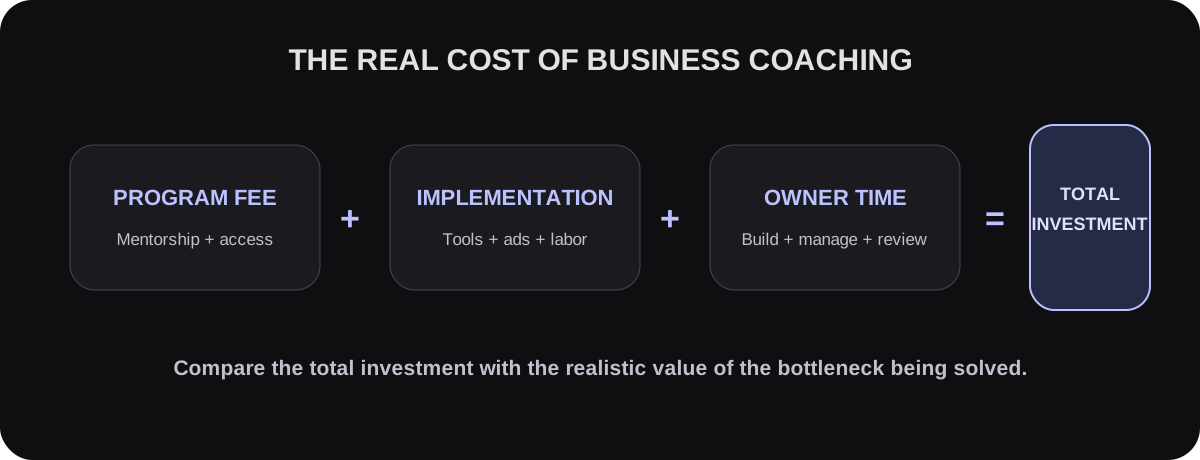
A simple total-investment formula
Before comparing programs, write the expected cost in one place.
Total investment = coaching fee + required tools + required traffic or labor + owner implementation time + financing costs.
You do not need a perfect estimate. The point is to prevent a $3,000 mentorship from being treated like a $3,000 decision if the recommended plan will realistically require another $4,000 in ads, software, and outsourced work over the same period.
Payment plan versus pay in full
Many mentorships offer both payment plans and pay-in-full options. Compare the total amount, not just the monthly payment.
A payment plan can protect cash flow and reduce the immediate burden on a smaller business. Paying in full may reduce the total cost when a genuine discount is offered. Neither is automatically better.
Be careful when a lower monthly number makes an expensive commitment feel smaller than it is. Multiply the payment by the full commitment length and add any setup fee before comparing it with another program.
Do not finance coaching based on an assumed revenue outcome
Business coaching can improve decisions and execution, but no provider controls every variable required to produce a specific revenue result. Your market, offer, sales ability, consistency, client results, retention, capacity, and implementation all matter.
That means the safest financial decision is one your business can absorb even if improvement takes longer than expected. Do not make the repayment plan depend on a guaranteed revenue jump that has not happened yet.
If the economics only work in the best-case scenario, the investment is probably too fragile.
How to calculate the break-even point
For an online fitness coach, break-even can be translated into clients, retained revenue, or avoided costs.
Suppose the total investment in mentorship and implementation is $4,000. If your coaching package contributes $1,000 of gross profit per new client over the period you are measuring, you would need roughly four incremental clients to recover that investment before considering taxes and other business costs.
That calculation does not prove the mentorship will create four clients. It simply turns the price into a business threshold you can evaluate. You can then ask whether the program is working on a bottleneck that could realistically influence enough revenue to clear that threshold.
Revenue is not the only source of value
Some improvements are valuable even when they do not create immediate new-client revenue. Better retention can protect recurring income. Better pricing can improve margin. Better onboarding can reduce support problems. Stronger tracking can stop you from wasting money on the wrong acquisition channel. Better systems can return owner time.
The key is to identify the expected mechanism before you buy. If the mentorship is supposed to improve sales, decide which sales metric should change. If it is supposed to reduce owner workload, decide what work should disappear or become easier. If it is supposed to improve lead generation, decide how you will measure the increase in useful conversations or qualified opportunities.
A vague promise of growth is hard to evaluate. A specific business mechanism is much easier to measure.
How much should a newer online fitness coach spend?
There is no responsible percentage of revenue that every newer coach should spend on mentorship. A coach with savings, low personal expenses, and an established in-person income has a different risk profile from someone whose online business is their only source of cash.
At an early stage, the biggest question is whether the program solves a problem you actually have and whether you have enough implementation capacity to use the support. If you still need basic education on how an online coaching offer works, a focused lower-cost resource may be enough. If you are already taking action but cannot identify why results are inconsistent, more personalized diagnosis may justify a larger investment.
Do not use a high price as proof that the program is advanced. Match the level of support to the complexity and value of the problem.
How much should a growing fitness coaching business spend?
A growing business may be able to justify more expensive support because the decisions carry more financial leverage. Improving a close rate, retention system, pricing structure, or acquisition channel in a business with meaningful lead volume can affect far more revenue than the same change in a business with almost no activity yet.
But larger revenue does not automatically justify larger coaching fees. The provider still needs to solve the right problem. A $10,000 advisory relationship that improves the wrong metric is worse than a $1,000 specialist resource that fixes the actual constraint.
As the business grows, evaluate support based on expected leverage, not status. The most expensive room is not automatically the room you need.
What should be included at a higher price?
A higher price should usually correspond to a stronger reason for the cost. That may be deeper personalization, more experienced support, more direct access, more implementation help, a smaller client load, stronger systems, or a broader scope of work.
You should be able to explain what the additional money buys. If the answer is mainly branding, exclusivity, lifestyle positioning, or access to a large community, decide whether those things are actually valuable to your current bottleneck.
- ✓A clear diagnostic process before major recommendations are made.
- ✓Strategy tied to your actual offer, market, numbers, and constraints.
- ✓Specific implementation priorities rather than a large library of optional tactics.
- ✓Feedback on the work you are building, not only verbal advice.
- ✓Regular review of the metrics connected to the current bottleneck.
- ✓A clear escalation path when the original plan is not producing the expected signal.
- ✓Access and response expectations that match the speed of implementation.
- ✓Visibility into who is actually delivering the coaching.
Questions to ask about price before you join
A strong provider should be able to explain the commercial terms clearly. You should not have to discover important implementation costs after payment.
- ✓What is the total program cost from start to finish?
- ✓Is there a setup fee or enrollment fee?
- ✓Does the payment plan cost more than paying in full?
- ✓How long is the commitment?
- ✓What happens at the end of the initial term?
- ✓Which software or tools will I need to buy separately?
- ✓Should I expect to spend money on ads, contractors, or other implementation support?
- ✓What one-to-one access is actually included?
- ✓Who will provide the coaching?
- ✓What work will you review directly?
- ✓What is the cancellation or refund policy?
- ✓Are there any performance fees, revenue-share terms, or continuing fees after the initial program?
Related reading
Red flags in fitness business coaching pricing
Price itself is not a red flag. Cheap programs can be excellent, and expensive programs can create meaningful value. The problem is when the economics or terms are difficult to understand before you commit.
- ✓The sales call focuses on the monthly payment while avoiding the total commitment.
- ✓The provider cannot explain what additional implementation expenses are likely.
- ✓A high price is justified mainly with the mentor's own revenue or lifestyle.
- ✓Financing is encouraged using an assumed future revenue increase as if it were guaranteed.
- ✓The contract, cancellation terms, or ongoing fees are difficult to review before payment.
- ✓The provider claims one price tier is right for everyone regardless of stage or problem.
- ✓You cannot tell what additional support you receive for a more expensive tier.
Price should be the final comparison, not the first
If two programs solve different problems, comparing their prices tells you almost nothing. Start by defining the bottleneck, then confirm the provider has relevant proof and a process that fits the problem. After that, compare total investment and expected value.
A $500 program that does not address the constraint is expensive. A $5,000 program that creates more than $5,000 of durable business value may be inexpensive relative to the outcome. But that conclusion has to come from the economics of your business, not from the sales page telling you the program will pay for itself.
The right price is the price attached to the right intervention, with enough financial room for you to implement without putting the business under unnecessary pressure.
Where Kinetic AI fits
Kinetic AI's Growth Partnership is built for online fitness coaches who want help diagnosing the business, building the strategy and systems around the current bottleneck, and reviewing the numbers as those systems are implemented.
The work can include offer and positioning, content strategy, lead generation, DM conversion, sales process, Kinetic AI automation, tracking, and weekly optimization. The point is not to sell one tactic as the answer. It is to connect the parts of the business and decide what needs to improve first.
Because the right support depends on the starting point, the useful first step is a conversation about where the business is now, what you are trying to reach, and what appears to be blocking that growth.
Final takeaway
Online fitness business coaching can cost hundreds, thousands, or substantially more depending on the model, duration, access, and scope. A single average is less useful than understanding what the program actually does and what implementation will cost on top of the fee.
Compare the total investment, not the installment. Compare support models before comparing prices. Translate the cost into a break-even threshold. Then ask whether the mentorship is working on a valuable enough bottleneck, with a credible enough process, to justify that risk.
The best coaching investment is not the cheapest or the most expensive. It is the one that helps you make and implement better decisions on a problem that matters enough to your business.
Build a more predictable online fitness coaching business
Kinetic AI's Growth Partnership helps online fitness coaches identify what is holding growth back, build the strategy and systems around it, and review the numbers so the next priority is clear.
DM “DOUBLE” on Instagram →