How to Choose an Online Fitness Business Coach or Mentor
Learn how to evaluate an online fitness business coach or mentor based on fit, proof, process, implementation support, accountability, economics, and the specific bottleneck you need help solving.
 Written by Dylan StottFounder of Kinetic AI
Choosing an online fitness business coach should start with your business, not the coach's audience, lifestyle, or revenue screenshots. The right mentor is the one whose experience, process, and support match the problem you actually need to solve.
That means the best choice for one online coach may be a poor choice for another. A new coach who needs positioning and offer clarity needs different help from a coach with plenty of leads but weak sales. A coach with strong acquisition but overloaded delivery needs different support again.
The goal is not to find the most impressive person. It is to find the clearest fit between your bottleneck and the provider's ability to help you diagnose, implement, measure, and improve it.
Step 1: Define the problem before you compare coaches
A vague goal like 'grow my business' is not enough to choose the right mentor. Almost every provider can claim to help with growth. The useful question is what currently prevents the next stage of growth.
Write down the strongest evidence you have. Are there too few leads? Are leads not booking calls? Are calls not closing? Is retention weak? Is the offer hard to explain? Is delivery taking so much time that acquisition disappears? The more specific the problem becomes, the easier it is to judge whether a coach is relevant.
If you cannot identify the bottleneck yet, that is also useful information. In that case, prioritize a coach with a strong diagnostic process rather than a provider who immediately prescribes one channel or tactic.
Step 2: Make sure mentorship is the support model you actually need
Before comparing individual mentors, confirm that business coaching is the right type of help. A mentor is most useful when you need diagnosis, prioritization, feedback, accountability, or help connecting multiple parts of the business.
If the strategy is already clear and the main problem is execution capacity in one specialized function, an agency or contractor may be more useful. If the gap is simply learning a defined skill and you are comfortable implementing alone, a focused course may be enough.
Choosing the wrong support model creates a mismatch before the relationship even begins. Do not pay for strategy when you only need execution, and do not outsource execution when the underlying strategy is still unclear.
Step 3: Look for stage fit, not just industry fit
Experience with online fitness coaching is valuable because the provider should understand offers, content, lead flow, direct messages, sales calls, onboarding, retention, and capacity in this business model. But industry familiarity alone is not enough.
The coach should also understand your stage. Advice that helps a solo coach get from inconsistent clients to a repeatable acquisition system is different from advice for a business with strong demand, a team, paid acquisition, and capacity constraints.
Ask who the provider works with most often and what those businesses typically look like before joining. The closer their normal client problems are to yours, the easier it is to judge whether their process is likely to transfer.
- ✓Early stage: positioning, offer clarity, first repeatable lead source, basic sales process, and simple tracking.
- ✓Traction stage: consistent lead generation, qualification, follow-up, show rate, close rate, and stronger offer economics.
- ✓Growth stage: bottleneck diagnosis, channel expansion, retention, capacity, systems, and delegation.
- ✓Scale stage: team structure, management, margins, operational visibility, and reducing owner dependency.
Step 4: Evaluate proof that matches the work you need
Testimonials are useful, but the quality of the proof matters more than the quantity. A long page of short compliments does not tell you whether the coach has repeatedly solved a problem similar to yours.
Look for proof that connects the starting situation, the work performed, and the result. If your main problem is converting leads, a case study about someone gaining social-media followers is weak evidence. If your main problem is retention, revenue growth that came entirely from more acquisition does not prove retention expertise.
The strongest proof is specific enough that you can understand what changed and relevant enough that the mechanism resembles the problem you want help solving.
- ✓Was the client's starting point explained?
- ✓Was the actual bottleneck identified?
- ✓Can you tell what the mentor helped change?
- ✓Is the result connected to that change rather than a vague success claim?
- ✓Is the client reasonably similar to your business model or stage?
- ✓Does the provider show more than one type of result when they claim broad expertise?
Do not confuse the mentor's personal success with client success
A mentor's own business can demonstrate experience, but it is not the same thing as evidence that they can help other people apply what they know.
Building a large audience, selling a high-ticket program, or running a successful company may show useful skills. Mentorship requires additional skills: diagnosis, communication, adapting strategy to different constraints, giving feedback, and helping another person implement consistently.
Use the mentor's background as one signal. Use client outcomes, the coaching process, and the quality of their thinking as separate signals.
Step 5: Ask how the diagnosis actually works
A strong mentor should have a way to understand the business before prescribing major changes. The process does not need to be complicated, but it should be more rigorous than asking your monthly revenue and handing you a generic checklist.
Useful diagnosis usually combines goals, current offer, client count, pricing, lead sources, lead volume, booking rate, show rate, close rate, retention, delivery capacity, and the owner's current constraints. The exact metrics depend on the business, but the mentor should be able to explain how they decide what deserves attention first.
If every prospect receives the same answer before the provider has looked at the business, you are probably buying a playbook rather than true diagnosis.
Related reading
Step 6: Understand how personalized the strategy really is
Almost every mentorship describes itself as personalized. Ask what that means operationally.
A useful strategy should reflect your target client, offer, current audience, lead sources, sales ability, available time, delivery model, financial constraints, and willingness to change. Personalization does not mean every tactic must be invented from scratch. Good mentors often use repeatable frameworks. The important part is whether the framework is adapted to the evidence in your business.
Templates can save time. They become a problem when the template replaces judgment.
Step 7: Evaluate implementation support, not just strategy quality
Knowing the right strategy is only valuable if it becomes real behavior and systems inside the business. Before joining, understand what happens after the mentor tells you what to do.
Some programs provide advice and leave implementation entirely to the client. Others review scripts, offers, landing pages, sales calls, content, dashboards, or operating processes while you build them. Neither model is automatically wrong, but they provide very different levels of support.
If your past problem has been implementation rather than information, choose a program that creates a shorter loop between action and feedback.
- ✓Are deliverables reviewed before you launch them?
- ✓Can you get feedback on work between scheduled calls?
- ✓Does the mentor help convert strategy into specific next actions?
- ✓Are there templates or systems that reduce unnecessary setup work?
- ✓Is there a clear owner for each action after a coaching session?
- ✓What happens when an implementation does not work as expected?
Step 8: Check the accountability and measurement system
Good accountability is not someone asking whether you worked hard this week. It connects actions to measurable outcomes.
The mentor should help define which numbers matter for the current bottleneck, what actions are supposed to influence those numbers, and when enough data exists to make another decision. That makes coaching more objective and reduces random strategy changes.
For example, if the current goal is improving booked calls from Instagram, the useful conversation might include qualified conversations, booking rate, show rate, and close rate. If the bottleneck is retention, acquisition metrics become less important than client outcomes, cancellations, check-in behavior, and delivery quality.
Related reading
Step 9: Understand exactly who will coach you
The person selling the program is not always the person delivering the coaching. That can be completely reasonable, especially in a larger company, but you should know before you buy.
Ask who runs your calls, who reviews your work, who answers questions between calls, and what qualifications or experience those people have. If the brand is built around one expert but most clients work with junior coaches, evaluate the actual delivery team rather than the public face of the company.
Also ask whether you keep the same coach over time. Continuity matters when the mentor needs to understand your history, experiments, constraints, and previous decisions.
Step 10: Compare one-to-one, group, and hybrid mentorship carefully
One-to-one coaching gives the provider more time to focus on your business, but it is not automatically better than every group program. A strong group environment can add useful peer examples, shared learning, and lower cost.
The real question is how much individual diagnosis and feedback your situation requires. If your business is complex or the cost of a wrong decision is high, more direct access may be valuable. If you are learning common fundamentals and can apply them independently, group support may be enough.
Hybrid programs can combine structured education, group support, individual strategy, and asynchronous feedback. Evaluate the actual access and workflow rather than the label used on the sales page.
Step 11: Evaluate access and response expectations
Unlimited access sounds attractive, but clear access is more useful than vague access. Understand where questions are asked, who responds, what normal response windows look like, and what should wait for the next scheduled call.
A mentor does not need to be available every minute to provide strong support. In fact, a structured process can be better than constant reactive messaging. The important part is whether the support cadence matches the speed of the work you are implementing.
If a sales page promises constant access, ask how that works when the provider has many clients. Operational clarity is more valuable than an impressive promise.
Step 12: Understand the economics before you sign
Price should be evaluated against the value of the problem being solved, but price is not the only cost. Include the time required to implement, software or advertising expenses, contractors, payment terms, and any additional services that are likely to be required.
Ask what is included and what is optional. A mentorship can appear inexpensive until you discover that meaningful implementation requires several additional tools or services. It can also appear expensive until you recognize that it replaces multiple disconnected subscriptions, courses, or failed experiments.
The useful comparison is total cost versus realistic expected value, not monthly fee versus monthly fee.
Related reading
How to think about guarantees and performance claims
A guarantee can reduce risk, but it should not replace evaluating the underlying service. Read what is actually guaranteed, what conditions apply, what the client must do, and what remedy is offered if the condition is met.
Be especially careful with promises that imply a specific revenue outcome is inevitable. Business results depend on the offer, market, starting point, execution, sales skill, client results, capacity, and many other variables the mentor may not fully control.
A credible provider should be comfortable explaining what their process can influence, what remains your responsibility, and what they cannot guarantee.
Red flags when choosing a fitness business coach
No single red flag proves a provider is bad, but several together should make you slow down and investigate further.
- ✓The provider prescribes a complete solution before learning anything meaningful about your business.
- ✓Most proof is lifestyle content or the mentor's own revenue rather than relevant client outcomes.
- ✓The offer depends on aggressive income promises without explaining assumptions or responsibilities.
- ✓The same acquisition channel is presented as the answer for every business stage and bottleneck.
- ✓The sales conversation creates pressure to decide before you can understand the scope, contract, or total cost.
- ✓You cannot tell who will actually coach you after payment.
- ✓Deliverables, access, feedback, and meeting cadence are described vaguely.
- ✓There is no clear way to measure whether the work is improving the business.
- ✓The provider discourages reasonable questions about client fit, limitations, or situations where the program is not appropriate.
Questions to ask on a discovery or strategy call
The sales call should help you evaluate the provider as much as it helps the provider evaluate you. You do not need to interrogate the coach, but you should leave with enough clarity to understand the problem they believe you have, the proposed process, the responsibilities on both sides, and the economics.
- ✓What types of online fitness businesses are the strongest fit for your program?
- ✓What types of coaches are not a good fit?
- ✓How do you diagnose the first bottleneck to work on?
- ✓What would the first few weeks typically look like for a business at my stage?
- ✓How much of the strategy is personalized versus standardized?
- ✓What implementation help is included?
- ✓Who will I work with directly?
- ✓How often will my numbers and progress be reviewed?
- ✓What happens if the original strategy is not producing the expected signal?
- ✓What additional costs should I expect beyond the mentorship fee?
- ✓Can you show an example of helping a client with a problem similar to mine?
- ✓What should I realistically expect to be responsible for each week?
Use a simple five-part scorecard when comparing mentors
If you are comparing several providers, do not rely on which sales call felt most exciting. Write down the same five categories for each option and compare them after the calls are over.
- ✓Problem fit: does this provider clearly understand the bottleneck I need help solving?
- ✓Proof fit: is there credible evidence they have helped with similar problems or stages?
- ✓Process fit: can they explain how diagnosis, strategy, implementation, and adjustment work?
- ✓Support fit: does the access, feedback, and accountability match the way I need to work?
- ✓Economic fit: is the realistic value worth the total money, time, and attention required?
Do not optimize for the mentor you like most
Personal chemistry matters because you need to communicate openly and accept feedback, but liking the mentor should not become the main selection criterion.
A good mentor may challenge your assumptions, tell you a favorite tactic is not the priority, or ask you to improve a boring process before adding a new growth channel. The relationship should feel constructive and respectful, but it should not simply confirm everything you already believe.
Choose someone whose thinking you trust, whose process you understand, and whose incentives are aligned with helping you build a stronger business rather than keeping you dependent on constant advice.
What a good fit should look like after you join
The selection process does not end when you pay. The first few weeks should confirm whether the experience matches what was sold.
You should become clearer about the current bottleneck, the strategy should become more specific to your business, and you should know what you are responsible for implementing. There should also be a visible way to review progress rather than relying on motivation or vague feelings about momentum.
If the program immediately turns into unrelated lessons, generic tasks, or constant strategy changes without measurement, raise the issue early. Good mentorship should increase clarity over time, not create a larger pile of tactics.
A practical decision rule
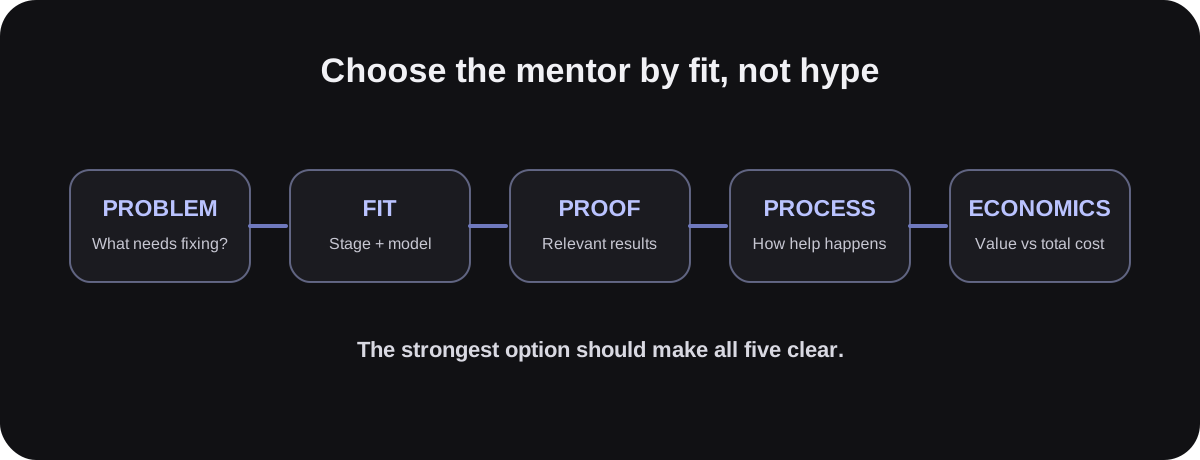
Choose an online fitness business coach when five things are true: you can describe the problem or need help diagnosing it, the provider has relevant evidence, the process makes sense, the support matches your ability to implement, and the expected value is greater than the total cost.
If one of those pieces is missing, investigate before buying. A mentor can be excellent and still be wrong for your current problem. A smaller provider can be a better fit than a famous one. A group program can be better than one-to-one support. And sometimes the correct decision is to implement what you already know before buying anything else.
The goal is not to find a perfect mentor. It is to choose the support that gives you the best chance of making better business decisions and turning those decisions into measurable improvements.
Build a more predictable online fitness coaching business
Kinetic AI's Growth Partnership helps online fitness coaches identify what is holding growth back, build the strategy and systems around it, and review the numbers so the next priority is clear.
DM “DOUBLE” on Instagram →