Is Fitness Business Coaching Worth It? How to Decide
Learn when fitness business coaching is worth the investment, how to evaluate the expected value, which warning signs to avoid, and how online fitness coaches can decide whether mentorship makes sense.
 Written by Dylan StottFounder of Kinetic AI
Fitness business coaching can be worth it when it helps you solve a valuable business problem faster, avoid expensive mistakes, and implement changes you are realistically capable of sustaining. It is not automatically worth it because the coach has a large audience, an impressive revenue claim, or a long curriculum.
The decision should be treated like any other business investment. You need to understand the problem you are trying to solve, the likely value of solving it, the total cost of the mentorship, your ability to implement the advice, and whether the coach has a credible process for helping with that specific problem.
For an online fitness coach, the right question is not simply, 'Can this mentorship make me more money?' A better question is, 'Can this mentorship help me improve the part of my business that is currently limiting profitable growth, and is that improvement worth more than the money, time, and attention required?'
What does 'worth it' actually mean?
Worth it does not mean the mentorship felt motivating or contained useful information. It means the value created by the decisions, systems, skills, or time saved is greater than the total cost of getting that help.
That value can show up in several ways. A coach may improve lead generation, increase the percentage of qualified prospects who book, close a higher percentage of appropriate sales calls, reduce client churn, raise prices with a stronger offer, recover owner time, or avoid spending money on a tactic the business is not ready for.
Some of those improvements create direct revenue. Others reduce waste, protect margin, or increase capacity. A useful evaluation should consider all of them without inventing value that cannot be measured.
- ✓Additional collected revenue created by better acquisition or conversion
- ✓Higher gross profit because pricing, delivery, or retention improves
- ✓Lower wasted spend on ads, tools, contractors, or strategies that do not fit the bottleneck
- ✓Owner time recovered through better systems and clearer priorities
- ✓Faster implementation because the coach stops testing random tactics
- ✓Better decisions that continue creating value after the mentorship ends
Business coaching is most valuable when it improves a real bottleneck
A mentorship becomes easier to justify when the business has a specific constraint that is expensive enough to solve.
For example, a coach with plenty of qualified leads but a weak sales process has a different problem from a coach with no consistent lead flow. A coach with strong sales but constant cancellations has a retention problem. A coach who is fully booked and overwhelmed may have a capacity and delivery problem.
If the mentorship can accurately identify that constraint and help the owner improve it, the value can be significant. If the mentorship gives the same content plan, sales script, and funnel to everyone regardless of the bottleneck, much of the advice may be irrelevant.
The four conditions that usually make mentorship worth considering
You do not need all four conditions to be perfect, but the investment becomes much easier to justify when they are present together.
- ✓There is a specific business problem or growth constraint worth solving.
- ✓The mentor has relevant experience, a clear process, and evidence that they understand that type of problem.
- ✓You have enough time, attention, and resources to implement the work instead of only consuming advice.
- ✓The realistic value of solving the problem is greater than the total cost of the mentorship.
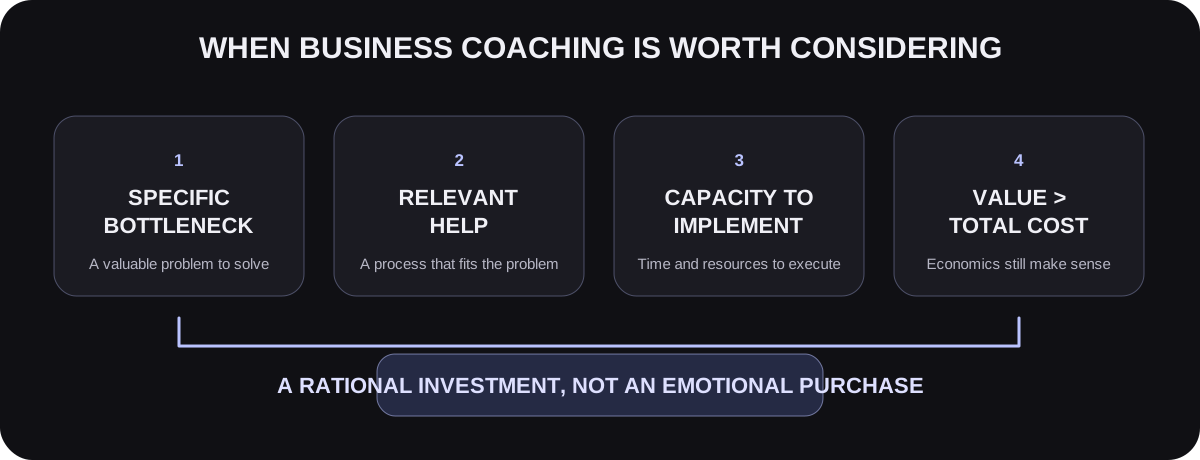
When fitness business coaching is more likely to be worth it
Mentorship tends to create the most value when the owner is already taking action but needs better diagnosis, prioritization, or feedback.
That does not mean you need a large business first. A newer coach can benefit from avoiding months of unfocused experimentation. But the coach still needs enough commitment and capacity to implement the work.
- ✓You have clients but revenue is inconsistent and you cannot identify the exact reason.
- ✓You are getting leads but too few become qualified booked calls or clients.
- ✓You have strong demand but the offer, pricing, or delivery model limits margin and capacity.
- ✓You keep changing strategies because you do not know which metric should determine the next move.
- ✓You know what needs to happen in theory but repeatedly fail to implement it consistently.
- ✓You are approaching a new stage of growth and the systems that worked earlier are beginning to break.
- ✓The cost of staying stuck for another six to twelve months is meaningful to you.
When business coaching is probably not the priority
A good mentorship cannot create value if the owner is not in a position to use it. Sometimes the right decision is to wait, solve a simpler problem first, or use a lower-cost resource.
This is especially important because business coaching is often sold with emotional urgency. A prospect who feels frustrated may buy a program to feel movement even when the actual business is not ready for the investment.
- ✓You cannot afford the fee without creating financial pressure that forces desperate short-term decisions.
- ✓You do not have time to implement and are hoping access to the program will create time for you.
- ✓You are looking for a guaranteed result rather than guidance and implementation support.
- ✓You expect the mentor to build the business for you when the offer is advisory rather than done-for-you.
- ✓You have not yet tested whether people will pay for your coaching offer and only need basic validation.
- ✓You already know the exact next action but are avoiding it for reasons the mentorship will not solve.
- ✓You are choosing a mentor mainly because of lifestyle marketing, status, or fear of missing out.
How to calculate the break-even value of mentorship
You do not need a perfect forecast to evaluate the economics. Start with the direct cost and ask how much additional gross profit or avoided cost is required for the investment to pay for itself.
A simple break-even formula is: total mentorship cost divided by gross profit per additional client equals the number of incremental clients required to cover the direct fee.
For example, assume a mentorship costs $3,000 and an average new coaching client contributes $1,000 of gross profit over the measurement window. The direct fee would be covered by three incremental clients. That is only an illustration, not a promise that mentorship will create three clients.
You can run the same calculation using other measurable outcomes. If the mentorship helps reduce monthly churn, raise contribution per client, prevent wasted ad spend, or free capacity for additional clients, include those benefits only when you can estimate them conservatively.
Include the total cost, not only the sticker price
The true cost of mentorship includes more than the amount charged by the mentor. Implementation requires owner time, tools, team changes, and sometimes additional marketing spend.
A $2,000 program that requires another $4,000 in ads, software, and contractors has a different risk profile from a $2,000 program focused on improving an existing funnel. Neither is automatically better, but the decision should reflect the full commitment.
- ✓Upfront or monthly mentorship fee
- ✓Software or tools required to implement the plan
- ✓Advertising or lead-generation spend
- ✓Contractors or employees needed to support the strategy
- ✓Owner time spent on calls, implementation, reporting, and review
- ✓Opportunity cost of delaying other important work
- ✓Potential switching costs if the mentorship requires rebuilding existing systems
Do not evaluate coaching only by immediate revenue
Revenue matters, but some of the best business improvements create value over a longer period.
A clearer offer can make future marketing easier. A documented sales process can improve every future sales call. A retention system can protect recurring revenue month after month. A weekly scorecard can prevent the owner from wasting money on the wrong bottleneck. These improvements may continue producing value after the formal mentorship ends.
At the same time, long-term value should not become an excuse for vague results. The mentorship should still define practical milestones and measurable changes along the way.
Information alone is usually the lowest-value part
Most fitness coaches can find free information about content, sales, pricing, lead generation, and client retention. Paying for mentorship only makes sense if the support creates value beyond access to information.
The higher-value layers are diagnosis, customization, implementation support, accountability, and feedback. These reduce the time between knowing something and turning it into a working business process.
- ✓Information tells you which strategies exist.
- ✓Diagnosis tells you which problem matters now.
- ✓Customization adapts the strategy to your market, offer, numbers, and constraints.
- ✓Implementation support helps turn the plan into actual scripts, systems, pages, content, or workflows.
- ✓Accountability keeps important work from disappearing behind client delivery.
- ✓Optimization uses results to decide what should change next.
The value changes depending on your stage
The same mentorship can be worth very different amounts to two coaches because the constraint and economics are different.
- ✓New coach: value may come from choosing a viable market, offer, and simple acquisition process before wasting months on random tactics.
- ✓Inconsistent coach: value may come from turning referrals and occasional strong months into a repeatable lead and sales system.
- ✓Plateaued coach: value may come from identifying which conversion, pricing, retention, or capacity metric is preventing the next level of growth.
- ✓Growing coach: value may come from standardizing delivery, documenting processes, protecting margins, and reducing owner dependence.
Related reading
What a good mentor should be able to explain before you buy
You should not need to understand every detail of the program before joining, but the mentor should be able to explain the operating logic clearly.
- ✓Who the mentorship is designed for and who it is not designed for
- ✓How the current business is assessed before recommendations are made
- ✓How priorities are chosen when several problems exist at once
- ✓What support is personalized versus standardized
- ✓What implementation help is included
- ✓How often performance is reviewed
- ✓Which metrics determine whether the strategy is working
- ✓What responsibilities remain with the client
- ✓How long the engagement lasts and what happens at the end
Red flags that can make mentorship a poor investment
The quality of the mentor matters as much as the category of service. A good business model can still be a poor purchase when the provider relies on weak incentives, vague promises, or one-size-fits-all tactics.
- ✓Revenue screenshots are the main proof and the underlying business context is never explained.
- ✓The program promises a specific income result regardless of market, offer, skill, starting point, or effort.
- ✓Every client is pushed into the same acquisition channel even when their current bottleneck is elsewhere.
- ✓The mentor cannot explain how progress will be measured beyond total revenue.
- ✓There is pressure to buy before you understand the scope, price, expectations, or cancellation terms.
- ✓The mentorship requires expensive additional services that were not clear before purchase.
- ✓Questions about fit are answered with more urgency instead of more clarity.
- ✓The program encourages constant strategy changes instead of giving a test enough time to produce useful data.
Ask these questions before joining a fitness business mentorship
Good questions protect both sides. They help you determine whether the mentorship matches your problem and give the provider a chance to tell you when it does not.
- ✓Based on my current business, what problem would you investigate first?
- ✓What would make you tell someone they are not ready for this program?
- ✓How much of the strategy is customized to my business?
- ✓What implementation support do I actually receive?
- ✓How often will we review my metrics and decisions?
- ✓What additional tools, advertising, or team costs should I expect?
- ✓How do you handle a strategy that is not producing the expected signal?
- ✓What does a successful engagement look like besides a revenue number?
- ✓What would I personally be responsible for each week?
Measure the mentorship against the business, not the mood
Business coaching often produces an immediate emotional benefit: you feel clearer, more confident, and more accountable. Those benefits matter, but they are not enough on their own to judge the investment.
Create a baseline before starting. Then review whether the business is actually changing in the areas the mentorship is designed to improve.
- ✓Offer clarity and average revenue per client
- ✓Relevant lead volume
- ✓Qualified conversations
- ✓Calls booked and attended
- ✓Close rate on qualified attended calls
- ✓Client retention and cancellations
- ✓Collected revenue and gross profit
- ✓Delivery hours and capacity
- ✓Completion of the agreed implementation priorities
Use a 30-, 60-, and 90-day review instead of waiting for the end
The exact timeline depends on the program and the size of the change, but frequent review prevents months of activity from being confused with progress.
In the first phase, look for diagnosis and implementation. In the next phase, look for enough data to evaluate whether the change is moving the correct metric. Later, determine whether the improvement is large and durable enough to justify continuing, expanding, or changing the strategy.
- ✓Around 30 days: Are the priorities clear and are the core changes actually implemented?
- ✓Around 60 days: Are the leading indicators moving in the expected direction?
- ✓Around 90 days: Is there enough evidence to keep, adjust, or replace the current approach?
A simple decision framework
Before joining, write down four answers: the bottleneck, the expected improvement, the total cost, and the implementation commitment.
If you cannot explain the bottleneck at all, the mentorship should have a credible diagnostic process. If you cannot afford the downside, wait. If you cannot implement the work, simplify the problem first. If the likely improvement would not justify the cost even in a reasonable scenario, the investment is probably not attractive.
If the business problem is valuable, the provider is relevant, you can implement, and the economics make sense, mentorship becomes a rational option rather than an emotional purchase.
Final takeaway
Fitness business coaching is worth it when the combination of diagnosis, strategy, implementation support, accountability, and optimization creates more business value than the total investment required.
It is not worth it simply because you feel stuck, because another coach joined, or because the mentor has impressive marketing. Start with the business problem. Estimate the value of solving it. Understand the full cost. Verify that the mentor's process matches the problem. Then decide whether you are prepared to execute.
The strongest mentorship should leave you with more than a temporary revenue bump. It should help you build a clearer business, understand the numbers that drive it, and make better decisions after the engagement ends.
Build a more predictable online fitness coaching business
Kinetic AI's Growth Partnership helps online fitness coaches identify what is holding growth back, build the strategy and systems around it, and review the numbers so the next priority is clear.
DM “DOUBLE” on Instagram →