Online Fitness Coach Mentorship: What to Expect and Who It’s For
See what a strong online fitness coach mentorship should include, how the process works, who benefits most, and what to expect from strategy, implementation, accountability, and optimization.
 Written by Dylan StottFounder of Kinetic AI
Online fitness coach mentorship is ongoing business guidance for personal trainers and online coaches who want help building or improving the systems behind client acquisition, sales, delivery, and growth. The best mentorships do more than provide lessons. They help the coach diagnose the business, choose priorities, implement changes, review the numbers, and adjust the plan as the business changes.
That distinction matters because most coaches do not need another library of videos. They need to know what applies to their business right now. A coach with weak positioning needs different work from a coach with plenty of leads but poor show rate. A coach with strong sales but constant churn needs different support from a coach who is simply not creating enough conversations.
A strong mentorship should therefore feel less like consuming information and more like operating the business with a clearer decision-making system.
What is online fitness coach mentorship?
Online fitness coach mentorship is a structured relationship in which an experienced business mentor helps a coach improve the commercial and operational side of an online coaching business. It can be one-to-one, group-based, or hybrid, but the core value should be relevant feedback and better decisions rather than information alone.
The mentorship may cover positioning, offers, lead generation, content, DMs, qualification, sales calls, client onboarding, retention, pricing, capacity, systems, and weekly metrics. The exact mix should depend on where the business is currently constrained.
The most useful mentorships connect these areas. Improving content without fixing the offer may increase attention but not inquiries. Improving lead generation without improving sales may create more lost opportunities. Improving sales without retention may increase workload while recurring revenue stays unstable.
Who is online fitness business mentorship for?
Mentorship is most useful for coaches who are actively building a business and have a clear reason for wanting outside guidance. You do not need to be at a particular revenue number, but you should be willing to implement, measure, and discuss the business honestly.
- ✓A newer coach who has coaching skill but lacks a clear business model, market, offer, or acquisition process.
- ✓A coach with some clients but inconsistent monthly revenue and no repeatable client-acquisition system.
- ✓A coach stuck at a plateau who cannot identify whether the bottleneck is lead volume, conversion, sales, retention, pricing, or capacity.
- ✓A coach growing quickly who needs to standardize delivery, protect service quality, and reduce owner-dependent work.
- ✓A coach who has consumed courses and free content but needs tailored feedback, prioritization, and accountability to implement it.
Who is mentorship probably not for?
A mentorship can improve the quality of your plan and shorten the feedback loop, but it cannot do the work for you. If you are looking for guaranteed income, passive results, or someone else to take responsibility for every decision, the format is a poor fit.
It can also be too early if the coach has not yet demonstrated basic consistency. If you already know you need to publish, start conversations, follow up, and make offers but you repeatedly avoid those actions, more sophisticated strategy may not solve the actual problem.
- ✓You want a guaranteed revenue outcome regardless of implementation.
- ✓You are unwilling to share accurate numbers or track the business.
- ✓You expect the mentor to complete every task for you.
- ✓You change direction every few days and are unwilling to test a strategy long enough to learn from it.
- ✓The investment would put personal or business finances under unhealthy pressure.
What should happen before the mentorship strategy is built?
A useful mentorship should begin with context. Generic advice is much more likely when the mentor does not understand the current business.
The initial assessment does not need to be a 50-question form. It needs enough information to understand the goal, current revenue, offer, client count, lead sources, lead volume, booked calls, show rate, close rate, retention, delivery model, current processes, and the owner's view of the biggest problem.
That baseline gives the mentor something concrete to diagnose. It also creates a reference point for future decisions, so progress is not judged only by memory or emotion.
- ✓Current and recent monthly revenue
- ✓Revenue goal and time horizon
- ✓Active clients and average client value
- ✓Primary offer, pricing, and payment structure
- ✓Main lead sources and approximate lead volume
- ✓Qualified conversations and calls booked
- ✓Show rate and close rate when available
- ✓Client retention, cancellations, and delivery capacity
- ✓Current sales process and follow-up process
- ✓The owner's biggest perceived bottleneck
Step 1: diagnose the real bottleneck
The first major deliverable should be clarity about the constraint. The mentor should compare the business goal with the current numbers and identify which stage prevents the next level of growth.
This prevents a common mentorship failure: giving the same content strategy, sales script, or advertising plan to every member regardless of what is actually broken.
The bottleneck may not be the issue the owner originally names. A coach may believe they need more leads when they already receive enough inquiries to hit the goal if qualification, show rate, and sales improved. Another may obsess over sales calls when there are too few qualified calls for close-rate optimization to matter yet.
Related reading
Step 2: build a tailored growth strategy
Once the constraint is clear, the mentor should translate it into a short list of priorities. A tailored strategy is not a custom 40-page document. It is an order of operations that fits the business.
The strategy should explain what is changing, why it matters, what the coach must implement, which metrics will indicate progress, and what will not be worked on yet.
That final point is important. Strong mentorship creates focus by explicitly deprioritizing tactics that are not the current bottleneck.
- ✓Offer and positioning priorities
- ✓Lead-generation channel and content priorities
- ✓Conversion and follow-up priorities
- ✓Sales-process priorities
- ✓Retention or client-experience priorities
- ✓Infrastructure, tracking, automation, or delegation priorities
Step 3: turn the strategy into real assets and systems
The gap between knowing and doing is where mentorship should earn much of its value. The mentor should help the coach turn abstract strategy into usable assets.
If the plan says improve the offer, the coach should leave with clearer positioning, offer structure, pricing logic, proof, and messaging. If the plan says improve lead conversion, the coach should build the qualification flow, follow-up logic, call invitation, tracking stages, and scripts. If the plan says improve retention, onboarding, progress reviews, communication expectations, and cancellation signals may need to change.
Templates can accelerate this work, but the template should serve the strategy. The business should not be forced into a template simply because the mentorship already has one.
Step 4: use weekly accountability to keep the important work moving
Accountability should not mean checking whether the coach was busy. It should make sure the highest-priority work actually moved and surface obstacles early.
A useful weekly check-in can be simple: what was completed, what numbers changed, what got stuck, what was learned, and what must happen next. The mentor can then use the next session to solve the real problem instead of spending half the call reconstructing the week.
This rhythm also protects against strategy hopping. When a coach knows the plan will be reviewed against agreed metrics, it becomes easier to stay with the test long enough to learn from it.
Step 5: review the scorecard and optimize the next bottleneck
The mentorship should become more evidence-based as the relationship continues. Early decisions may rely on limited data, but every week should improve the picture.
A scorecard does not need dozens of metrics. It should show the few numbers connected to the growth path: lead volume, qualified conversations, calls booked, attendance, sales, client count, cancellations, and collected revenue. Add more detail only when it helps diagnose a specific stage.
Once one bottleneck improves, another will usually become the constraint. That is normal. Growth is a sequence of constraints, not a one-time fix.
- ✓Relevant leads or inquiries
- ✓Qualified conversations
- ✓Calls booked
- ✓Calls attended
- ✓New clients
- ✓Close rate on attended qualified calls
- ✓Client cancellations or churn
- ✓Net active-client growth
- ✓Collected revenue
What should weekly mentorship calls actually include?
A weekly call should not become an open-ended brainstorming session. The best structure is usually a short review of progress, a look at the relevant numbers, a deeper discussion of the current constraint, a decision about what changes, and a small set of priorities for the next week.
That keeps the call connected to implementation. The mentor can still teach, review content, role-play sales, troubleshoot a funnel, or inspect an offer, but those activities should support the current objective.
- ✓Review wins, misses, and completed priorities
- ✓Review the small set of relevant metrics
- ✓Identify what changed and why
- ✓Solve the highest-impact obstacle
- ✓Review or improve the asset connected to that obstacle
- ✓Set the next one to three priorities
- ✓Define what will be measured before the next review
How much access should a mentorship include?
More access is not automatically better. Unlimited messaging can sound premium and still produce slow, scattered support if nobody knows what belongs in a message versus a call.
The useful question is whether the access model matches the problems you are likely to face. A coach implementing a new sales process may benefit from quick call feedback between sessions. A coach building a larger strategic plan may need less frequent messaging but deeper scheduled reviews.
Clear expectations matter: response windows, where questions go, what can be reviewed asynchronously, and what requires a scheduled call.
One-to-one vs. group mentorship
Neither format is automatically better. The correct choice depends on how much customization, direct feedback, community, and budget the coach needs.
- ✓One-to-one mentorship usually offers deeper personalization, faster feedback, and more time on the exact business, but tends to cost more and depends heavily on mentor availability.
- ✓Group mentorship can provide peer learning, examples from other businesses, community, and lower cost, but individual businesses may receive less direct attention.
- ✓Hybrid mentorship combines curriculum or group support with individual strategy reviews and can work well when the standard principles are shared but implementation still needs customization.
What role should templates, scripts, and software play?
Tools should reduce implementation time, not become the mentorship itself. A good script gives the coach a starting structure. A good dashboard makes the numbers easier to see. A good automation system handles repeatable work. None of them can replace judgment about the market, offer, or current bottleneck.
The strongest mentorships explain why a system exists and when to change it. That helps the coach avoid becoming trapped by a template that worked at one stage but no longer fits the business.
What good mentorship should not feel like
There are several warning signs that the program may be creating activity without enough business value.
- ✓Every member is given the same strategy regardless of current numbers or stage.
- ✓The answer to every growth problem is more content, more DMs, or more ad spend.
- ✓Revenue screenshots replace clear explanations of process, fit, and context.
- ✓The mentor cannot explain which metric a recommendation is supposed to improve.
- ✓Calls are motivational but rarely result in concrete implementation changes.
- ✓New tactics are introduced every week before previous tests are measured.
- ✓The program creates dependence instead of improving the owner's ability to diagnose the business.
What results should you expect from mentorship?
No ethical mentorship can guarantee a specific income result. The coach controls only part of the outcome, and the starting point, market, offer, execution, lead volume, sales skill, retention, and time horizon all matter.
What you should expect is a better process for creating results: clearer positioning, stronger priorities, faster implementation, fewer repeated mistakes, cleaner measurement, and a business that becomes easier to diagnose and operate.
Revenue should matter, but it should be interpreted alongside the leading indicators and the time required for changes to mature. An offer rewrite may improve inquiry quality before monthly revenue clearly changes. A retention system may take several months to show its full effect.
How to get more value from a mentorship
The client has responsibilities too. Mentorship works better when the coach arrives with accurate information, completes agreed priorities, asks specific questions, and reports what happened instead of trying to make every week look successful.
- ✓Track the agreed metrics consistently.
- ✓Complete the high-priority work before adding optional tactics.
- ✓Bring real sales calls, messages, content, objections, and client feedback into reviews.
- ✓Tell the mentor when a recommendation is difficult to implement instead of quietly abandoning it.
- ✓Keep a record of decisions so the strategy does not reset every call.
- ✓Judge changes over a sensible time window rather than reacting to one strong or weak day.
A simple mentorship rhythm
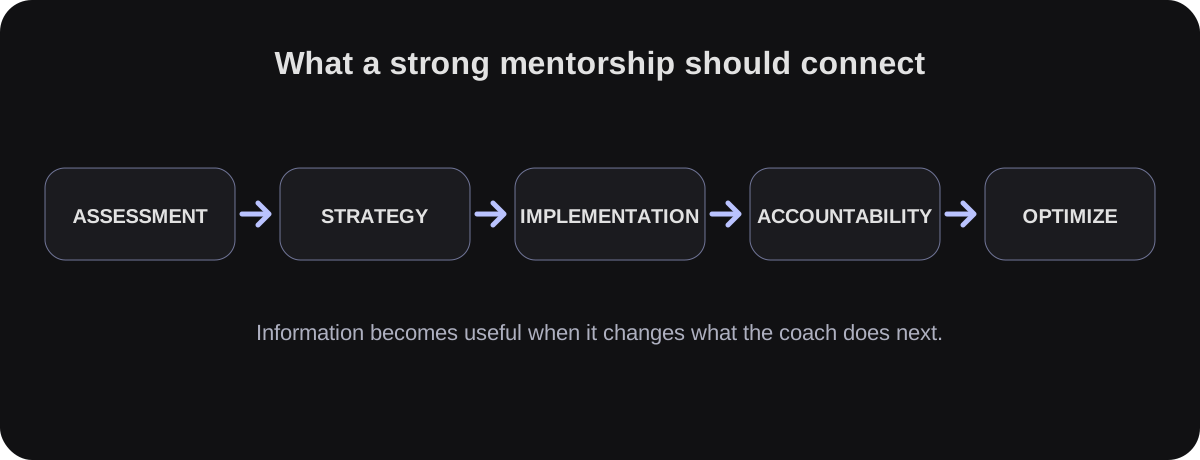
A practical mentorship rhythm can be summarized as: assess, prioritize, implement, measure, and optimize.
The first stage makes the business visible. The second chooses the current constraint. The third turns the recommendation into real work. The fourth checks what changed. The fifth decides whether to keep improving the same stage or move to the next bottleneck.
That rhythm is simple on purpose. The value of mentorship is not how complicated the framework sounds. It is whether the coach can repeatedly make better decisions and build a business that works more predictably.
Final takeaway
Online fitness coach mentorship should provide more than information. It should give the coach a clearer way to diagnose the business, choose priorities, implement the right systems, stay accountable to the work, and optimize based on real performance.
The best fit is usually a coach who is actively building, has a meaningful growth goal, is willing to measure the business, and wants tailored feedback rather than another pile of tactics.
Before joining any mentorship, understand what is actually included, how the strategy is personalized, how implementation is supported, how progress is measured, and what will still be your responsibility. The right mentorship should make the business clearer, not more confusing.
Build a more predictable online fitness coaching business
Kinetic AI's Growth Partnership helps online fitness coaches identify what is holding growth back, build the strategy and systems around it, and review the numbers so the next priority is clear.
DM “DOUBLE” on Instagram →