Online Fitness Business Coach: What They Do and When You Need One
Learn what an online fitness business coach actually does, which business problems they should help solve, when coaching makes sense, and how to evaluate whether you need one.
 Written by Dylan StottFounder of Kinetic AI
An online fitness business coach helps a personal trainer or online fitness coach improve the business behind the coaching service. The job is not to teach better squat technique or write client programs. It is to help the coach build a clearer offer, attract the right prospects, convert more of that demand into clients, improve the client experience, and make the business easier to operate and measure.
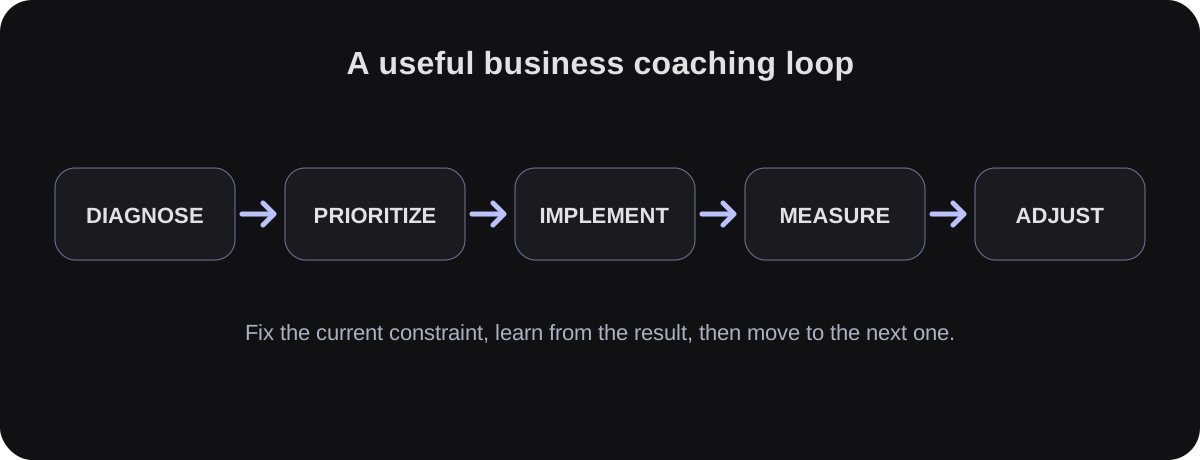
That sounds simple, but the useful part is not access to more tactics. Most online coaches already have more tactics than they can use. The value of good business coaching is diagnosis, prioritization, implementation, and feedback: finding the constraint that matters now, choosing the right change, helping the coach execute it, then reviewing the result before moving to the next problem.
A business coach is most useful when the business has enough activity to reveal a real problem but the owner is too close to the day-to-day work to see which problem should be fixed first. More advice is not always the answer. Better decisions usually are.
What is an online fitness business coach?
An online fitness business coach is a business advisor and implementation partner who understands the economics and operating realities of selling coaching online. They should understand how an offer, content, lead generation, direct messages, sales calls, onboarding, retention, capacity, and weekly metrics fit together as one system.
The word coach matters because the relationship should involve more than giving instructions. A strong business coach helps the owner think clearly, make decisions, implement the plan, review evidence, and build the ability to diagnose future problems without becoming permanently dependent on the coach.
That is different from hiring someone to simply complete a task. A video editor can edit videos. An ad buyer can manage campaigns. A setter can handle conversations. A business coach should help determine whether those are the right investments in the first place and whether the rest of the business is ready to benefit from them.
The real job: diagnose the bottleneck before adding another tactic
Online fitness businesses are chains. Positioning affects who pays attention. The offer affects whether that attention becomes interest. Lead generation creates opportunities. The conversion process moves qualified prospects toward calls. Sales turns attended calls into clients. Delivery and retention determine whether new revenue compounds or constantly replaces churn.
When one part of that chain is weak, improving another part can create more work without creating more profit. More leads sent into a weak sales process produce more lost opportunities. Better sales with poor retention creates a treadmill where the coach has to replace clients every month. More clients with an overloaded delivery model can reduce service quality and create burnout.
A useful business coach should therefore start with diagnosis, not a preset tactic. The first question is not, ‘What strategy should we use?’ It is, ‘Where is the business currently losing the most growth?’
- ✓Low relevant reach: positioning or distribution may be the constraint.
- ✓Reach but few inquiries: offer clarity, proof, profile conversion, or calls to action may be weak.
- ✓Inquiries but few qualified conversations: response, messaging, or qualification may need work.
- ✓Qualified leads but few bookings: the transition to the call may be the leak.
- ✓Booked calls but low attendance: qualification, call framing, convenience, or reminders may be weak.
- ✓Attended calls but few sales: offer-market fit, sales skill, or prospect fit may be the issue.
- ✓Sales but flat revenue: retention, pricing, capacity, or churn may be limiting growth.
Related reading
What should an online fitness business coach help with?
The exact work should depend on the coach's stage and bottleneck. A beginner with no clear offer needs different support from a coach already signing clients but struggling with inconsistent revenue or delivery capacity.
Good mentorship should be broad enough to see the whole business and specific enough to work on one priority at a time. The coach should not receive a giant list of improvements with no order of operations.
- ✓Offer and positioning: ideal client, problem, promise, package, pricing, proof, and differentiation.
- ✓Lead generation: content strategy, calls to action, referrals, reactivation, outreach, and appropriate paid acquisition.
- ✓Conversion: DM conversations, qualification, follow-up, booking, show-rate improvements, and pipeline management.
- ✓Sales: discovery, diagnosis, offer presentation, objection handling, follow-up, and decision quality.
- ✓Client experience: onboarding, communication expectations, progress visibility, retention, and referrals.
- ✓Operations: capacity, standardization, delegation, automation, and reducing owner-dependent work.
- ✓Measurement: weekly scorecards, revenue math, funnel conversion, retention, and identifying the next constraint.
Business coaching should connect strategy to implementation
Advice without implementation is easy to consume and easy to ignore. A useful coach should help translate the diagnosis into specific actions that can be completed, measured, and reviewed.
If the offer is weak, the work should result in a clearer offer, not merely a conversation about positioning. If lead follow-up is inconsistent, the work should produce a defined process, ownership, timing, and tracking. If close rate is weak, there should be call review, practice, and a better sales framework rather than a vague instruction to become more confident.
The point is to move the business from insight to operating system. The owner should leave each priority with a clearer process than they had before.
Online fitness business coach vs. course, consultant, agency, and mastermind
These options can all be useful, but they solve different problems. Choosing the wrong format creates frustration even when the provider is competent.
- ✓Course: best when the problem is mainly missing knowledge and the owner can diagnose and implement alone.
- ✓Consultant: best when the owner wants expert diagnosis and recommendations but needs less ongoing accountability.
- ✓Agency: best when a defined function should be executed for the business, such as ads, editing, or appointment setting.
- ✓Mastermind: best when peer learning, network, and broad strategic discussion are the main value.
- ✓Business coach or mentor: best when the owner needs diagnosis, prioritization, implementation feedback, accountability, and ongoing optimization across multiple parts of the business.
Seven signs an online fitness business coach may be useful
Business coaching becomes more valuable when the owner has a real business to diagnose and a meaningful gap between current performance and the next goal. The following signs do not automatically mean you should hire a coach, but they are strong reasons to consider outside help.
- ✓Revenue is inconsistent and you cannot explain why one month is strong and the next is weak.
- ✓You are doing many marketing activities but cannot identify which one creates qualified clients.
- ✓You know something is wrong in the funnel but do not know whether the issue is lead volume, qualification, show rate, closing, pricing, or retention.
- ✓You repeatedly change strategies before collecting enough data to know whether the previous one worked.
- ✓You are signing clients but delivery workload is growing almost one-for-one with revenue.
- ✓You have learned plenty from free content and courses but still struggle to turn knowledge into a consistent operating system.
- ✓You want to reach the next stage faster and can clearly afford the investment without putting the business under unhealthy financial pressure.
Related reading
When you probably do not need a business coach yet
Mentorship is not automatically the next step for every coach. Sometimes the problem is simple enough that paid guidance would add little value.
If you have no offer, no clients, no consistent effort, and no willingness to implement basic recommendations, the limiting factor may be execution rather than strategy. A good course, a few focused resources, and several weeks of disciplined action may be enough to create the first useful data.
You also should not hire a coach to avoid making decisions. Mentorship should improve your judgment, not outsource responsibility for the business.
- ✓You have not consistently tried the basic strategy you already understand.
- ✓The investment would create financial stress or require revenue promises to justify it.
- ✓You mainly want motivation rather than business guidance.
- ✓You expect the mentor to generate results without your implementation.
- ✓You are unwilling to track the numbers needed to evaluate what is working.
What a good business coaching process should look like
The exact format can vary, but the operating logic should be simple: establish the baseline, identify the bottleneck, choose the highest-leverage change, implement it, measure the result, and repeat.
That cycle protects the business from random strategy changes. It also gives the coach and mentor a common language for progress. Instead of saying ‘content feels slow,’ they can inspect relevant reach, profile visits, inquiries, and qualified conversations. Instead of saying ‘sales are bad,’ they can inspect attendance, close rate, objections, and lead fit.
- ✓Baseline: understand revenue, clients, offer, lead sources, funnel numbers, retention, and capacity.
- ✓Diagnosis: locate the first material constraint in the growth chain.
- ✓Priority: define the one or two changes that matter most now.
- ✓Implementation: build the assets, scripts, systems, or habits required to make the change real.
- ✓Measurement: review the leading and lagging indicators connected to the change.
- ✓Optimization: keep what worked, adjust what did not, and move to the next bottleneck.
What an online fitness business coach should not promise
No legitimate mentor controls market demand, platform distribution, prospect behavior, the quality of every sales conversation, or how consistently the client implements the plan. Specific revenue guarantees should therefore be treated carefully.
A coach can improve the quality of decisions, the clarity of the strategy, the speed of implementation, the consistency of measurement, and the probability that obvious mistakes are corrected earlier. That is meaningful value without pretending business outcomes are guaranteed.
- ✓Guaranteed revenue regardless of starting point or execution
- ✓Guaranteed follower growth or viral content
- ✓A claim that one script or funnel works for every fitness business
- ✓A promise that paid ads, setters, or automation can fix an unclear offer
- ✓A claim that the mentor can remove all risk from entrepreneurship
Questions to ask before hiring an online fitness business coach
The goal of the buying process should be fit, not pressure. You should understand how the mentor thinks, what they actually help with, how implementation works, and what success will be measured against.
- ✓Who is this mentorship designed for, and who is it not for?
- ✓How do you diagnose the business before recommending tactics?
- ✓Is the strategy tailored or is everyone given the same sequence?
- ✓How much direct access and feedback is included?
- ✓What happens between calls when implementation gets stuck?
- ✓Which parts are coaching, which parts are templates, and which parts are done for me?
- ✓How do you measure progress before revenue fully reflects the change?
- ✓Can I see examples that resemble my stage, business model, and constraints?
- ✓What will still be my responsibility after I join?
- ✓What are the payment, cancellation, and continuation terms?
How should you measure whether business coaching is working?
Do not judge mentorship only by whether monthly revenue rises immediately. Some improvements affect leading indicators before cash results appear, while other changes may reveal that the business needs to simplify before it grows.
At the same time, do not accept endless activity as proof of progress. A business mentorship should eventually improve measurable business performance or materially improve the systems that produce it.
- ✓Clearer positioning and offer conversion
- ✓More qualified inquiries from the same or better-targeted marketing activity
- ✓Higher percentage of qualified leads reaching the correct next step
- ✓Better booking, show, or close performance where those were the constraint
- ✓Improved retention and fewer preventable cancellations
- ✓Lower owner workload per client or per sale where capacity was the constraint
- ✓More consistent weekly tracking and faster identification of problems
- ✓Revenue, profit, and cash collection over an appropriate measurement window
What the first 90 days can reasonably focus on
There is no universal 90-day business transformation, but a useful mentorship should create visible progress in the way the business is understood and operated even before every financial result has matured.
The first phase usually establishes the baseline and fixes the highest-leverage strategic issues. The middle phase implements the acquisition and conversion changes. Later reviews should use real performance data to optimize what is working and move into retention, capacity, or the next growth constraint when appropriate.
The exact order should follow the business, not a calendar. A coach with a broken offer should not rush into lead generation because week three arrived. A coach with strong demand and weak follow-up may need conversion work immediately.
The best business coach should make the business easier to understand
A good mentorship does not make the owner feel dependent on a secret system. It should make the business more legible.
You should know where leads come from, how they move through the funnel, which numbers matter, what your current constraint is, what you are changing, and how you will decide whether that change worked. As the business improves, the owner should become better at making these decisions without needing permission for every move.
That is one of the clearest differences between useful mentorship and information overload: the business becomes simpler to operate even as it becomes more capable.
Final takeaway
An online fitness business coach should help you build a better business, not simply give you more marketing ideas. The highest-value work is usually diagnosis, prioritization, implementation, measurement, and repeated optimization across the parts of the business that actually control growth.
You may benefit from a coach when the business is producing enough activity to reveal bottlenecks but you cannot confidently identify or fix the next one. You may not need one when the main issue is simply doing the basic work you already understand.
If you do invest in mentorship, look for a process that starts with your current numbers and constraints, gives you a clear order of operations, helps you implement the changes, and measures whether the business is becoming more predictable, profitable, and sustainable.
Build a more predictable online fitness coaching business
Kinetic AI's Growth Partnership helps online fitness coaches identify what is holding growth back, build the strategy and systems around it, and review the numbers so the next priority is clear.
DM “DOUBLE” on Instagram →