Fitness Business Coach vs. Marketing Agency vs. Online Course: Which Is Right for You?
Compare a fitness business coach, marketing agency, and online course across strategy, execution, customization, accountability, cost, control, and the business problems each option is best suited to solve.
 Written by Dylan StottFounder of Kinetic AI
A fitness business coach, marketing agency, and online course can all help an online fitness coach grow, but they solve different problems. Choosing the wrong type of support can leave you with more information, more activity, or more expenses without fixing the actual constraint in the business.
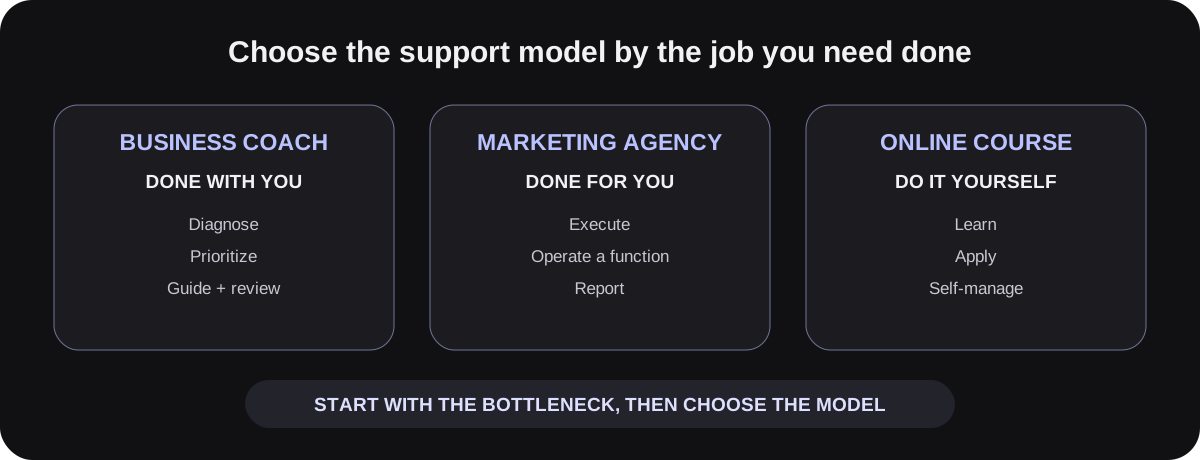
The simplest distinction is this: a business coach usually works with you to diagnose and improve the business, an agency usually does a defined type of work for you, and a course teaches you a process that you are responsible for applying yourself.
None of those models is automatically better. The right choice depends on what is broken, how clearly you understand the problem, how much execution capacity you have, how much control you want to keep, and whether your main need is strategy, implementation, or education.
The quick answer: coach, agency, or course?
Start with the job you need done. If you need help deciding what to fix, a business coach is usually the closest fit. If you already know what needs to be done but do not have the time or specialized skill to execute it, an agency may fit better. If the problem is mainly that you do not yet know how a process works and you are willing to implement it yourself, a course can be efficient.
This is not a strict rule. Some coaches provide implementation support, some agencies include strategic consulting, and some courses include community or coaching. Evaluate the actual service being delivered rather than relying on the label.
- ✓Business coach: strongest when diagnosis, prioritization, tailored strategy, feedback, and accountability are the main needs.
- ✓Marketing agency: strongest when the strategy is sufficiently clear and a specialized execution function needs to happen consistently.
- ✓Online course: strongest when education is the main gap and you have the time, discipline, and judgment to apply the material yourself.
Think in three operating models: done with you, done for you, and do it yourself
The cleanest way to compare the three options is by ownership of the work.
Business coaching is usually a done-with-you model. The coach helps diagnose the problem, design the plan, review implementation, and adjust based on results, but you still own the business and much of the execution.
An agency is usually a done-for-you model inside a defined scope. The agency may run paid ads, produce content, build funnels, manage email, or complete another specialized function while you focus elsewhere.
A course is usually a do-it-yourself model. The creator packages knowledge, templates, examples, or a process, and you are responsible for deciding how it applies, implementing it, and troubleshooting when reality does not match the lesson.
What a fitness business coach should actually help with
A strong fitness business coach should help connect the parts of the business rather than optimize one tactic in isolation. For an online fitness coach, that can include positioning, offer structure, pricing, lead generation, content, qualification, sales, onboarding, retention, capacity, and the metrics that connect them.
The highest-value work often happens before a tactic is chosen. If the business is stuck because the offer is unclear, hiring someone to produce more content may only send more attention toward an offer that still does not convert. If leads are plentiful but sales calls are weak, buying more leads may increase cost without increasing clients.
Good business coaching should make the order of operations clearer: diagnose the constraint, choose the change, implement it, measure what happened, and then decide what deserves attention next.
What a marketing agency should actually help with
A marketing agency should own a clearly defined execution outcome or process. The best agency relationship begins with a specific problem that the agency is equipped to solve, not a vague expectation that the agency will somehow make the entire business grow.
For example, an agency might manage paid acquisition, build landing pages, produce creative, run email campaigns, edit content, or operate a specific lead-generation channel. That specialization can be valuable when the business already has a strong offer and knows what it wants the agency to execute.
An agency becomes a poor fit when it is hired to compensate for a business problem outside its scope. More ads cannot make a weak offer desirable. More leads cannot fix a bad sales process. Better editing cannot solve unclear positioning. If the core strategy is unstable, outsourcing execution can scale the wrong thing.
What an online business course should actually help with
A course is most useful when the knowledge itself is valuable and you are capable of turning that knowledge into action. It can be an efficient way to learn a repeatable skill such as content planning, sales fundamentals, offer design, paid advertising, or basic business finance without paying for ongoing personalized support.
The limitation is that a course usually cannot see your business. It cannot reliably tell whether your version of the problem is caused by positioning, lead quality, execution, sales skill, retention, or something else unless personalized feedback is part of the product.
That means courses work best for people who can diagnose reasonably well, learn independently, test ideas, and resist the temptation to consume another module instead of implementing the current one.
Difference 1: diagnosis and strategy
Diagnosis is where business coaching should have the strongest advantage. A coach can look across the business, ask questions, challenge assumptions, and help identify the first constraint worth fixing.
An agency may provide useful strategy inside its specialty, but its natural expertise is usually tied to the service it sells. An ad agency will naturally view growth through paid acquisition. A content agency will naturally see content as a major lever. That perspective can be valuable, but it is narrower than full-business diagnosis.
A course provides a framework for diagnosis, but the student still has to apply the framework correctly. If you misdiagnose the problem, you can execute the course perfectly and still improve the wrong part of the business.
Difference 2: execution capacity
Execution is where agencies are often strongest. If you already know that a function needs to happen every week and the main constraint is time or specialized skill, paying a capable team to perform that function can create leverage.
Business coaching does not automatically remove work from your calendar. It may make the work more focused and may include templates, systems, software, or implementation help, but you should still expect to make decisions and take action.
A course requires the most self-directed execution. That can make it less expensive in direct cash cost, but the real cost becomes high if months of material are purchased and never implemented.
Difference 3: customization
A one-to-one business coach should provide the highest level of customization because the plan can change based on your market, offer, current numbers, resources, skills, and constraints.
An agency should customize execution to the account, but its service is usually standardized around a repeatable delivery model. That standardization is not a weakness. It is often what makes the agency efficient. The issue is whether the standardized service matches the problem you actually have.
A course is typically the least customized. Everyone may receive the same curriculum, templates, or process. That works when the subject is broadly transferable, but it leaves more interpretation to the buyer.
Difference 4: accountability and feedback
Accountability matters when the barrier is not knowing what to do but consistently doing it, reviewing the result, and making the next decision.
Business coaching should create a feedback loop. You implement, report what happened, review the numbers and obstacles, and adjust. That prevents a plan from remaining static after the business changes.
An agency provides a different type of accountability. The agency is accountable for its deliverables and agreed reporting process, while you remain accountable for the parts of the funnel it does not control. A course may provide little accountability unless it includes live calls, community, or assignments.
Difference 5: skill building and long-term independence
A useful business coach should make you better at running the business, not only better at following instructions. Over time, you should become stronger at diagnosing bottlenecks, reading the numbers, making tradeoffs, and deciding what deserves attention.
A course can also build strong skills because you are forced to learn and implement the process yourself. For disciplined operators, this can be one of its biggest advantages.
An agency can create leverage without requiring you to master the function being outsourced. That is valuable when the function is not a core skill you want to own, but it can create dependency if nobody inside the business understands what the agency is doing or how performance should be judged.
Difference 6: control and dependency
Every support model changes how much control stays with the owner.
With a coach, you usually keep direct control because the coach advises and supports while you make the final decisions. With a course, control is almost entirely yours because nobody else is executing. With an agency, some control moves outside the business because the agency owns part of the process.
That tradeoff is not inherently bad. Delegation is necessary as a business grows. The important question is whether you have enough visibility to understand performance, retain access to your accounts and data, and replace the provider without losing the operating knowledge of the business.
Difference 7: total cost, not just the price tag
The cheapest option is not always the lowest-cost option, and the most expensive option is not automatically the highest-value option.
A course may have the smallest direct fee but require substantial owner time. A coach may cost more directly but reduce wasted time by improving prioritization and implementation. An agency may have the highest recurring cash cost but free up meaningful operating capacity if the outsourced function is valuable and well defined.
Compare total cost using money, implementation time, management time, tools, opportunity cost, and the risk of solving the wrong problem. Then compare that total with the realistic value of the constraint being removed.
Related reading
Choose based on the bottleneck, not the support model you find most appealing
It is easy to choose support based on what sounds easiest. A done-for-you agency can sound attractive because someone else will handle the work. A course can sound safe because it is cheaper. Coaching can sound attractive because the plan is personalized.
The better decision starts with the bottleneck. What specifically is stopping the next stage of growth, and which support model has the highest chance of improving that constraint?
- ✓Unclear niche, positioning, offer, priorities, or overall growth strategy: business coaching is usually the closest fit.
- ✓Clear strategy but insufficient time or specialized execution skill in one channel: an agency may be the better fit.
- ✓A defined skill gap with plenty of time and strong self-direction: a course may be the most efficient fit.
- ✓Several connected problems across offer, acquisition, sales, and operations: diagnose the business before outsourcing one tactic.
- ✓A working system that has become too time-consuming for the owner: delegation or an agency may create more leverage than additional strategy.
When hiring a marketing agency too early creates problems
An agency can magnify a working system. It can also magnify a broken one.
Suppose an online fitness coach hires an ad agency while the offer is broad, the sales call is inconsistent, and the coach does not track show rate or close rate. The agency may successfully generate leads, yet the business still loses money because the downstream system is not ready to convert them.
The problem is not necessarily the agency. The business bought traffic before understanding the economics and conversion process behind that traffic.
Before outsourcing acquisition, the coach should know who the offer is for, why people buy it, what a qualified lead looks like, what happens after the lead arrives, and how the results will be measured.
When buying another course creates problems
Courses are easy to buy because they reduce uncertainty for a moment. You feel like you have taken action because a new framework, template, or system is now available.
But if your real problem is implementation, prioritization, or feedback, more information can increase confusion. You end up combining advice from several creators, changing strategies before any one strategy has enough time to work, and blaming yourself when the growing library does not produce a clear plan.
Before buying another course, ask whether you genuinely lack knowledge or whether you already know enough to act and need help choosing, implementing, or reviewing the right action.
When business coaching is not the right answer
Business coaching can also be a poor fit. A coach cannot implement on your behalf if you consistently avoid the work, and a broad strategic relationship may be unnecessary when the problem is already obvious and highly specialized.
If your tracking shows that the business is healthy except for one specific execution function, hiring a specialist may be more efficient than paying someone to repeatedly diagnose a problem you already understand.
Coaching is also a weak investment when the provider cannot explain how the work will connect to your actual business, relies mainly on motivation, or pushes the same playbook regardless of your market, offer, stage, and constraints.
A practical online fitness coaching example
Consider three online fitness coaches who all want to add clients. Their goal is similar, but the right support could be completely different.
Coach A has inconsistent revenue, changes offers often, does not know the close rate, and is unsure whether lead volume or conversion is the real problem. Business coaching is likely more useful because diagnosis and prioritization come first.
Coach B has a clear niche, proven offer, reliable sales process, strong unit economics, and knows paid acquisition is the next lever, but does not want to become an advertising specialist. A qualified agency may be a strong fit.
Coach C is early, has a small budget, understands the immediate skill gap, and has several hours each week to learn and implement. A focused course may provide enough support without adding a larger recurring expense.
The lesson is that revenue goals do not determine the support model by themselves. The current constraint and the owner's operating capacity matter more.
Can you combine coaching, an agency, and courses?
Yes. In a more mature business, the three models can complement each other rather than compete.
A business coach or mentor can help identify priorities and evaluate performance. An agency can execute a specialized function that no longer deserves the owner's time. Courses can train the owner or team on skills they want to keep internally.
The risk is stacking support before roles are clear. If the coach recommends one direction, the agency follows another strategy, and a course introduces a third framework, the owner becomes the integration problem. Every provider should have a defined job, owner, metric, and boundary.
Questions to ask before hiring a business coach
Do not evaluate a coach only by revenue screenshots, follower count, or how persuasive the sales call feels. Evaluate the process you will actually receive.
- ✓How do you diagnose which part of the business should be fixed first?
- ✓How customized is the strategy to my market, offer, numbers, and constraints?
- ✓What happens between calls when I am implementing the plan?
- ✓How will we track whether the changes are working?
- ✓Which parts of the business are inside and outside your expertise?
- ✓What would make you tell me not to use a tactic or service you offer?
Questions to ask before hiring a marketing agency
The agency should be able to define its responsibility precisely enough that you can judge performance without confusing its work with the rest of the funnel.
- ✓What exact function or outcome are you responsible for?
- ✓What must already be true about my offer, sales process, tracking, and capacity for your service to work well?
- ✓Which accounts, assets, data, and creative will I own?
- ✓What metrics will you report, and which downstream metrics should I track myself?
- ✓What work will still be required from me or my team each week?
- ✓How do we determine whether poor performance comes from traffic, creative, offer, sales, or another stage?
Questions to ask before buying an online course
A course should solve a defined learning problem. If you cannot name what you expect to know or be able to do after completing it, the purchase is probably too vague.
- ✓What specific skill or system am I buying this to learn?
- ✓Do I already own another resource that teaches the same thing?
- ✓Do I have time scheduled to implement the material?
- ✓Does the course include examples relevant to my stage and business model?
- ✓Will I receive feedback if my implementation does not work?
- ✓What will I stop doing so I can actually apply this process?
A five-step decision framework
You can make the decision without turning it into a complicated procurement process. Use five questions in order.
- ✓1. Name the bottleneck: what measurable part of the business is currently limiting growth?
- ✓2. Define the missing resource: do you need diagnosis, education, execution capacity, specialized skill, or accountability?
- ✓3. Choose the ownership model: should the work be done with you, for you, or by you?
- ✓4. Calculate total cost: include money, owner time, management time, tools, and implementation burden.
- ✓5. Define success before buying: choose the leading and lagging indicators that would show the investment is helping.
Do not outsource a problem you have not defined
The biggest mistake across all three options is purchasing support before the business problem is clear.
If you cannot explain whether you need more qualified leads, stronger conversion, better retention, more capacity, clearer positioning, or a better offer, every provider can appear to have the answer. That makes comparison almost impossible because you are comparing promises rather than solutions to a defined constraint.
A simple weekly view of leads, qualified conversations, booked calls, attended calls, sales, active clients, cancellations, revenue, and capacity can make the decision much easier. Once the bottleneck is visible, the type of outside help you need becomes more obvious.
Final takeaway
A fitness business coach, marketing agency, and online course are not substitutes for one another. They are different ways of adding capability to the business.
Choose a business coach when the largest need is diagnosis, tailored strategy, feedback, prioritization, and accountability. Choose an agency when the strategy is sufficiently clear and the business needs specialized execution capacity. Choose a course when the main gap is knowledge and you have the time and ability to implement independently.
Start with the bottleneck, decide what type of help would actually remove it, and then evaluate providers inside that category. The best support model is the one that improves the right part of the business without creating more complexity than the problem requires.
Build a more predictable online fitness coaching business
Kinetic AI's Growth Partnership helps online fitness coaches identify what is holding growth back, build the strategy and systems around it, and review the numbers so the next priority is clear.
DM “DOUBLE” on Instagram →