AI Lead Qualification vs. Lead Scoring: What's the Difference?
Learn the difference between AI lead qualification and lead scoring, when to use each, how they work together, and how to avoid confusing priority with true sales fit.
 Written by Dylan StottFounder of Kinetic AI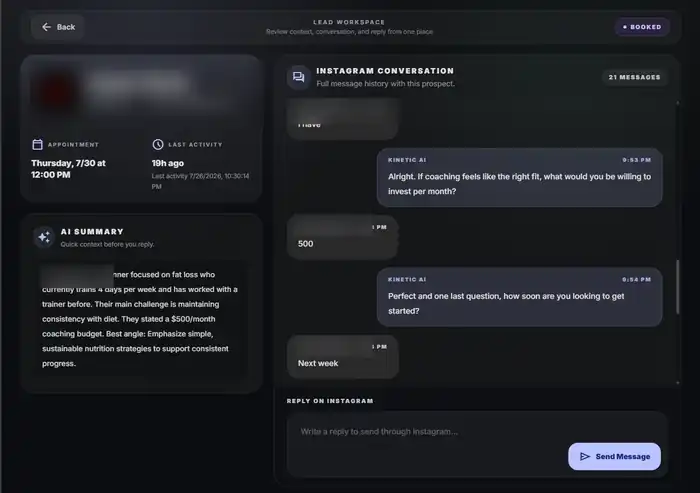
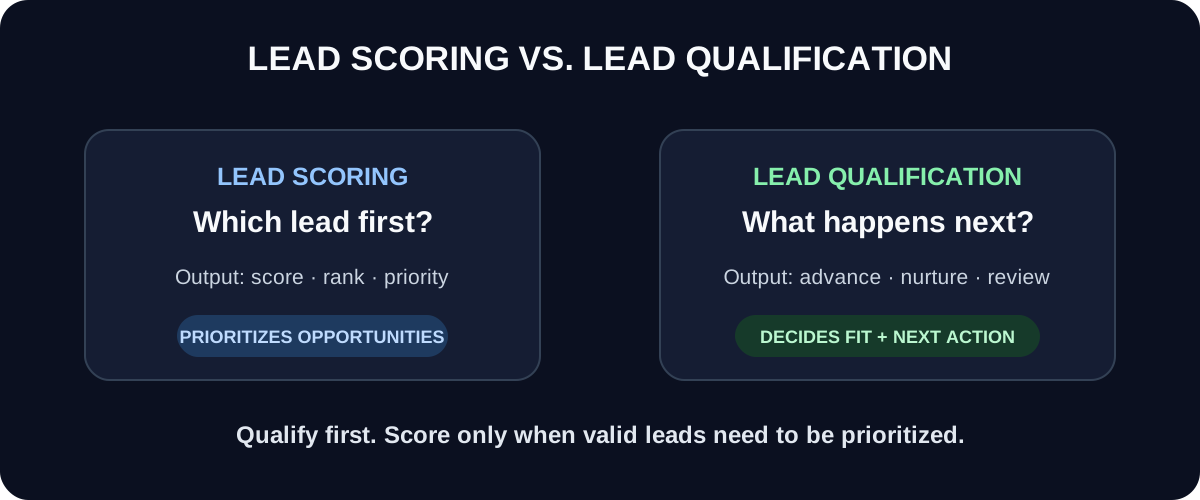
AI lead qualification and lead scoring are related, but they answer different questions. Lead scoring helps a business rank or prioritize leads. Lead qualification helps decide whether a lead is a fit and what should happen next.
That difference matters because a high-scoring lead is not automatically qualified, and a qualified lead does not always need the highest score in the database. One system is mainly about priority. The other is mainly about decision and routing.
Businesses often blur the two together because both can use the same lead data and both can be supported by AI. A cleaner sales process gives each system a specific job, then connects them only where the combination creates a better next action.
The simple difference: lead scoring ranks, lead qualification decides
The easiest way to separate the two concepts is to look at the output each system creates.
Lead scoring usually produces a number, tier, label, probability, or priority level. Qualification usually produces a decision such as advance, ask another question, nurture, route to a human, redirect, or close.
A score can influence that decision, but the score itself is not the decision. That is the core distinction to keep in mind throughout the rest of the sales system.
- ✓Lead scoring question: Which leads deserve attention first?
- ✓Lead qualification question: Which leads fit, and what should happen next?
- ✓Lead scoring output: score, rank, tier, probability, or priority
- ✓Lead qualification output: advance, continue qualifying, nurture, review, redirect, or close
What is lead scoring?
Lead scoring is a method for assigning value to leads based on signals that suggest fit, interest, intent, or likelihood to progress. The score can be simple, such as points for specific attributes and behaviors, or more advanced, such as a predictive model that estimates the chance of conversion.
A business might give more weight to a lead who matches the target customer profile, visits a pricing page, requests a demo, replies to an email, or returns to the website several times. The exact signals depend on the sales process and what the business can measure reliably.
The main purpose is prioritization. If a salesperson has fifty open leads and only enough time to contact ten immediately, a useful score can help decide where to start.
What is AI lead qualification?
AI lead qualification uses artificial intelligence to interpret lead information, compare it with business-defined criteria, identify missing context, and determine the appropriate next action.
The AI may read form answers, emails, chat messages, direct messages, CRM fields, or other lead context. Instead of simply calculating a priority value, the qualification system tries to answer whether the opportunity makes sense for the business and whether enough information exists to move forward.
A qualified lead may be routed to a sales call, estimate, demo, checkout, consultation, or another next step. A lead that is not ready may enter nurture. An unclear lead may need another question or human review.
Why businesses confuse scoring and qualification
Both systems often look at similar information. Company size, location, budget, engagement, source, timing, message content, and prior behavior can all influence either a score or a qualification decision.
The confusion usually appears when the business turns one score threshold into a universal definition of a qualified lead. For example, every lead above 70 points might automatically be labeled qualified even though the score combines website activity with only a small amount of actual fit information.
That shortcut can work in a tightly controlled model, but it can also hide a weak assumption: that priority and fit are the same thing. They are not always the same.
A high lead score does not automatically mean qualified
Imagine a prospect has opened several emails, downloaded two resources, visited the pricing page, and returned to the website multiple times. That lead may deserve a high engagement score.
But suppose the prospect is outside the service area, needs a service the company does not provide, or cannot meet a required eligibility condition. The lead can be highly engaged and still be a poor fit.
Scoring tells the team that the prospect is showing strong signals. Qualification checks whether those signals belong to an opportunity the business can actually serve.
A qualified lead does not always need a high score
The opposite situation happens too. A prospect may submit one detailed inquiry that clearly describes the exact problem the business solves, confirms the required location or company profile, gives a realistic timeline, and asks for the correct next step.
That person may have almost no prior engagement history. A behavior-heavy lead-scoring model could assign a lower score than it gives to someone who has consumed more content for months.
Qualification can recognize that the new inquiry already contains enough evidence to advance, even if the lead has not accumulated many historical points.
Lead scoring is strongest when the problem is prioritization
Scoring becomes valuable when the business has more leads or accounts than the sales team can work equally at the same time. It creates an ordering system.
That can be especially useful in longer sales cycles, larger databases, outbound programs, nurture systems, and B2B environments where many leads remain open for weeks or months.
A score can help surface which existing opportunities are becoming more active without forcing the sales team to inspect every record manually.
- ✓Prioritizing a large list of open leads
- ✓Identifying accounts showing increased engagement
- ✓Ranking prospects for outbound follow-up
- ✓Finding re-engaged leads inside a nurture database
- ✓Helping salespeople decide where to spend limited manual time first
Lead qualification is strongest when the problem is routing
Qualification becomes more important when the business needs to decide what should happen to each inquiry rather than simply which one should be contacted first.
A local service company may need to confirm service area and project type. A consultant may need to understand the business problem and decision timeline. A fitness coach may need to know whether the person is genuinely looking for coaching before offering a consultation.
Those are routing decisions. They determine the correct next step, not just the order in which a salesperson opens the records.
- ✓Send a qualified lead to booking
- ✓Ask for one missing piece of information
- ✓Move a future-fit lead into nurture
- ✓Route a complex opportunity to a human
- ✓Redirect or close a clearly poor-fit inquiry
- ✓Separate sales inquiries from support or existing-customer messages
Fit signals and intent signals are not the same
One useful way to design both systems is to separate fit from intent.
Fit describes whether the lead matches the type of customer or opportunity the business can serve. Intent describes whether the lead appears interested or ready to act. Both matter, but they answer different questions.
A scoring system may combine fit and intent into one number. A qualification system usually needs to preserve enough detail to know which condition is missing before choosing the next action.
- ✓Fit signals: service area, use case, customer type, company profile, eligibility, project type, relevant need
- ✓Intent signals: direct inquiry, demo request, pricing interest, repeated engagement, reply behavior, stated urgency, buying timeline
Behavioral lead scoring
Behavioral scoring assigns value to actions a lead takes. Examples can include visiting high-intent pages, replying to outreach, attending a webinar, downloading a resource, starting a trial, or returning to the site.
This can help reveal rising interest, but behavior needs context. A competitor, student, vendor, job applicant, existing customer, or researcher may generate a large amount of activity without becoming a valid sales opportunity.
Behavior is evidence of attention. Qualification determines whether that attention belongs inside the sales path you are trying to optimize.
Fit-based lead scoring
Fit scoring gives value to attributes that resemble the business's preferred customer. In B2B, that could include industry, company size, role, geography, or technology used. In local services, it could include service area and project category.
Fit scoring gets closer to qualification because it evaluates suitability, but it still usually produces a rank or numerical estimate. A high fit score may say the account looks attractive without confirming that the prospect has a current need or wants to take action.
That is why fit scoring can support qualification but does not necessarily replace it.
Predictive and AI lead scoring
AI can also be used inside lead scoring. Instead of manually assigning fixed points to each signal, a model may estimate conversion probability based on patterns in historical data or interpret unstructured information before calculating priority.
That can make a score more flexible, but it does not change the basic purpose of scoring. The output is still primarily a prediction or prioritization signal.
Businesses should understand what the model is predicting and what data it was trained or calibrated on. A probability of conversion, response, meeting attendance, or revenue are different targets and should not be treated as interchangeable.
AI qualification uses interpretation to make a next-step decision
AI qualification often adds the most value when the important information is hidden inside normal language rather than clean database fields.
A prospect might write, 'We need this installed before our second location opens in six weeks.' An AI system can interpret that statement as timing context. A prospect might explain a problem in several sentences without using the exact language in the company's qualification checklist. AI can help map that response to the relevant criterion.
The important design rule is that the business still defines the allowed outcomes and the facts the AI is permitted to rely on. Interpretation should support a clear process, not replace the process with an unexplained model decision.
Scoring can be continuous while qualification is often state-based
A useful score can change frequently. A lead may move from 42 to 61 after visiting a product page, then to 75 after requesting pricing, then fall in priority after a long period of inactivity.
Qualification is often represented as a state or outcome: unqualified, needs more information, qualified, nurture, human review, or disqualified. The state can change too, but the purpose is to make the workflow clear.
This is another reason the systems work well together. The score can keep changing as new signals arrive, while the qualification status tells the team what action is currently appropriate.
How AI lead qualification and lead scoring can work together
The cleanest combined model is to let qualification control eligibility and routing, then use scoring to prioritize leads within the appropriate group.
For example, qualification can first determine that twelve leads are valid opportunities for the sales team. Scoring can then help rank those twelve based on urgency, engagement, potential value, or another approved priority signal.
That order prevents a highly active but clearly poor-fit lead from jumping ahead simply because the person generated more tracked behavior.
- ✓Step 1: determine whether the lead belongs in the sales path
- ✓Step 2: determine the correct next action
- ✓Step 3: when several valid leads need the same action, use scoring to help prioritize them
- ✓Step 4: update both the qualification state and score as new evidence appears
You do not always need both systems
A common mistake is building a complicated scoring model because lead-scoring software is available, even when the business only receives a manageable number of inquiries.
If every relevant inbound lead can be reviewed or answered quickly, a clear qualification workflow may be enough. The business may gain very little from ranking six qualified leads from 1 to 100 when all six can be handled promptly.
Scoring becomes more valuable as prioritization becomes a real constraint. Qualification becomes valuable as soon as different leads need different next steps.
When lead scoring is probably unnecessary
Scoring may add complexity without much value when lead volume is low, sales cycles are short, the next action is obvious, or the business can respond to every valid inquiry quickly.
In those cases, a simple status system can be easier to understand and maintain. New inquiry, needs qualification, qualified, booked, nurture, won, and lost may provide more operational clarity than an extra numerical field.
Do not confuse having more data with having a better sales process.
When qualification alone is not enough
Qualification can tell the business which opportunities are valid, but it may not tell a busy sales team where to start when hundreds of valid leads are open at once.
That is where a well-designed score can add another layer. The score might reflect recency, engagement, urgency, potential account value, or likelihood of progressing, depending on the actual sales objective.
The key is to keep the score's purpose narrow enough that the team knows what a higher number means.
Example: a B2B service business
Imagine an agency works with established ecommerce brands. One lead fits the target company profile, has a clear growth problem, is actively searching for help, and wants to make a decision this month. Another lead is also a valid fit but says the project may not start for six months.
Qualification can mark both as legitimate opportunities while routing the first toward a sales conversation and the second toward an appropriate future follow-up path.
If several qualified near-term opportunities exist, scoring can help rank them based on factors such as timing, engagement, or expected account value. The score improves prioritization after qualification has already protected the pipeline from obvious mismatches.
Example: a local service business
Suppose a contractor receives twenty inquiries in one day. Ten are outside the service area, three ask for work the company does not perform, and seven describe projects the company can potentially handle.
Qualification should remove or redirect the thirteen inquiries that do not belong in the active sales queue. If the company can contact all seven valid leads quickly, a score may add little value.
If the team can only handle a few estimates immediately, a score could then help prioritize the seven qualified opportunities based on urgency, project type, scheduling window, or another useful business rule.
Example: an online fitness coaching business
An online fitness coach may receive several Instagram DMs from people at different stages. One person wants coaching now and describes a goal the coach serves. Another person asks a general workout question. A third person appears interested but is not ready to make a change yet.
Qualification determines which conversation belongs on the path toward a consultation, which should receive a useful answer without a sales push, and which may need later follow-up.
A numerical score is often unnecessary at this volume if the coach or system can handle every relevant conversation. The next-action decision creates more value than ranking a small number of DMs against each other.
Related reading
Do not let one score hide why the lead matters
A single number is convenient, but it can hide important differences between leads. Two people can both score 80 for completely different reasons.
One may be an excellent customer fit with moderate engagement. The other may be a weak fit with unusually high activity. If the salesperson sees only the number, the model has compressed away context that may matter to the decision.
Keep the underlying signals accessible. Salespeople should be able to see the important fit, intent, and timing information behind the priority level.
Avoid arbitrary scoring weights
Point systems are easy to create and easy to over-engineer. A business might assign ten points for opening an email, twenty for visiting pricing, thirty for a certain job title, and fifty for requesting a call without evidence that those weights reflect actual outcomes.
Start with simple rules tied to observable business logic. If historical data is available, review whether higher-scoring leads actually produce better downstream outcomes. If they do not, the score may be measuring activity rather than sales value.
A complicated formula is not automatically more accurate than a small set of well-chosen signals.
Avoid using AI scoring as an unexplained black box
Predictive models can be useful, but the sales team still needs to understand what the output is for and how it should affect action.
If a model says a lead has an 82 percent probability, ask: probability of what? Replying, booking, showing up, buying, renewing, or producing a certain amount of revenue are different outcomes.
Also define what happens when the model is uncertain or when business rules conflict with the prediction. Hard eligibility or service rules should not be silently overridden by a high predictive score.
Keep hard disqualifiers separate from soft priority signals
Some criteria are hard rules. If a business cannot serve a location, does not offer a requested service, or has a real eligibility requirement, no amount of engagement should erase that constraint.
Other signals are soft. Repeated website visits, rapid replies, or a near-term timeline may increase priority without determining eligibility by themselves.
Separating hard qualification rules from soft scoring signals makes the automation easier to explain and reduces accidental routing errors.
Measure scoring and qualification differently
Because the systems have different jobs, they should not be judged by the same metric.
A lead score should be evaluated by whether higher-scoring leads actually perform better on the outcome the score is meant to predict or prioritize. A qualification system should be evaluated by whether it sends the right leads to the right next step and improves downstream sales quality.
- ✓Scoring metrics: conversion by score band, response by score band, revenue by score band, lift from prioritizing higher-score leads
- ✓Qualification metrics: qualification completion rate, qualified-to-next-step rate, human-review rate, false positives, false negatives, downstream close quality
- ✓Combined metric: whether prioritized qualified leads produce better sales outcomes than the previous process
A practical decision framework
Choose the system based on the bottleneck you are trying to solve.
If the business does not know which inquiries are legitimate opportunities or what should happen after each one, improve qualification first. If the business already has many legitimate opportunities but cannot decide where limited sales attention should go, add scoring.
If both problems exist, qualify first and score second. That creates a cleaner hierarchy between eligibility, next action, and priority.
- ✓Need different next steps? Use qualification.
- ✓Need to rank many valid leads? Use scoring.
- ✓Need to interpret free-text lead context? AI can support qualification or scoring.
- ✓Need strict eligibility checks? Use deterministic rules where possible.
- ✓Need both routing and prioritization? Qualify first, then score within the valid group.
How to design the combined workflow
A combined system does not need to be complicated. Start with the minimum information required to know whether the lead belongs in the sales process. Then decide whether prioritization is actually necessary among the leads that remain.
Document the score and qualification state separately in the CRM. The salesperson should be able to see both without guessing whether an 85 automatically means qualified.
Finally, connect each qualification state to an explicit action. A score is useful only when it changes priority. A qualification state is useful only when it changes the workflow.
- ✓Define qualification criteria and hard disqualifiers
- ✓Define the small set of allowed qualification states
- ✓Define what the score is intended to prioritize or predict
- ✓Choose the signals that belong in the score
- ✓Keep source evidence available for human review
- ✓Set routing rules for each qualification state
- ✓Set priority rules for leads sharing the same next action
- ✓Review downstream outcomes and adjust the system over time
Where Kinetic AI fits
Kinetic AI is built around qualification and next-step movement for inbound Instagram leads from personal trainers and online fitness coaches. Its core workflow is not a generic points-based lead-scoring system.
The system interprets the Instagram conversation, gathers fitness-specific qualification context, keeps the lead record and AI summary connected, and can send the coach's booking link when the conversation reaches the appropriate point. That is a qualification-oriented workflow because the goal is to determine what should happen next with each lead.
For a coach handling a manageable number of inbound conversations, that next-action clarity can matter more than assigning every prospect a numerical score. If a business later reaches a volume where many qualified opportunities compete for limited sales attention, a separate prioritization layer may become useful.
Related reading
Common mistakes when combining the two
The most common problems come from treating the score as a universal truth instead of one input inside a broader sales system.
- ✓Calling every lead above a score threshold qualified without checking fit
- ✓Letting high engagement override hard eligibility or service constraints
- ✓Building a scoring model before the business has enough lead volume to need prioritization
- ✓Using dozens of arbitrary point values that nobody can explain
- ✓Hiding the signals behind a single number
- ✓Failing to define what the AI score is actually predicting
- ✓Using the same metric to judge both scoring and qualification
- ✓Creating qualification states that do not trigger a clear next action
- ✓Adding AI where a simple validation rule would be more reliable
Final takeaway
Lead scoring and AI lead qualification can strengthen the same sales process, but they should not be treated as interchangeable.
Lead scoring answers which valid opportunities should receive attention first. AI lead qualification answers whether the lead fits, what information is missing, and what should happen next. A score can support that decision, but it should not automatically replace it.
For most businesses, the cleanest order is simple: qualify the opportunity, choose the next action, then use scoring only if there are enough valid leads that prioritization has become a real problem.
Build a more predictable online fitness coaching business
Kinetic AI's Growth Partnership helps online fitness coaches identify what is holding growth back, build the strategy and systems around it, and review the numbers so the next priority is clear.
DM “DOUBLE” on Instagram →