Online Fitness Coaching Client Retention: How to Reduce Churn and Keep Clients Longer
Learn how online fitness coaches can improve client retention by setting expectations, creating visible progress, strengthening check-ins, catching disengagement early, and building a clear renewal process.
 Written by Dylan StottFounder of Kinetic AI
Signing more clients does not automatically create a stronger online fitness coaching business. If clients leave almost as quickly as new ones arrive, revenue becomes harder to predict and the coach stays trapped on an acquisition treadmill.
Client retention improves when the coaching experience keeps proving its value after the excitement of signing up wears off. That means clients understand what they are working toward, can see progress, receive useful feedback, know what to do when life gets messy, and feel that the coaching is still being adapted to them.
The goal is not to keep every client forever. Some clients reach their goal, change priorities, or should move on. The goal is to reduce preventable churn and build a service that gives good-fit clients a clear reason to continue.
What is client retention in online fitness coaching?
Client retention is the ability to keep appropriate coaching clients active long enough for the relationship to create meaningful value for both sides. Churn is the opposite: clients ending the relationship, whether because they cancel, do not renew, or quietly disengage before leaving.
Retention should not be treated as a trick for extending contracts. A client stays when the service continues to feel useful. The strongest retention systems improve the actual coaching experience rather than simply making cancellation more difficult.
The retention system starts before the client signs
Poor-fit clients are difficult to retain because the problem begins before delivery. If the sales conversation creates unrealistic expectations, the client may enter coaching expecting faster results, more access, a different communication style, or a level of service the program was never designed to provide.
Retention therefore starts with accurate positioning, qualification, and a clear sales process. The client should know what outcome the program is designed to support, what the coach will provide, what the client is responsible for, and what progress is likely to require from them.
A simple client-retention framework
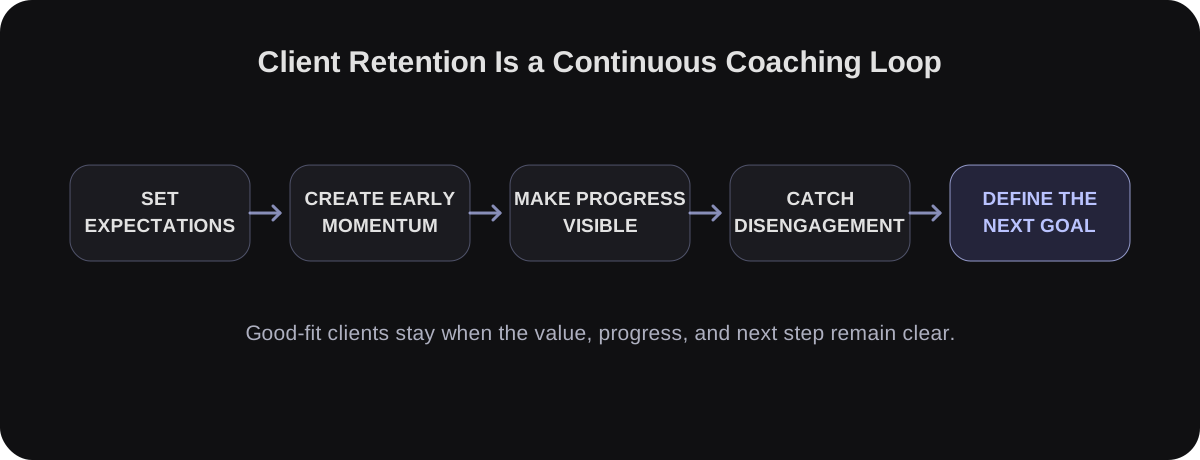
A useful retention system can be thought of as five connected stages: set expectations, create early momentum, make progress visible, catch disengagement, and create the next goal before the current phase ends.
If one stage is missing, the client experience can start to feel vague. The program may still contain good workouts and nutrition guidance, but the client no longer feels a clear sense of direction or progress.
- ✓1. Set expectations clearly
- ✓2. Create early momentum
- ✓3. Make progress visible
- ✓4. Catch disengagement early
- ✓5. Build the next goal before renewal
1. Set clear expectations during onboarding
The first weeks should teach the client how coaching works, not just give them access to an app. Explain how often they should train, what to do if they miss a session, how check-ins work, when they can expect feedback, how to ask questions, and how progress will be evaluated.
Clients are more likely to become frustrated when they do not know what normal progress looks like or how the relationship should function. Clear expectations reduce that uncertainty.
- ✓What happens each week
- ✓How and when the coach responds
- ✓What the client should track
- ✓What to do when the plan cannot be followed perfectly
- ✓How program changes are made
- ✓How progress will be reviewed
2. Create an early win without chasing dramatic results
An early win does not have to mean a dramatic physical transformation. It can be completing the first full week, learning how to plan meals around work, improving exercise confidence, reducing decision fatigue, or finally following a realistic schedule.
The purpose is to help the client feel that the coaching is already making life more manageable. If the first month feels like setup, admin, and waiting, the client may question the value before the longer-term results have time to appear.
3. Make progress visible in more than one way
Clients can make progress while feeling stuck. Body weight may pause while strength improves. Measurements may move slowly while consistency becomes dramatically better. A client may feel healthier and more confident without noticing those changes because they are focused on one number.
Part of coaching is helping the client see the complete picture. Track the outcomes that matter to the goal, but also show the behaviors and capabilities that make the result more sustainable.
- ✓Body weight or measurements when relevant
- ✓Progress photos when appropriate and wanted
- ✓Strength and performance
- ✓Training consistency
- ✓Nutrition adherence or useful habits
- ✓Energy, confidence, routine, or other relevant client-reported changes
4. Make weekly check-ins specific enough to prove you are paying attention
A check-in can become a retention problem when it turns into the same generic response every week. The client submits information, receives a short motivational message, and gradually stops feeling that the coach is making decisions from the data.
Useful check-ins should show observation and judgment. Reference what changed, explain what matters, make the next adjustment, and tell the client what to focus on before the next review.
The client does not need a huge message. They need evidence that the coach noticed their week and knows what should happen next.
5. Do not punish imperfect weeks
Retention often breaks when coaching works only during perfect conditions. Real clients travel, get sick, have deadlines, lose motivation, attend social events, and miss workouts.
A strong service has a response for those weeks. Instead of treating disruption as failure, reduce the plan to the minimum useful actions, adjust expectations, and help the client regain momentum quickly.
Clients are more likely to trust the process when they see that coaching can adapt to real life rather than collapsing the first time the original plan becomes difficult to follow.
6. Watch for disengagement before the cancellation message
Clients often disengage gradually. A cancellation can feel sudden to the coach even though the warning signs were visible for several weeks.
Look for changes in behavior rather than waiting for the client to say they are thinking about leaving. A single missed check-in may mean nothing, but a pattern deserves attention.
- ✓Repeated missed or late check-ins
- ✓Shorter, lower-effort responses
- ✓Fewer completed workouts
- ✓Less logging or communication than usual
- ✓Repeatedly ignoring agreed priorities
- ✓More frustration without a change in the plan
- ✓A client who stops discussing future goals
What to do when a client starts disengaging
Do not immediately send more reminders or assume the client needs more motivation. Ask what changed.
The issue may be workload, finances, confidence, frustration with progress, an unrealistic plan, confusion, or a goal that no longer feels important. The correct response depends on the reason.
A short direct conversation is often more useful than continuing the normal check-in loop while engagement declines. Clarify the problem, decide what can reasonably change, and agree on one simple next step.
7. Keep the program evolving without changing it for entertainment
Clients want to feel that the service remains personal, but constant program changes can make progress harder to evaluate. The goal is not novelty for its own sake.
Adjust when the data, goal, schedule, performance, adherence, or client feedback gives you a reason. Explain why the change is being made. That helps the client understand that the program is being managed rather than randomly refreshed.
8. Create milestones before motivation disappears
Long-term goals can feel distant. Break the coaching period into smaller milestones so the client always knows what the current phase is trying to accomplish.
A fat-loss client might move from establishing consistency, to improving nutrition execution, to a focused loss phase, to maintenance. A strength client might move through technique, volume, progression, and performance goals.
Each milestone gives the coach a reason to review progress and gives the client a sense that the program is moving somewhere.
9. Start the renewal conversation before the final week
A renewal should not arrive as a surprise invoice after months of coaching. Before the current period ends, review where the client started, what changed, what still needs work, and what the next phase would be designed to accomplish.
If there is a valuable next goal, make it visible before the current goal is fully completed. If the client is ready to continue independently, say that. Retention is stronger when the next phase has a clear purpose rather than existing only because another payment is due.
10. Use cancellations as feedback instead of taking them personally
Some churn is normal. The useful question is whether the same preventable reason appears repeatedly.
When a client leaves, record the main reason in a simple category. Over time, patterns become easier to see. Several clients leaving because progress felt unclear suggests a different problem from several leaving because the service became too time-consuming or because the offer attracted poor-fit buyers.
- ✓Goal completed or no longer needs coaching
- ✓Financial change
- ✓Low engagement or adherence
- ✓Did not perceive enough value
- ✓Poor fit or wrong expectations
- ✓Life or schedule change
- ✓Service or communication issue
- ✓Other reason with a short note
What client-retention metrics should an online fitness coach track?
You do not need a complicated analytics system. Track enough to understand whether clients are staying, where they are dropping, and whether the service is becoming more stable over time.
- ✓Active clients at the start and end of each month
- ✓New clients added
- ✓Clients who canceled or did not renew
- ✓Average client length over time
- ✓Renewal rate for clients who reach the end of a term
- ✓Primary cancellation reasons
- ✓Check-in completion or another simple engagement signal
- ✓Referrals from current and former clients
Do not optimize retention by making the contract harder to leave
Long commitments and clear cancellation terms can be reasonable business decisions, but they should not be used to hide a weak client experience.
The best retention comes from continued value. A client understands the plan, feels supported, can see progress, knows what the next goal is, and trusts that the service will adapt when their situation changes.
If clients stay only because exiting is difficult, the retention number can look healthy while satisfaction, referrals, and reputation quietly deteriorate.
How client retention affects the rest of the coaching business
Retention changes more than monthly revenue. It changes how aggressively you need to acquire new clients, how much capacity you can plan for, how predictable cash flow feels, how much proof your marketing can collect, and how often current clients generate referrals.
This is why retention belongs beside lead generation and sales when you diagnose a growth bottleneck. More leads cannot fully solve a business that constantly has to replace preventable cancellations.
A practical monthly retention review
Once per month, review the client roster before looking for another new tactic. Identify who is progressing, who appears stuck, who has disengaged, who is approaching the end of a term, and who needs a new goal.
Then choose the few interventions that matter most. One client may need a simplified plan. Another may need a progress review. Another may need an honest conversation about whether the current goal still matters.
- ✓Who has become less engaged than last month?
- ✓Who cannot clearly see their progress?
- ✓Who has repeated the same problem without a useful adjustment?
- ✓Who is approaching a renewal or natural transition point?
- ✓Who needs the next milestone defined now?
- ✓What cancellation reason appeared most often recently?
How Kinetic AI's Growth Partnership approaches retention
Kinetic AI's Growth Partnership looks at retention as one part of the full online fitness coaching business rather than treating growth as a lead-generation problem alone. If clients are leaving too quickly, adding more conversations may only hide the underlying issue temporarily.
The goal is to identify where the client experience is breaking, track the relevant numbers, and improve the system around onboarding, expectations, delivery, check-ins, progress visibility, renewals, and the other bottlenecks affecting revenue.
Kinetic AI software remains a separate part of that system focused on repetitive Instagram lead qualification, follow-up, booking, reminders, and lead organization. Retention itself still depends on the quality of the coaching experience after the sale.
Final takeaway
Online fitness coaching client retention is not about convincing people to stay longer than they should. It is about making the value of good coaching visible throughout the relationship.
Set accurate expectations, create early momentum, show progress clearly, make check-ins specific, adapt when real life interferes, notice disengagement early, and define the next goal before the current phase ends. Those systems make retention easier because the client can understand why continuing still makes sense.
Build a more predictable online fitness coaching business
Kinetic AI's Growth Partnership helps online fitness coaches identify what is holding growth back, build the strategy and systems around it, and review the numbers so the next priority is clear.
DM “DOUBLE” on Instagram →