Online Fitness Coaching Business Metrics: What to Track Every Week
Learn which online fitness coaching business metrics to track every week, how to calculate the key conversion rates, and how to use a simple scorecard to find the next growth bottleneck.
 Written by Dylan StottFounder of Kinetic AI
An online fitness coaching business can feel busy while still being difficult to understand. You post content, answer DMs, book calls, coach clients, collect payments, and somehow still end the week unsure whether the business actually improved.
The solution is not a giant dashboard. It is a small weekly scorecard that shows where demand is being created, where prospects are dropping out, whether sales are converting, whether clients are staying, and whether revenue is moving in the right direction.
The goal of tracking is not to collect numbers for their own sake. The goal is to make the next business decision easier.
What should an online fitness coach track every week?
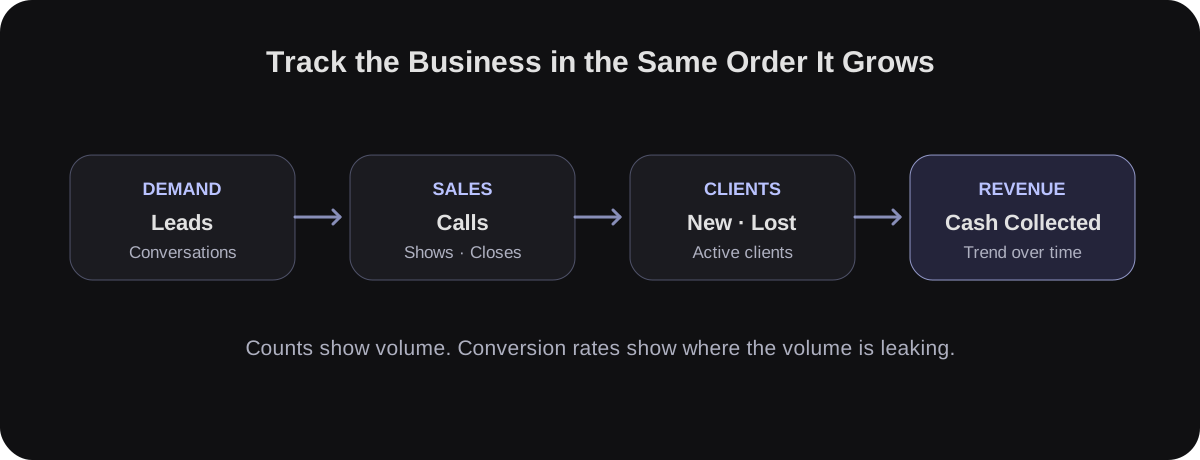
A useful weekly scorecard should follow the path money takes through the business. Start with demand, then track sales activity, client movement, and cash collected.
For most online fitness coaches, the core weekly numbers are leads, sales conversations, calls booked, calls attended, qualified calls, clients closed, new clients, clients lost, active clients, and cash collected.
You can add more metrics later, but these are enough to answer the most important question: where is the current bottleneck?
- ✓New leads
- ✓Sales conversations started
- ✓Calls booked
- ✓Calls attended
- ✓Qualified calls attended
- ✓New clients closed
- ✓New clients started
- ✓Clients canceled or did not renew
- ✓Total active clients
- ✓Cash collected
Track the funnel in order, not as separate numbers
A single metric rarely tells you what to fix. The numbers become useful when they are connected in sequence.
If leads are low, the business has a demand problem. If leads are healthy but few conversations become calls, the problem may be qualification, follow-up, positioning, or the booking transition. If calls are booked but people do not attend, the show-up process needs work. If qualified calls attend but few become clients, the sales conversation or offer may need attention. If acquisition is strong but active client count stays flat, retention is likely offsetting growth.
This is why your scorecard should mirror the customer journey rather than grouping numbers by whatever software happens to report them.
1. New leads
A lead is a person who has taken a meaningful step toward the coaching offer. Depending on your business, that might be someone who sends a relevant DM, submits an application, replies to outreach, opts into a lead magnet and starts a conversation, or otherwise signals real interest.
Do not count followers, views, likes, or random profile visits as leads. Those can support demand generation, but they are not the same as a person entering the sales process.
Track total new leads each week and the source of each lead. Source matters because ten leads from referrals can behave very differently from ten leads from cold outreach or a viral Reel.
2. Sales conversations started
For a DM-led coaching business, a sales conversation is usually the bridge between attention and a booked call. Tracking it separately from raw leads helps you see whether people are actually entering a meaningful conversation.
If you generate many leads but very few real conversations, inspect response speed, opening messages, lead quality, the relevance of your call to action, and whether your content is attracting the right person.
If your business uses applications instead of DMs, this metric can be replaced with completed applications or another equivalent sales-entry event.
3. Calls booked
Calls booked tells you how many prospects agreed to the next sales step. It is one of the clearest leading indicators of near-term client acquisition for a coaching business that sells through consultations.
The raw count matters, but the conversion from qualified conversations to booked calls matters more. A low booking rate can point to weak qualification, poor timing, unclear value in the call, excessive friction, or a booking invitation that arrives too early or too late.
4. Calls attended and show rate
Booked calls are not useful if the prospect never attends. Track calls attended separately from calls booked, then calculate show rate.
Show rate = calls attended divided by calls booked, multiplied by 100.
If show rate falls, do not immediately blame the prospect. Review how far in advance calls are scheduled, whether the prospect understood the purpose of the call, confirmation and reminder touchpoints, and whether weak-fit leads are being allowed onto the calendar.
5. Qualified calls attended
Not every attended call should be treated as an equal sales opportunity. Someone can attend and still be a poor fit for the service, unable to use the program, outside the target market, or not genuinely looking for coaching.
Separating qualified calls from total attended calls gives you a cleaner sales metric. It also tells you whether your upstream qualification system is doing its job.
If a large share of attended calls are poor fit, improving the sales script will not solve the real problem. The better fix is usually earlier in the funnel.
Related reading
6. Clients closed and close rate
Track how many new clients commit to the offer, then calculate close rate on qualified calls rather than every calendar booking.
Qualified close rate = new clients closed divided by qualified calls attended, multiplied by 100.
The purpose is not to chase someone else's benchmark. Your own trend is more useful because your lead sources, price, offer, qualification standard, proof, audience, and sales process are unique to the business.
When close rate changes, review recordings or notes from the calls and categorize why qualified prospects did not buy. Patterns such as unclear value, poor fit, affordability, timing, weak urgency, or confusing offer structure tell you much more than the percentage alone.
7. New clients, lost clients, and net client growth
A business can sign new clients every week and still fail to grow if clients are leaving at nearly the same rate.
Track new clients started and clients lost during the same period. Then calculate net client growth: new clients minus clients lost.
If you add four clients but lose three, the business did not really grow by four. It grew by one. That simple comparison prevents strong acquisition from hiding a retention problem.
8. Active clients
Active client count tells you the current size of the delivery business. It also matters for capacity planning.
A growing active-client count is useful only if service quality can be maintained. If coaching hours, check-ins, programming, support, or admin work rise faster than revenue, the business can become more stressful even while sales improve.
Track active clients alongside the amount of time required to serve them. You do not need a detailed time study every week, but you should know when client volume is approaching the point where delivery starts to break.
9. Cash collected
Revenue booked and cash collected are not always the same thing. Payment plans, failed payments, delayed invoices, and longer contracts can create a gap between what has been sold and what actually entered the bank account.
Track cash collected each week and review monthly revenue separately. Weekly cash gives you a practical operating signal. Monthly revenue gives you a better picture of the business over a more stable period.
If you offer payment plans, also keep track of expected future payments so you understand what is recurring and what came from one-time upfront collections.
10. Lead source
Lead source is not a vanity detail. It tells you where the clients who actually buy are coming from.
Tag leads by a few useful categories such as organic Instagram content, outbound outreach, referrals, paid ads, reactivation, partnerships, or another meaningful source. Then connect source to calls and closed clients.
A channel that creates a large number of weak leads can look better at the top of the funnel than a smaller channel that consistently produces qualified clients. Track source through the full funnel before deciding what to scale.
The weekly scorecard can stay very small
You do not need thirty KPIs. A useful first version can fit in one row per week.
- ✓Week ending
- ✓New leads
- ✓Sales conversations
- ✓Calls booked
- ✓Calls attended
- ✓Qualified calls
- ✓New clients
- ✓Clients lost
- ✓Active clients
- ✓Cash collected
Add conversion rates only where they help diagnose the funnel
Counts tell you volume. Conversion rates tell you where the volume is leaking. You need both, but only at meaningful transitions.
- ✓Conversation-to-booking rate = calls booked / relevant sales conversations
- ✓Show rate = calls attended / calls booked
- ✓Qualification rate = qualified calls / calls attended
- ✓Qualified close rate = new clients closed / qualified calls attended
- ✓Net client growth = new clients - clients lost
Do not let percentages hide low volume
A conversion rate can look excellent with very few opportunities. Closing two out of two qualified calls is a 100 percent close rate, but it does not mean the sales system is solved if the business only generated two opportunities all month.
Read the rate next to the count. Volume answers whether enough opportunities exist. Conversion answers whether those opportunities are moving efficiently.
What should be reviewed weekly versus monthly?
Weekly reviews are best for leading indicators and recent operating decisions. Monthly reviews are better for numbers that need a larger sample or reflect the financial health of the business over time.
Weekly: leads, conversations, calls, shows, qualified calls, closes, new clients, lost clients, active clients, cash collected, and major lead sources.
Monthly: total revenue, average revenue per client, retention and churn trends, acquisition cost when paid channels are involved, client lifetime value when you have enough historical data, profit, and delivery capacity.
Do not force every metric into a weekly cadence just because the spreadsheet is reviewed every Friday. Some numbers become misleading when the sample is too small.
How to use the scorecard to find the bottleneck
At the end of each week, do not ask, 'How do I improve everything?' Ask which stage most limits the next stage.
Start at the bottom of the funnel and work backward. If retention is poor, fixing acquisition alone can pour more clients into a leaky system. If retention is healthy but few clients are being closed, inspect sales. If sales converts well but the calendar is empty, inspect booking and lead generation.
One primary constraint gives the next week a clear priority. That is much more useful than making ten small changes because ten metrics moved slightly.
- ✓Low leads: fix demand generation.
- ✓Healthy leads, low calls booked: fix the conversation, qualification, or booking transition.
- ✓Healthy bookings, low attendance: fix show-up systems and lead quality.
- ✓Healthy qualified calls, low closes: review offer, proof, positioning, and sales calls.
- ✓Healthy acquisition, flat active clients: fix retention and client experience.
- ✓Healthy client growth, weak cash: inspect pricing, payment structure, failed payments, or collection timing.
Avoid vanity metrics unless they connect to the funnel
Followers, views, likes, reach, watch time, and website traffic can be useful marketing diagnostics, but they should not replace business metrics.
If content reach increases while qualified leads remain flat, the extra attention may not be reaching the right people or the call to action may be weak. If follower count barely changes while inbound conversations and clients increase, the business may still be moving in the right direction.
Use audience metrics to improve marketing. Use pipeline and revenue metrics to judge the business.
A simple weekly review process
A weekly review does not need to become a long meeting with yourself. The goal is to update the scorecard, compare the numbers with recent weeks, identify the constraint, and choose the next action.
- ✓Update the week's counts.
- ✓Calculate the few key conversion rates.
- ✓Compare with the previous four to eight weeks, not only last week.
- ✓Identify the stage creating the biggest constraint.
- ✓Choose one or two actions that directly address that constraint.
- ✓Write down what you changed so you can judge the effect later.
How Kinetic AI fits into business measurement
Kinetic AI's Growth Partnership uses measurement to make business decisions more specific. Instead of assuming the coach needs more content, more outreach, or a different sales script, the goal is to look at the offer, lead flow, conversion path, client movement, and weekly numbers to identify the real constraint.
The Kinetic AI software can support the Instagram portion of that system by organizing inbound leads, qualification context, follow-up, booking activity, and scheduled calls. The broader business scorecard still needs to include leads and revenue that come from other sources, plus client retention and cash collected, so the coach can see the whole business rather than one channel.
Final takeaway
The best weekly scorecard is not the one with the most data. It is the one that makes the bottleneck obvious.
Track the path from lead to conversation, booked call, attended call, qualified opportunity, new client, active client, and cash. Add retention so acquisition cannot hide client losses. Then use the numbers to choose the one stage that deserves the most attention next week.
When the scorecard consistently leads to a decision, measurement stops feeling like admin work and becomes part of the growth system itself.
Build a more predictable online fitness coaching business
Kinetic AI's Growth Partnership helps online fitness coaches identify what is holding growth back, build the strategy and systems around it, and review the numbers so the next priority is clear.
DM “DOUBLE” on Instagram →