Bottom-of-Funnel Content for Fitness Coaches: 40 Ideas That Turn Trust Into Clients
Learn how to create bottom-of-funnel content that speaks directly to ideal coaching clients, solves specific problems, shows credible proof, answers objections, and creates a clear path to inquiry.
 Written by Dylan StottFounder of Kinetic AI
Bottom-of-funnel content is where your marketing becomes specific. You are no longer trying to reach the largest possible audience or simply prove that you know fitness. You are speaking directly to the person most likely to become a client and helping them answer one question: can this coach help someone like me solve this problem?
For fitness coaches, that means content built around the exact situations your ideal clients face, the outcomes they want, the reasons they hesitate, and the evidence that your process can work in the real world. Testimonials, case studies, detailed client examples, objection handling, process breakdowns, and direct problem-solving posts all belong here.
The goal is not to pressure people into buying. The goal is to reduce uncertainty. Strong bottom-of-funnel content makes the right prospect feel understood, shows that your coaching has a credible path to the result, and gives them a clear next step when they are ready.
What is bottom-of-funnel content?
Bottom-of-funnel content, often shortened to BOFU content, is created for people who already understand the problem, know that coaching may be a solution, and are deciding whether you are the right person to help them.
This audience needs less broad education and more decision-making evidence. They want to understand whether your approach fits their situation, whether you have solved similar problems before, what working with you actually looks like, and whether the likely benefit justifies the time, effort, and cost.
- ✓Speaks directly to a defined ideal client
- ✓Addresses a specific problem or desired outcome
- ✓Shows how your coaching solves that problem
- ✓Uses proof to reduce uncertainty
- ✓Answers common objections and practical concerns
- ✓Creates a clear next step such as a DM, application, or call
The job of BOFU content is to reduce uncertainty
People rarely hesitate because they need one more generic fitness tip. They hesitate because they are unsure whether the coach understands their situation, whether the method will fit their life, whether the result is realistic, or whether the investment is worth it.
Bottom-of-funnel content should answer those questions before the prospect reaches a sales conversation. The more accurately the content reflects the prospect's real concerns, the less explaining you need to do later.
- ✓Do they understand my exact problem?
- ✓Have they helped someone in a similar situation?
- ✓Does their process fit my schedule and constraints?
- ✓What will happen if I work with them?
- ✓Why is this different from what I already tried?
- ✓What would I need to do next?
The simple bottom-of-funnel content framework
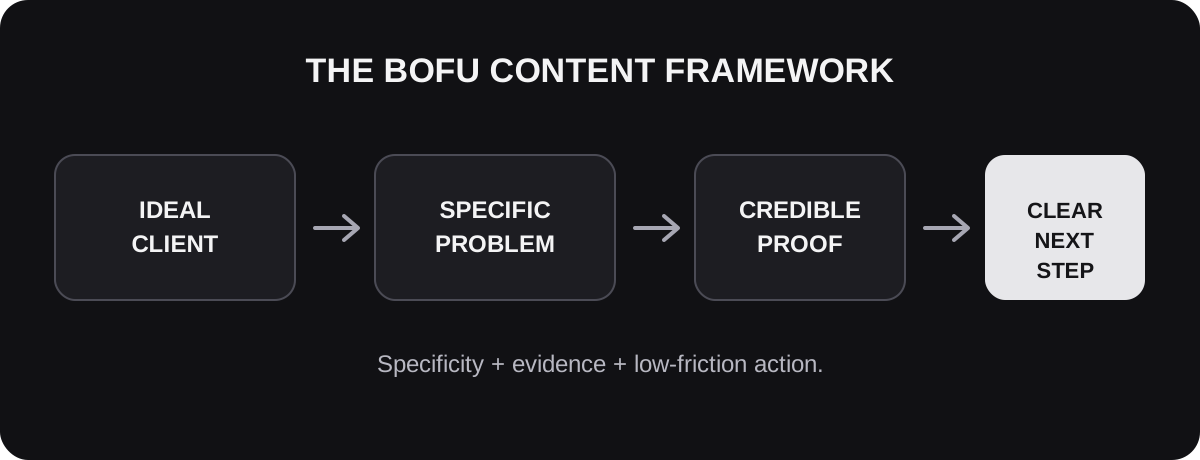
A useful BOFU post can often be built around four parts: ideal client, specific problem, credible proof, and clear next step.
The ideal client creates relevance. The problem makes the post feel personal. The proof makes the claim believable. The next step gives the prospect a simple way to continue when the timing is right.
- ✓Ideal client: who should feel that this post was written for them?
- ✓Specific problem: what expensive, frustrating, or persistent issue are they trying to solve?
- ✓Credible proof: what evidence shows that your approach can work in a similar situation?
- ✓Clear next step: what should an interested prospect do after reading?
How bottom-of-funnel content differs from middle-of-funnel content
Middle-of-funnel content builds trust in you as a coach. It shows your thinking, values, process, judgment, and personality. Bottom-of-funnel content applies that trust directly to a buying decision.
A middle-of-funnel post might explain why you do not use extreme diets. A bottom-of-funnel post might show how a client with a demanding travel schedule lost weight using a flexible nutrition system instead of an extreme diet.
The distinction matters because you do not want every post to become a sales pitch. Trust-building content earns the right to be more direct later. BOFU content then helps the most interested people understand why your offer fits them specifically.
1. Ideal-client problem posts
The strongest BOFU content starts with the exact problem your best clients are already trying to solve. Avoid broad topics such as 'how to lose weight.' Describe the problem the way the prospect experiences it in real life.
- ✓Why busy fathers keep losing progress every time work gets hectic
- ✓How to lose weight when dinner has to work for the entire family
- ✓What to do when you can train only three days per week but still want visible results
- ✓Why former athletes struggle when they try to train like they did ten years ago
- ✓How to rebuild consistency after years of starting and stopping
2. Direct problem-solving posts
A direct problem-solving post shows the audience how you would approach a problem that commonly leads people to hire you. Give enough detail to demonstrate your thinking without pretending that one post replaces individualized coaching.
- ✓If a client could not stop overeating at night, these are the first three things I would investigate
- ✓How I would build a fat-loss plan for someone traveling two weeks every month
- ✓What I would change first for a client training hard but not getting stronger
- ✓How I would simplify nutrition for a parent who refuses to cook separate meals
- ✓What I would do for someone who can stay consistent Monday through Thursday but loses control every weekend
3. Client case-study ideas
Case studies are one of the highest-value BOFU formats because they connect a real starting problem to a real process and outcome. The result matters, but the context is what makes the story persuasive.
A strong case study explains where the client started, what made their situation difficult, what changed, how the plan adapted, and what happened over time. This helps a prospect decide whether the evidence is relevant to them rather than simply admiring a transformation photo.
- ✓How a client trained three days per week and still made consistent progress
- ✓How a frequent traveler built a routine that survived hotel gyms and restaurant meals
- ✓How a beginner stopped restarting every Monday and completed twelve consistent weeks
- ✓How a client broke a weight-loss plateau without adding another hour of cardio
- ✓How a parent improved nutrition without asking the family to eat a separate menu
4. Testimonial content ideas
Testimonials work best when they answer a buying question. A screenshot saying 'great coach' is positive but vague. A testimonial that describes the client's starting problem, the experience of working together, and the specific change is much more useful.
Use testimonials with permission, keep the client's words accurate, and avoid presenting an exceptional outcome as a guaranteed result. Proof is strongest when it is specific and believable.
- ✓A client describing why the plan finally fit their work schedule
- ✓A testimonial about feeling supported after previous programs felt generic
- ✓A client explaining how weekly adjustments helped them stay consistent
- ✓A testimonial about gaining confidence in the gym rather than only changing body weight
- ✓A client explaining what surprised them most about the coaching process
How to make testimonials more convincing
The testimonial itself is only part of the post. Add enough context around it that the audience understands why the result matters.
Instead of posting a screenshot alone, explain who the client was, what they struggled with, what changed in the process, and what the audience should learn from it. Keep the emphasis on the client's experience rather than turning every testimonial into a boast.
- ✓Starting situation: what problem was the client dealing with?
- ✓Constraint: what made the problem difficult to solve?
- ✓Process: what did you change or prioritize?
- ✓Evidence: what improved over time?
- ✓Lesson: why should a similar prospect care?
5. Before-and-after content ideas
Before-and-after content can be useful proof when the visual change is relevant to the offer, but the transformation should not be the entire story. A prospect also needs to understand the behavior, timeline, constraints, and process behind it.
Do not imply that everyone will achieve the same outcome. Use accurate timelines, obtain permission, avoid misleading editing, and explain what the client actually did.
- ✓Before and after with the three behaviors that changed between the photos
- ✓A twelve-week progress timeline showing what happened each month
- ✓A strength before and after for a client whose primary goal was performance
- ✓A routine before and after showing how an inconsistent week became structured
- ✓A nutrition before and after showing the practical changes rather than only scale weight
6. Objection-handling content ideas
Your prospects often tell you the same reasons they are unsure about coaching. Those objections are valuable content topics because the audience may be thinking the same thing without ever messaging you.
Do not dismiss the objection. Acknowledge why it is reasonable, explain when it matters, and show how your process addresses it when appropriate.
- ✓I do not have enough time to work out
- ✓I travel too much to follow a consistent plan
- ✓I have tried coaching before and stopped following the program
- ✓I do not want to track calories forever
- ✓I am worried online coaching will feel too impersonal
7. Offer-fit and process content ideas
A qualified prospect should understand what kind of coaching experience they are considering. Process content reduces uncertainty by showing what happens after someone becomes a client and what the coach actually does to create value.
- ✓What happens during your first seven days as a coaching client
- ✓How I adjust a program when a client's schedule changes unexpectedly
- ✓What I look for during a weekly check-in
- ✓How I decide whether to change calories, steps, training volume, or nothing at all
- ✓Who my coaching is designed for and who should choose a different option
8. Decision-stage FAQ content ideas
Prospects close to a decision often have practical questions that are too specific for TOFU content but perfect for BOFU. Answer them publicly so people can evaluate fit before they ever book a call.
- ✓How often do you change a client's training plan?
- ✓What happens if a client misses a week because of travel or illness?
- ✓Do clients need a full gym to work with you?
- ✓How much communication happens between weekly check-ins?
- ✓What happens if the client's goal changes halfway through coaching?
Use the language your ideal client already uses
Bottom-of-funnel content becomes much stronger when the audience recognizes their own language. Save recurring phrases from sales calls, DMs, check-ins, comments, and intake forms, then use those phrases as topic inputs.
If prospects repeatedly say, 'I know what to do, I just cannot stay consistent,' that is more useful than a generic topic such as 'how to build discipline.' The first version reflects the problem exactly as the buyer experiences it.
- ✓I do well all week and ruin it on the weekend
- ✓I know what to do but cannot stay consistent
- ✓I do not have time to make separate meals
- ✓I used to be fit and now I do not know where to start
- ✓I am worried I will pay for coaching and fall off again
How to write a high-converting case study
A case study should read like a useful explanation, not an advertisement. The reader should be able to see the problem, understand the decisions, and determine whether the story is relevant to them.
- ✓Who: briefly describe the client and their situation
- ✓Problem: explain the obstacle that made progress difficult
- ✓Failed attempts: mention what had not worked and why
- ✓Plan: show the main changes without overwhelming detail
- ✓Adaptation: explain how the plan responded to real life
- ✓Result: show the relevant measurable and experiential outcomes
- ✓Lesson: connect the story to a similar prospect
- ✓CTA: invite the right person to ask about the process
Proof should match the promise
The best proof depends on what you sell. If the offer is about fat loss for busy professionals, the strongest evidence is not a bodybuilding transformation from someone training twice per day. If the offer is about sustainable consistency, a client explaining how they maintained the plan during travel may be more persuasive than a dramatic photo.
Choose proof that resembles the audience, problem, process, and outcome you want the next client to believe is possible.
- ✓Physical transformation: use relevant photos, measurements, or performance changes
- ✓Consistency: show training completion, routines, or client reflections
- ✓Confidence: use client quotes about behavior and self-efficacy
- ✓Convenience: show how the plan adapted to work, travel, or family life
- ✓Coaching quality: use messages describing support, clarity, and useful adjustments
Bottom-of-funnel hooks for fitness coaches
BOFU hooks should identify the right person or problem quickly. They can be more specific than discovery hooks because the goal is not universal reach.
- ✓If you are a [ideal client] struggling with [specific problem], this is what I would fix first
- ✓How one of my clients solved [problem] without [common sacrifice]
- ✓Why my clients do not need to [common approach] to achieve [result]
- ✓What I would change if your [specific symptom] keeps happening every week
- ✓This is what coaching looks like when [constraint] gets in the way
- ✓A client told me [objection]. Here is how we handled it
- ✓Before you hire an online coach for [goal], make sure they can answer these questions
- ✓Who my coaching is for and who it is not for
- ✓The exact reason we changed this client's plan in week four
- ✓If you have tried [common failed approach] three times, read this before trying it again
Calls to action should match buying intent
Bottom-of-funnel content can use a more direct CTA because the viewer is closer to a decision. The CTA should still feel like a logical continuation of the post rather than a sudden pitch.
If the post explains how you solve a specific client problem, invite people with that problem to start a conversation. If it is a case study, invite similar prospects to ask whether the approach would fit their situation.
- ✓If this sounds like your situation, DM me the word COACH
- ✓If you want help figuring out what is blocking your progress, send me a message
- ✓If you are dealing with the same problem, apply for coaching through the link in my bio
- ✓If you want to see whether this approach fits your situation, book a call
- ✓DM me your biggest obstacle and I will tell you what I would look at first
What not to do with bottom-of-funnel content
BOFU content becomes weak when every post says the same thing in a different wrapper: client result, book a call, client result, book a call. The audience needs different kinds of decision-making evidence.
- ✓Do not post testimonials without explaining why the result is relevant
- ✓Do not imply that one client's outcome is guaranteed for everyone
- ✓Do not use fake scarcity or invented urgency
- ✓Do not hide important context around timelines or starting points
- ✓Do not speak so broadly that the ideal client disappears from the message
- ✓Do not make every post about your credentials instead of the client's problem
- ✓Do not attack competing coaches to make your offer look stronger
- ✓Do not turn every educational post into a hard sales pitch
- ✓Do not use before-and-after photos without consent
- ✓Do not rely on proof alone if the audience does not understand the process behind it
How often should a fitness coach post BOFU content?
There is no universal ratio. A coach with a small warm audience and an active launch may need more direct decision-stage content than a coach focused on discovery. The key is that the account should contain enough BOFU evidence for an interested prospect to evaluate the offer without scrolling for twenty minutes.
A practical starting point is one or two strong BOFU posts per week, supported by regular Stories that show client wins, answer questions, and explain the coaching process. Increase or decrease that frequency based on how much qualified demand the content creates and how repetitive the feed feels.
A simple weekly bottom-of-funnel content system
Instead of inventing new sales content every week, rotate through a small set of evidence types. This creates variety while repeatedly answering the questions a serious prospect needs resolved.
- ✓Week 1: client case study
- ✓Week 2: direct ideal-client problem breakdown
- ✓Week 3: objection-handling post
- ✓Week 4: testimonial with context
- ✓Week 5: behind-the-scenes coaching process
- ✓Week 6: who the offer is for and who it is not for
- ✓Then repeat the cycle using a different client problem, objection, or example
How to measure bottom-of-funnel content
BOFU content should be judged by buying behavior, not by broad reach. A post with fewer views can be extremely valuable if it creates qualified conversations with people who fit the offer.
Track which content leads people to ask questions, send keywords, visit the application page, book calls, and mention the post during a sales conversation. Those signals tell you which problems and proof matter most to your market.
- ✓Qualified DMs generated
- ✓Application starts and completions
- ✓Booking-link clicks
- ✓Booked calls
- ✓Sales-call mentions of specific posts, case studies, or testimonials
- ✓Close rate by content source when trackable
- ✓Quality and fit of the conversations created
How BOFU content fits into the full content funnel
Top-of-funnel content helps the right stranger discover you. Middle-of-funnel content builds connection and trust. Bottom-of-funnel content gives the most interested people enough specific evidence to decide whether they should take the next step.
The three stages support each other. Without TOFU, not enough new people enter the audience. Without MOFU, the audience may know you but not trust you. Without BOFU, interested people may trust you but still lack a clear reason to act.
The strongest content system does not force every post to do all three jobs. It gives each stage a clear purpose and makes the path between them easy to follow.
Where Kinetic AI fits
Kinetic AI supports the step after bottom-of-funnel content creates intent. When a prospect responds to a CTA or sends a coaching keyword, the system can reply, ask qualification questions, identify fit, send the Calendly link when appropriate, follow up, track booking status, and preserve the context the coach needs before the call.
BOFU content creates the reason to start the conversation. A reliable DM and booking process helps make sure that qualified interest does not disappear between the post and the calendar.
Final takeaway
Bottom-of-funnel content should help the right prospect make a decision. Speak directly to the ideal client, address the specific problem they already want solved, show proof that matches that problem, explain how your process works, and make the next step obvious.
Use case studies, testimonials, before-and-after stories, problem-solving posts, objection handling, process breakdowns, FAQs, and offer-fit content to reduce uncertainty from different angles.
The goal is not to make every follower buy. The goal is to make the best-fit prospects feel increasingly certain that you understand their situation and have a credible process for helping them move forward.
Kinetic Growth Partnership
Build a more predictable online fitness coaching business
The Growth Partnership helps online fitness coaches identify the constraint limiting growth, build the missing strategy and systems around it, and review the numbers so the next priority stays clear.