Top-of-Funnel Content for Fitness Coaches: 50 Ideas That Attract the Right Audience
Learn how to create top-of-funnel content that reaches new people, attracts the right fitness audience, and creates a clear path toward trust, DMs, and coaching clients.
 Written by Dylan StottFounder of Kinetic AI
Top-of-funnel content is the content that introduces new people to your world. Its job is not to close a coaching sale in one post. Its job is to make the right stranger stop, recognize a problem, understand one useful idea, and become interested enough to take a small next step.
For fitness coaches, that sounds simple. In practice, many accounts publish content that is either too generic to attract the right people or too sales-focused for a cold audience. The coach posts exercises, recipes, motivation, client results, and calls to action, but the content does not create a clear reason for a specific person to follow, visit the profile, or continue learning.
A stronger top-of-funnel strategy combines relevance with simplicity. The audience should understand the idea quickly, see why it applies to them, and know what to do next without being pushed into a sales call before trust exists.
What is top-of-funnel content?
Top-of-funnel content, often shortened to TOFU content, is designed for people who may fit your market but do not know you well yet. They may not fully understand their problem, may not know which solution they need, and are usually not ready for a direct coaching pitch.
The content should help them recognize something useful about their situation. That may be a mistake they keep making, a symptom they have ignored, a belief that is holding them back, or a simple action that creates an immediate improvement.
The goal is relevant awareness. You are not trying to reach every person who likes fitness content. You are trying to reach more people who could eventually become a good fit for the coaching outcome you provide.
- ✓Reach people who do not already know the coach
- ✓Make a familiar problem easier to recognize
- ✓Deliver one useful idea without requiring prior context
- ✓Create enough relevance for a profile visit, follow, save, or share
- ✓Prepare the audience for deeper trust-building content later
Top-of-funnel content is not the same as viral content
A post can reach a large audience and still do very little for the coaching business. Broad entertainment, generic motivation, and trend-based content may produce views while attracting people with no connection to the offer.
Useful top-of-funnel content earns attention from the right type of person. A coach who helps busy fathers lose weight should care more about reaching busy fathers who recognize their evening eating problem than reaching a huge unrelated audience through a random gym trend.
The test is not only whether the post travels. The test is whether the right viewer understands that the coach speaks to problems people like them experience.
The simple formula for strong top-of-funnel content
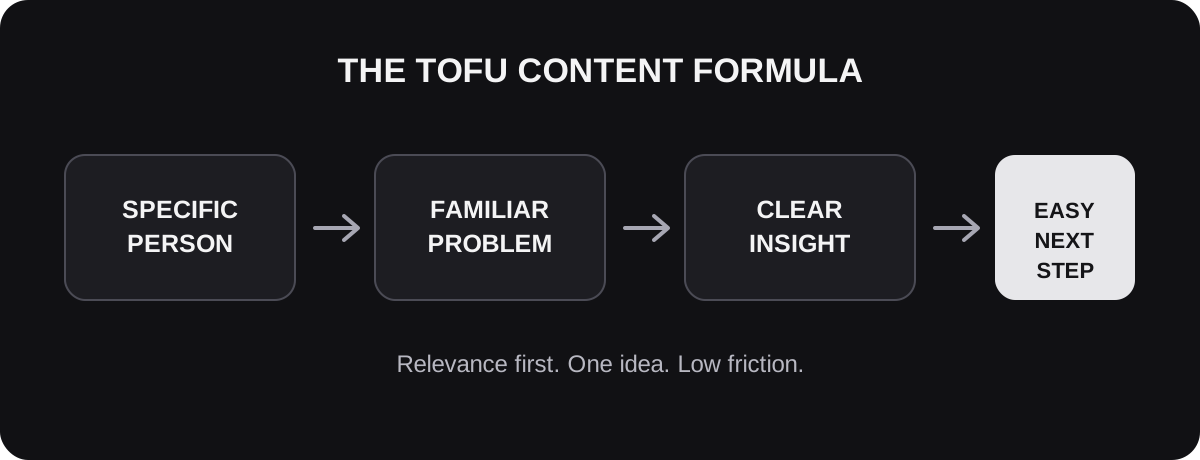
A strong TOFU post usually contains four parts: a specific person, a familiar problem, a clear insight, and an easy next step.
The person creates relevance. The problem creates recognition. The insight provides value. The next step gives the viewer a low-friction way to continue the relationship.
- ✓Specific person: who should immediately feel that the post is for them?
- ✓Familiar problem: what situation, symptom, or frustration do they already recognize?
- ✓Clear insight: what useful explanation, correction, or action can they understand quickly?
- ✓Easy next step: should they save, share, follow, visit the profile, or request a relevant resource?
How top-, middle-, and bottom-of-funnel content work together
Top-of-funnel content earns attention. Middle-of-funnel content builds trust by explaining the coach's thinking, process, and judgment. Bottom-of-funnel content reduces uncertainty and creates a direct reason to inquire about coaching.
The stages should not compete. A top-of-funnel post does not need to explain the full offer. A bottom-of-funnel case study does not need to reach every stranger. Each piece should have one primary job.
This article focuses only on the discovery layer so it does not duplicate the broader Instagram marketing guide. Use the ideas here to attract the right audience, then use deeper content, DMs, and the sales process to move qualified people forward.
1. Problem-recognition content ideas
Problem-recognition content helps the viewer name an issue they have been experiencing without fully understanding. This is useful because people often begin looking for a solution only after the problem becomes clear.
- ✓Five signs your fat-loss plan is too restrictive to survive a busy week
- ✓Why your lower back feels tight after sitting all day, even when you stretch
- ✓The reason you keep losing your routine after one missed workout
- ✓Why evening hunger feels uncontrollable after an unstructured workday
- ✓Three signs your training plan has more volume than you can recover from
2. Common-mistake content ideas
Mistake content works because the viewer can compare their current behavior with a better approach. The strongest examples explain why the mistake matters rather than simply telling people they are wrong.
- ✓The meal-prep mistake that makes healthy eating harder by Wednesday
- ✓Why changing your workout every week makes progress difficult to measure
- ✓The warm-up mistake that leaves beginners tired before the real workout starts
- ✓Why saving all your calories for dinner often backfires
- ✓The mistake busy professionals make when they copy six-day training programs
3. Myth and misconception content ideas
Myth content creates attention by challenging an assumption the audience already carries. Avoid inventing controversy for reach. Choose beliefs that genuinely affect the viewer's decisions or progress.
- ✓You do not need to remove every food you enjoy to lose body fat
- ✓Soreness is not proof that a workout was effective
- ✓Sweating more does not automatically mean you burned more fat
- ✓A perfect week is not required for meaningful progress
- ✓Lifting weights does not automatically make women bulky
4. Quick-win content ideas
Quick wins give the viewer an action they can use immediately. The idea should be simple enough to try without a full coaching relationship, but useful enough to demonstrate the coach's ability to simplify fitness.
- ✓A ten-minute high-protein breakfast for rushed mornings
- ✓The two-exercise warm-up I would use before a lower-body session
- ✓A simple way to make restaurant meals easier to estimate
- ✓The minimum workout to use when your schedule falls apart
- ✓One change that makes daily step goals easier to reach
5. Comparison and ranking content ideas
Comparisons help viewers make sense of several options quickly. They work especially well when the coach explains which option is best for a particular goal, experience level, or constraint instead of declaring one universal winner.
- ✓Walking versus running for a beginner trying to build consistency
- ✓Full-body versus upper-lower training for someone lifting three days per week
- ✓Protein bars ranked by convenience, taste, and usefulness
- ✓Home workouts versus gym training for busy parents
- ✓Five common cardio options ranked by joint impact and accessibility
6. Relatable-situation content ideas
Relatable content makes the viewer feel understood. It should reflect a real moment from the audience's life, not a generic statement that could apply to everyone.
- ✓When Monday starts perfectly and the entire plan disappears by Thursday
- ✓What happens when a work trip ruins the routine you built at home
- ✓Trying to eat differently while the rest of the family wants the usual meals
- ✓Getting back into the gym when every exercise feels unfamiliar
- ✓Wanting to train after work but feeling mentally finished before you arrive
7. Beginner-roadmap content ideas
Roadmap content reduces uncertainty by showing the first few steps. It is particularly effective for people who feel overwhelmed by the amount of fitness information available.
- ✓What I would do during my first seven days back in the gym
- ✓The first three nutrition habits I would build before tracking every calorie
- ✓A beginner's first month of strength training explained simply
- ✓What to focus on before buying supplements
- ✓The order I would fix sleep, training, nutrition, and daily movement
8. Opinion and perspective content ideas
Opinion content can attract attention when it reveals how the coach thinks. The opinion should be supported by useful reasoning and connected to the intended audience, not designed only to provoke comments.
- ✓Most beginners do not need more exercise variety
- ✓A plan that survives a bad week is better than a perfect plan that never does
- ✓The best diet is not automatically the one that produces the fastest first week
- ✓Busy parents should stop copying routines built for fitness creators
- ✓Consistency is often a design problem before it is a motivation problem
9. Demonstration content ideas
Demonstrations create value through visible contrast. Show the viewer what changes rather than relying entirely on explanation.
- ✓Two ways to adjust a squat when ankle mobility limits depth
- ✓How exercise tempo changes the difficulty of the same movement
- ✓A side-by-side example of a rushed rep and a controlled rep
- ✓Three versions of the same exercise for different experience levels
- ✓How to turn one basic meal into higher- and lower-calorie versions
10. Search-led question content ideas
The questions people repeatedly type into search, ask in comments, or send in DMs are valuable TOFU topics. Answer the question directly, then add the context most short answers miss.
- ✓How many days per week should a beginner work out?
- ✓How much protein do you need when trying to build muscle?
- ✓Should you train when you are still sore?
- ✓Why does body weight change so much from one day to the next?
- ✓Can you make progress with thirty-minute workouts?
How to adapt any idea to your coaching niche
A generic idea becomes more valuable when it is connected to a recognizable person and situation. Instead of posting 'three fat-loss mistakes,' identify who is making the mistakes and when they happen.
The goal is not to make every headline long. The goal is to create enough specificity that the right viewer sees themselves in the topic.
- ✓Generic: three reasons fat loss stalls
- ✓Specific: three reasons fat loss stalls for shift workers who eat most of their calories at night
- ✓Generic: best beginner workout
- ✓Specific: a three-day beginner workout for parents returning to the gym after several years
- ✓Generic: how to eat more protein
- ✓Specific: how busy professionals can reach a protein target without cooking four separate meals
Top-of-funnel hook templates for fitness coaches
The hook should create recognition quickly and accurately. It should not promise a result the post cannot deliver. Use these structures as starting points, then replace the broad language with details from the audience you coach.
- ✓Three signs your current plan is making [problem] harder
- ✓Why [common action] is not fixing [familiar problem]
- ✓What I would do first if I wanted to [goal] without [constraint]
- ✓Stop doing [mistake] if your goal is [outcome]
- ✓The difference between [option one] and [option two] for [specific person]
- ✓Most [audience] do not need more [common solution]. They need this instead
- ✓If [situation] keeps ruining your routine, start here
- ✓The beginner's guide to [topic] without [common frustration]
- ✓What nobody explains about [familiar fitness problem]
- ✓Before you try [popular tactic], check these three things
Choose the format after choosing the idea
The format should make the idea easier to understand. Do not begin with a Reel, carousel, or static post and then force a weak idea into it.
Use video when movement, personality, or demonstration matters. Use a carousel when the idea benefits from a sequence, comparison, or saved checklist. Use a simple static post when one clear statement can create recognition. Use collaboration content when another person gives the idea access to a relevant audience.
- ✓Reel: demonstrations, relatable scenarios, opinions, and fast explanations
- ✓Carousel: roadmaps, mistakes, myths, comparisons, and checklists
- ✓Static post: one strong belief, business lesson, or diagnostic statement
- ✓Collaboration: shared audiences, interviews, reactions, and expert comparisons
Use a low-friction call to action
A cold viewer has made a small commitment by watching or reading one post. Asking them to book a call immediately may be too large a jump unless the content itself creates strong buying intent.
Most TOFU calls to action should help the person continue learning. Ask for a save, share, follow, profile visit, or relevant resource request. A keyword DM can work when the resource directly continues the topic rather than acting as a disguised sales pitch.
- ✓Save this for your next busy week
- ✓Follow for the next part
- ✓Share this with someone rebuilding their routine
- ✓Visit the profile for the full guide
- ✓DM the keyword PLAN for the beginner checklist
How to measure top-of-funnel content
Judge the post by the job it was designed to perform. A discovery post should not be considered a failure because nobody bought coaching directly from it.
Look for evidence that new and relevant people discovered the account, found the idea useful, and took a small next step. Then evaluate whether those people continue into profile visits, follows, deeper content, DMs, and eventually qualified sales opportunities.
- ✓Non-follower reach and relevant reach
- ✓Watch time, completion, or carousel progression
- ✓Saves and shares
- ✓Profile visits generated by the post
- ✓Follows from content
- ✓Keyword DMs or resource requests when used
- ✓Quality of the audience and conversations created
Common top-of-funnel content mistakes
Most weak TOFU strategies fail because they optimize for activity or broad attention instead of useful relevance.
- ✓Posting generic tips that do not reveal who the coaching is for
- ✓Copying trends that attract an unrelated audience
- ✓Trying to educate, prove expertise, explain the offer, and sell in one post
- ✓Giving so much context that the core idea becomes difficult to understand
- ✓Using exaggerated hooks that the post does not support
- ✓Choosing the format before choosing the audience problem
- ✓Repeating beginner education without ever showing a distinct perspective
- ✓Judging every post only by views
- ✓Using the same direct sales call to action on every discovery post
- ✓Publishing TOFU content without a profile or deeper content that continues the journey
A practical 30-day TOFU content plan
Do not test fifty ideas at once. Choose a small number of repeatable angles, publish enough examples to learn, and compare the quality of attention each one produces.
A useful 30-day test could include twelve TOFU posts across four categories. Publish three problem-recognition posts, three mistake or myth posts, three quick wins or demonstrations, and three comparisons or relatable scenarios.
At the end of the month, identify which topics produced the strongest combination of relevant reach, saves, profile visits, follows, and conversations. Keep the winning angles and create deeper variations rather than constantly starting over.
- ✓Week 1: problem recognition, mistake, demonstration
- ✓Week 2: myth, quick win, relatable situation
- ✓Week 3: comparison, beginner roadmap, problem recognition
- ✓Week 4: opinion, demonstration, search-led question
How TOFU content eventually creates clients
Top-of-funnel content creates the first useful interaction. It does not carry the entire acquisition process alone.
The viewer may discover a Reel, visit the profile, consume a case study, request a guide, enter a DM conversation, answer qualification questions, and book a call. Each stage depends on the previous stage creating enough relevance and trust for the next step.
This is why more reach does not automatically solve a weak funnel. The profile, offer, middle-of-funnel content, DMs, qualification, follow-up, and booking process still need to work.
Where Kinetic AI fits
Kinetic AI does not create top-of-funnel content for the coach. It supports the conversion process after that content begins producing inbound Instagram interest.
When someone responds to a keyword or starts a coaching conversation, Kinetic AI can reply, ask qualification questions, identify fit, send the Calendly link when appropriate, follow up, track booking status, and preserve useful context before the call.
Strong TOFU content creates more relevant opportunities. A reliable DM system helps prevent those opportunities from disappearing after the first message.
Final takeaway
Top-of-funnel content should make the right stranger feel understood quickly. Start with a specific person, a familiar problem, one clear insight, and an easy next step.
Use problems, mistakes, myths, quick wins, comparisons, relatable situations, roadmaps, opinions, demonstrations, and real audience questions to create a repeatable supply of ideas.
The goal is not maximum reach at any cost. The goal is to attract more of the people who can benefit from the deeper content, conversations, and coaching process that follow.
Kinetic Growth Partnership
Build a more predictable online fitness coaching business
The Growth Partnership helps online fitness coaches identify the constraint limiting growth, build the missing strategy and systems around it, and review the numbers so the next priority stays clear.