Middle-of-Funnel Content for Fitness Coaches: 40 Ideas That Build Trust and Connection
Learn how to create middle-of-funnel content that helps fitness coaches build connection, demonstrate expertise, earn trust, and move followers closer to becoming clients.
 Written by Dylan StottFounder of Kinetic AI
Middle-of-funnel content is where a fitness coach stops being just another useful account and starts becoming someone the audience trusts.
The viewer already knows you exist. They may have followed you after a Reel, saved one of your posts, visited your profile, or consumed several pieces of content. The next question in their mind is no longer only, 'Is this useful?' It becomes, 'Do I trust this person enough to listen to them, follow their advice, and eventually pay them to coach me?'
That trust is not built by posting more tips. It is built by showing how you think, how well you understand the audience, what you believe, how you make decisions, what your coaching looks like, and whether your advice feels consistent with the results you claim to create.
This guide is specifically about that trust-building layer. It does not replace top-of-funnel content, which attracts new people, or bottom-of-funnel content, which helps qualified prospects decide whether to buy. Middle-of-funnel content connects those two stages by turning attention into belief.
What is middle-of-funnel content?
Middle-of-funnel content, often called MOFU content, is designed for people who already have some awareness of the coach but are not yet ready to buy. They may understand the problem, agree that they need help, and even like the coach's content, but they still need reasons to trust the person behind the account.
The job of MOFU content is to reduce uncertainty. It should help the audience understand how you think, what you stand for, what makes your approach different, and what it would feel like to learn from you.
- ✓Build familiarity with the coach as a person
- ✓Demonstrate useful expertise and judgment
- ✓Show that the coach understands the audience's real situation
- ✓Reveal the process behind the advice
- ✓Create consistent evidence that the coach can be trusted
- ✓Make deeper engagement feel natural instead of forced
The real goal is trust, not more education
Fitness coaches often assume that more education automatically creates more trust. It does not. Someone can learn useful information from you for months and still see you as interchangeable with dozens of other accounts.
Trust grows when the audience sees evidence of competence and character repeatedly. They need to believe that you know what you are doing, understand people like them, make sensible decisions, communicate clearly, and will not disappear or change your philosophy every week.
That means MOFU content should go deeper than information. Explain why you make certain choices. Show what you notice that beginners miss. Share the tradeoffs behind a decision. Let the audience see the person and process behind the advice.
The four trust signals strong MOFU content should build
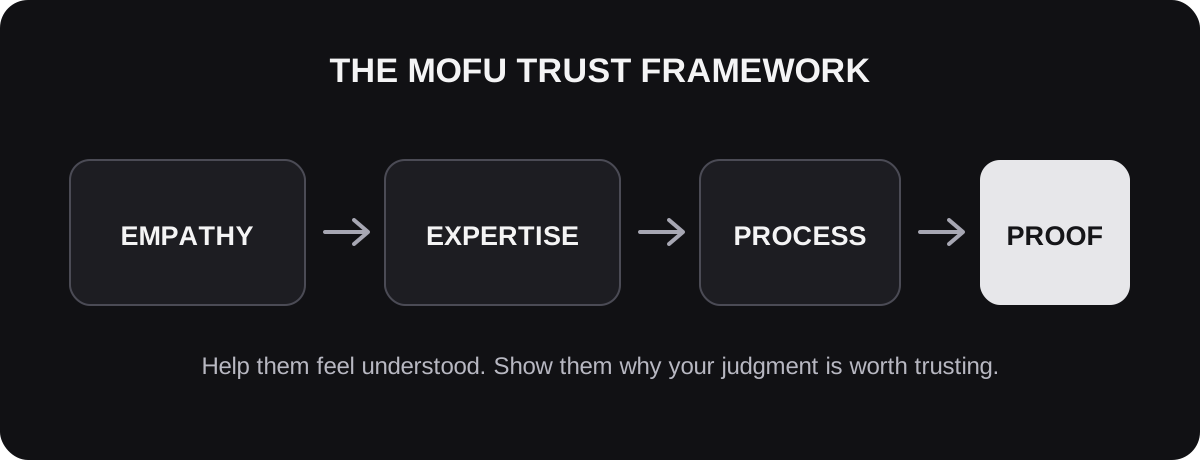
Most effective middle-of-funnel content strengthens one or more of four trust signals: empathy, expertise, process, and proof.
Empathy tells the audience that you understand their situation. Expertise shows that your advice is worth listening to. Process makes your coaching feel structured rather than improvised. Proof gives the audience evidence that your thinking works in practice.
- ✓Empathy: you understand what their problem actually feels like
- ✓Expertise: you can explain the problem and make good decisions
- ✓Process: you have a repeatable way to help people move forward
- ✓Proof: your approach has produced credible outcomes or useful progress
Connection matters because people hire people
A prospect may agree with your advice and still choose another coach because they feel more connected to that person. Coaching is a relationship-based service. The client expects to communicate, be held accountable, receive feedback, and trust the coach with personal goals and frustrations.
That does not mean posting your entire private life. Connection comes from showing enough personality, values, communication style, and real-world perspective that the audience can imagine interacting with you.
A useful test is simple: after consuming your content for a few weeks, would a follower know what you care about, how you coach, what you believe, and what kind of person you are to work with?
1. Belief and point-of-view content ideas
Your beliefs help the audience decide whether they agree with your approach. Strong point-of-view content explains the reasoning behind the belief instead of relying on a provocative statement alone.
- ✓Why I would rather give a client a three-day plan they can follow than a six-day plan they cannot
- ✓Why consistency problems are often planning problems before they are motivation problems
- ✓Why I do not judge a client's week by one bad meal
- ✓Why the fastest possible result is not always the best coaching target
- ✓Why a good fitness plan should get simpler when life gets harder
2. Coaching-decision breakdowns
Decision breakdowns are one of the strongest ways to demonstrate expertise because they show judgment rather than memorized information. Walk the audience through what you would notice, what you would ignore, and why you would make a particular adjustment.
- ✓How I decide whether to lower calories or increase activity when fat loss stalls
- ✓What I look at before changing a client's training program
- ✓How I decide whether a client needs more accountability or a simpler plan
- ✓What I would change first for someone who keeps missing evening workouts
- ✓How I decide whether a plateau is a real problem or just normal short-term noise
3. Behind-the-scenes coaching process ideas
Behind-the-scenes content makes the service easier to understand without turning the post into a direct sales pitch. Show how real coaching decisions are made and what happens between the obvious deliverables.
- ✓What I review before sending a weekly client check-in response
- ✓How I adjust a plan when a client has a week of travel
- ✓What happens after a client says their workout felt too difficult
- ✓How I use progress photos, strength trends, body weight, and adherence together
- ✓What I document after a coaching call so the next week is easier to manage
4. Personal-story content that reinforces your coaching philosophy
Personal stories build connection when they help the audience understand why you think the way you do. The story should serve the audience rather than becoming an unrelated autobiography.
- ✓A mistake I made in my own training that changed how I coach beginners
- ✓The period when I was doing too much and why it changed my view of recovery
- ✓What I misunderstood about nutrition before I learned to make it sustainable
- ✓A time I lost consistency and what actually helped me rebuild it
- ✓The coaching lesson I learned after giving someone a plan that was technically good but unrealistic
5. Client-problem breakdowns without turning every post into a testimonial
You can use client experiences to demonstrate judgment without constantly posting before-and-after photos. Focus on the problem, the decision, and the lesson.
- ✓A client was training five days but progressing less than when we moved to three. Here is why
- ✓Why I increased a client's food intake before asking them to lose more weight
- ✓How we rebuilt consistency after a client missed two weeks instead of starting over
- ✓The small schedule change that fixed a client's repeated missed workouts
- ✓Why a client needed fewer nutrition rules, not more discipline
6. Frequently asked question content
Questions that appear repeatedly in comments, DMs, consultations, and check-ins reveal what the audience is uncertain about. Answering them publicly shows that you understand the decisions prospects are already trying to make.
- ✓What should I do if I cannot hit my calorie target perfectly every day?
- ✓How long should I stay on the same workout program?
- ✓What happens if I miss a full week of training?
- ✓Do I need to track food forever to keep results?
- ✓How do I know whether I need a coach or just a better plan?
7. Objection content without the hard sell
A prospect can have concerns long before they are ready to book a call. Address those concerns through useful content rather than waiting until a sales conversation.
- ✓What online coaching should actually help with beyond giving you workouts
- ✓Why being busy does not automatically mean coaching will not work for you
- ✓What a coach can and cannot do when motivation drops
- ✓Why a customized plan still needs client feedback to work well
- ✓The difference between needing more information and needing accountability
8. Standards and values content
Standards help the audience understand how seriously you take the coaching relationship. They can also repel poor-fit prospects, which is useful.
- ✓What I will never ask a client to do just to make progress look faster
- ✓What I expect from clients and what they should expect from me
- ✓Why I would rather adjust a plan than shame someone for missing it
- ✓When I would tell someone they do not need my coaching
- ✓Why I care more about honest check-ins than perfect check-ins
How to show personality without posting random lifestyle content
Personality content works best when it adds context to the coaching relationship. The audience does not need to see every meal, errand, or coffee order. They need enough exposure to understand how you communicate and what kind of person you are.
Use daily life as a vehicle for a useful belief, decision, lesson, or standard. A walk can become a short explanation of how you think about steps. A grocery trip can show how you make nutrition practical. Your own workout can explain how you choose exercises rather than simply showing that you train.
- ✓Show the decision behind what you are doing
- ✓Explain the value or belief the moment represents
- ✓Let your normal communication style come through
- ✓Avoid manufacturing vulnerability or oversharing for engagement
- ✓Connect personal content back to the audience when possible
Teach your thinking, not just your conclusions
A generic tip says, 'Eat more protein.' Trust-building content says, 'Here is why I would increase protein for this person, what I would change first, and what would make me choose a different approach.'
When followers understand how you arrive at decisions, they begin to trust your judgment. That matters because clients do not only pay for information. They pay for someone to make better decisions when the situation changes.
- ✓State the situation
- ✓Explain what information matters
- ✓Show the tradeoff
- ✓Make the decision
- ✓Explain what would cause you to change your mind
Use stories to create repeated familiarity
Instagram Stories are naturally suited to middle-of-funnel content because people who view them have usually chosen to follow or revisit the account. That makes Stories a good place to build familiarity in smaller, more frequent interactions.
Use Stories to show your day, answer questions, explain coaching decisions, share client wins with context, respond to polls, and talk directly to the audience. The value is not one perfect Story. It is repeated exposure to the same coach, values, and way of thinking.
- ✓Quick coaching lesson from something that happened that day
- ✓Poll followed by an explanation of the result
- ✓Question box with thoughtful answers
- ✓Client win with the decision that helped create it
- ✓A common DM question answered publicly
- ✓Short behind-the-scenes look at programming or check-ins
Use proof carefully in the middle of the funnel
Proof belongs in both middle- and bottom-of-funnel content, but the purpose changes. In the middle of the funnel, proof should strengthen trust in your process rather than force a buying decision.
Instead of only posting a dramatic transformation with a sales call to action, explain what the client struggled with, what changed in the process, and what the audience can learn from it. The proof becomes educational and credible at the same time.
- ✓Show the starting problem, not only the final result
- ✓Explain the coaching decision that mattered
- ✓Include setbacks or adjustments when relevant
- ✓Avoid implying that every client will get the same result
- ✓Use permission before sharing client details, images, or messages
Middle-of-funnel hook templates
MOFU hooks can assume slightly more familiarity than top-of-funnel hooks. They do not need to chase maximum curiosity. They should create interest in your judgment, story, or process.
- ✓Here is what I would look at before changing your plan
- ✓This is why I coach [problem] differently
- ✓A client asked me [question]. Here is how I answered
- ✓The mistake I used to make with [topic] and what changed my mind
- ✓If a client told me [situation], this is what I would do next
- ✓Most people focus on [obvious thing]. I would look at these three things first
- ✓Here is what actually happens when one of my clients has a bad week
- ✓This is the standard I use before I recommend [action]
Calls to action for middle-of-funnel content
The audience is warmer than a top-of-funnel viewer, but not every post needs to push them to book a call. The best next step depends on how much buying intent the content creates.
Use calls to action that deepen the relationship. Invite a reply, question, profile visit, direct message, resource request, or conversation. Save direct booking calls for posts where the prospect has enough context to understand why a call makes sense.
- ✓Reply with the part you struggle with most
- ✓Send me your question and I may break it down in a future post
- ✓DM me PLAN if you want the checklist I use for this
- ✓Check the pinned post if you want to see how I approach this with clients
- ✓If this sounds like the problem you are dealing with, send me a message
How to measure middle-of-funnel content
MOFU content often produces quieter signals than discovery content. A post may reach fewer people while doing more to create trust with the people who matter.
Look for evidence of depth. Are followers returning? Are they watching Stories, replying, visiting the profile repeatedly, asking better questions, sending warmer DMs, or mentioning specific content when they inquire? Those signals show that the relationship is developing.
- ✓Returning viewers and repeat Story viewers
- ✓Saves and shares from existing followers
- ✓Profile visits from warm audience members
- ✓Story replies and question-box responses
- ✓DMs that reference a specific post or idea
- ✓Longer, more specific conversations
- ✓Prospects who arrive on calls already understanding your approach
Common middle-of-funnel content mistakes
Weak MOFU content usually fails because it is either too generic to build trust or too sales-heavy to feel like a relationship.
- ✓Posting endless tips without showing how you think
- ✓Trying to sound authoritative without showing empathy
- ✓Sharing random personal content that has no relevance to the coaching relationship
- ✓Turning every client result into a direct sales pitch
- ✓Copying strong opinions from other creators without having your own reasoning
- ✓Changing your philosophy constantly for engagement
- ✓Trying to look perfect instead of showing realistic coaching judgment
- ✓Using fake vulnerability or manufactured controversy to create connection
- ✓Assuming followers understand what your coaching process actually looks like
- ✓Measuring success only by reach instead of relationship depth
A simple weekly MOFU content system
You do not need to publish trust-building content every day. The goal is repeated exposure to a consistent set of beliefs, standards, and coaching decisions.
A simple weekly system could include one coaching-decision breakdown, one connection or story-based post, one proof or client-process post, and regular Stories that reinforce the same themes.
- ✓Post 1: coaching belief or decision breakdown
- ✓Post 2: personal story connected to a useful coaching lesson
- ✓Post 3: client process, proof, or behind-the-scenes breakdown
- ✓Stories: questions, daily coaching observations, polls, and client context
How middle-of-funnel content fits the full client journey
Top-of-funnel content helps a stranger discover you. Middle-of-funnel content gives that person reasons to trust you. Bottom-of-funnel content helps them decide whether your coaching is the right next step.
The middle is what prevents the funnel from feeling like a jump from free tip to sales pitch. A prospect may watch several Reels, follow you, consume your Stories for two weeks, read a client breakdown, agree with your coaching philosophy, and only then respond to an offer or send a DM.
That sequence is not wasted time. It is the trust-building process that makes the later sales conversation easier.
Where Kinetic AI fits
Kinetic AI does not build trust for the coach. The coach's content, expertise, communication, and client experience have to do that work.
Kinetic AI becomes useful once that trust creates inbound Instagram conversations. It can respond to a keyword or coaching inquiry, ask qualification questions, identify fit, send the Calendly link when appropriate, follow up, track booking status, and preserve context before the call.
Strong MOFU content makes the lead warmer before the DM begins. A reliable DM system helps make sure that warm lead does not disappear after taking the next step.
Final takeaway
Middle-of-funnel content should help your audience trust both your competence and your character. Show that you understand them, explain how you think, reveal the process behind your coaching, and provide credible proof that your approach works.
The best MOFU content does not feel like a constant pitch. It feels like repeated evidence that you are someone worth listening to and someone the right prospect could trust as a coach.
If top-of-funnel content earns attention, middle-of-funnel content earns belief. That belief is what makes the eventual DM, consultation, and buying decision feel natural instead of forced.
Kinetic Growth Partnership
Build a more predictable online fitness coaching business
The Growth Partnership helps online fitness coaches identify the constraint limiting growth, build the missing strategy and systems around it, and review the numbers so the next priority stays clear.