How to Calculate the ROI of Instagram DM Automation for Personal Trainers
A practical ROI framework personal trainers can use to evaluate Instagram DM automation using revenue, booked calls, time saved, and total cost.
 Written by Dylan StottFounder of Kinetic AI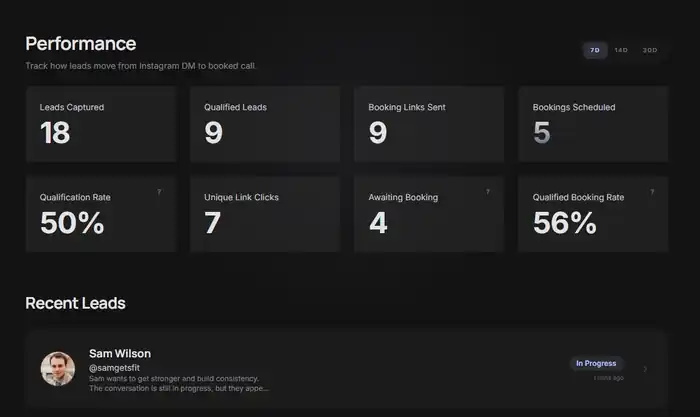
Instagram DM automation is not valuable because it sends messages. It is valuable only if it creates or protects more economic value than it costs.
That value can come from additional clients, faster lead response, better qualification, recovered follow-up opportunities, fewer missed booking links, and less staff or owner time spent on repetitive conversations.
A serious return-on-investment calculation must include the full cost of the system and use outcomes the trainer can actually verify. Inflated revenue projections and vague claims about saving time are not enough.
The basic Instagram DM automation ROI formula
Use this formula: ROI percentage equals net benefit divided by total automation cost, multiplied by 100.
Net benefit equals measurable financial benefit minus total automation cost.
For example, if a system creates $4,500 in attributable gross profit and costs $750 during the same period, net benefit is $3,750. ROI is $3,750 divided by $750, multiplied by 100, which equals 500 percent.
That example is not a promise or benchmark. The result depends on lead volume, offer economics, conversion, retention, implementation, and attribution quality.
Use gross profit when costs change with each client
Revenue is simple to understand, but it can exaggerate the value of automation when delivering the coaching program creates meaningful variable costs.
If a $1,500 client requires $300 of contractor labor, payment fees, fulfillment, or other incremental cost, the contribution before fixed overhead is $1,200. That is usually a more honest input than the full $1,500.
For a coaching offer with very low variable fulfillment costs, revenue and gross profit may be closer. The important rule is consistency: define the value basis before comparing periods or tools.
Step 1: Establish the baseline
You cannot credibly claim automation improved performance without knowing what happened before it was introduced.
Measure a representative baseline period using the same definitions you plan to use after implementation. Avoid selecting an unusually weak week just to make the new system look better.
- ✓New inbound Instagram conversations
- ✓Median first-response time
- ✓Lead reply rate
- ✓Qualified leads
- ✓Calls booked
- ✓Calls attended
- ✓New clients
- ✓Collected revenue or gross profit
- ✓Hours spent managing DMs and follow-up
Step 2: Calculate incremental clients
Incremental clients are the additional clients produced after automation beyond what the baseline would predict for the same lead volume.
Do not simply count every client after launch as automation revenue. Content performance, seasonality, pricing changes, sales improvements, and lead quality may also affect results.
One practical approach is to compare conversion per 100 inbound conversations before and after the change. This controls for part of the variation in lead volume, although it still does not prove that automation caused the entire difference.
If the baseline produced two clients per 100 inbound conversations and the new system produces three per 100, the estimated incremental lift is one client for that volume.
Step 3: Value faster response and recovered follow-up
Some automation value comes from opportunities that were previously lost rather than from generating brand-new demand.
Examples include a prospect who receives a reply while interest is still high, a qualified lead who gets the booking link instead of being forgotten, or a conversation that resumes after the lead stops answering.
The defensible way to value these outcomes is to track the leads that moved forward through automated actions and connect them to booked calls and collected revenue. Do not assign an arbitrary dollar value to every automatic message.
Related reading
Step 4: Calculate labor savings
Time saved can be a real benefit, but only when it is measured and valued honestly.
Start with the weekly hours previously spent sending first replies, asking repetitive qualification questions, checking who needs follow-up, sending booking links, and updating lead status. Then measure the time still required after automation, including review, exceptions, and manual takeover.
Time saved equals baseline weekly hours minus post-automation weekly hours.
Monthly labor value equals time saved per week multiplied by 4.33 and multiplied by the chosen hourly value.
- ✓Use actual tracked time rather than memory when possible
- ✓Include time spent correcting automation mistakes
- ✓Do not value every owner hour at the coaching session rate unless that time can realistically be sold
- ✓Use employee wage plus employment cost when automation replaces staff workload
- ✓Record what the saved time is redeployed toward
What is the trainer's time actually worth?
This is where many ROI calculations become fiction. A trainer who charges $150 for a session does not automatically create $150 of value every time automation saves an hour.
The relevant value depends on the alternative use of that hour. If the trainer can use it for a paid session, sales calls, or high-impact content, the economic value may be substantial. If the time would otherwise remain unused, the immediate cash value may be lower even though the lifestyle value is real.
A conservative calculation can show two versions: cash ROI without owner-time savings and economic ROI including a reasonable hourly value. Keeping those separate prevents soft assumptions from disguising weak financial performance.
Step 5: Include the total cost of ownership
The subscription price is only one part of the cost. A tool that appears inexpensive can become costly after setup, integrations, contact limits, staff time, maintenance, and message usage are included.
- ✓Monthly or annual software subscription
- ✓Onboarding or setup fee
- ✓Usage, message, contact, or AI charges
- ✓Integration and calendar costs
- ✓Implementation labor
- ✓Ongoing management and quality-control time
- ✓Training costs for the coach or team
- ✓Cost of mistakes, missed leads, or poor-fit calls when measurable
Related reading
A worked monthly ROI example
Assume a trainer previously handled 120 inbound DM conversations per month and signed four clients. After implementing automation, the same approximate lead volume produces six clients. Each new client generates $1,200 in gross profit over the measurement window.
The estimated incremental client benefit is two multiplied by $1,200, or $2,400.
The trainer also reduces repetitive DM work by 12 hours per month. Using a conservative value of $40 per hour, measured labor value is $480.
Total measured benefit is therefore $2,880. Assume total monthly automation cost, including software and management time, is $600. Net benefit is $2,280. ROI is $2,280 divided by $600, multiplied by 100, which equals 380 percent.
Run the calculation again without owner-time savings. Cash-oriented benefit is $2,400, net benefit is $1,800, and ROI is 300 percent. Showing both versions makes the result more transparent.
Calculate the break-even number of clients
Break-even analysis is often more useful than an impressive ROI percentage because it answers a direct buying question: how many additional clients must this system create or protect to pay for itself?
Use this formula: break-even incremental clients equals total automation cost divided by gross profit per new client.
If the all-in monthly automation cost is $600 and gross profit per new client is $1,200, the system needs 0.5 incremental clients per month to break even. In practical terms, one additional client every two months covers the modeled cost.
This does not mean the system will produce that result. It tells the trainer the performance threshold required for the investment to make financial sense.
Calculate cost per qualified booked call
Cost per qualified booked call is useful when sales outcomes take longer to mature or lead volume is too small for stable client-level ROI.
Use this formula: total automation cost divided by qualified calls booked through the system.
For example, a $600 monthly system that contributes to 12 qualified booked calls has a cost of $50 per qualified booked call.
Do not compare that number with a vendor's cost-per-lead claim unless both use the same definition. A form submission, a DM response, a qualified prospect, a booked call, and an attended qualified call are not interchangeable outcomes.
Use sensitivity analysis instead of one optimistic forecast
ROI is uncertain because conversion rates and client value vary. A single forecast can create false confidence.
Build conservative, expected, and strong scenarios. Change only the assumptions that materially affect the result, such as incremental booked calls, show rate, close rate, gross profit per client, and total cost.
- ✓Conservative: little conversion improvement and full implementation cost
- ✓Expected: moderate improvement based on observed baseline gaps
- ✓Strong: better execution without assuming impossible conversion
- ✓Downside: no incremental clients, with only measured labor savings
Choose a measurement window that matches the sales cycle
A seven-day test may be too short when leads take weeks to book, attend, decide, and pay. At the same time, an indefinite attribution window lets almost any later sale get credited to automation.
Choose a consistent window based on the actual business. A trainer might report leading indicators weekly, booked and attended calls monthly, and client revenue by 30-day or 60-day cohort.
The key is to compare like with like. Leads entering near the end of a period need enough time to mature before final conversion is judged.
Separate automation performance from sales performance
Automation can improve response, qualification, and booking while overall revenue remains weak because attended calls are not closing. The reverse can also happen: a strong salesperson may hide a weak DM funnel by converting a small number of opportunities extremely well.
Evaluate both layers. The DM system should be judged on response time, engagement, qualification, booking, and show outcomes. The sales process should be judged on attended-call conversion, collected revenue, and retention.
This separation makes improvement more precise and prevents a software purchase from being blamed for an offer or sales problem it cannot solve.
Common ROI calculation mistakes
An ROI model is only as useful as its assumptions and attribution rules.
- ✓Crediting automation for every client signed after installation
- ✓Using revenue when variable fulfillment costs are substantial
- ✓Ignoring setup, management, and usage costs
- ✓Assigning an inflated value to every hour saved
- ✓Using booked calls while ignoring qualification and attendance
- ✓Comparing different lead volumes without normalizing the data
- ✓Judging results before the cohort has time to convert
- ✓Using vendor benchmarks as guarantees
- ✓Reporting only the best scenario
When Instagram DM automation is probably not the priority
Automation cannot manufacture demand, repair an offer nobody wants, or replace competent selling.
If the trainer receives almost no relevant inbound DMs, the immediate bottleneck may be content, positioning, profile conversion, or lead generation. If prospects book and attend but rarely buy, the offer or sales process may deserve attention first. If the trainer cannot define who qualifies, automating the conversation can scale inconsistency.
The best time to automate is when there is a repeated process worth improving: meaningful inbound volume, delayed or inconsistent replies, repetitive qualification, missed follow-up, and enough offer economics to justify the investment.
A practical ROI scorecard
Review the system with a small set of financial and operational measures rather than one vanity number.
- ✓Incremental gross profit attributed conservatively
- ✓Total cost of ownership
- ✓Net benefit
- ✓ROI percentage
- ✓Break-even incremental clients
- ✓Cost per qualified booked call
- ✓Hours saved and how they were redeployed
- ✓Change in response, booking, and show rates
Final takeaway
The ROI of Instagram DM automation should be calculated from measurable improvement, not from the number of automatic messages sent.
Establish the baseline, calculate incremental gross profit, value labor conservatively, include every meaningful cost, and run more than one scenario. Then inspect the funnel metrics to understand why the financial result changed.
Kinetic AI is built to help personal trainers respond to inbound Instagram leads, qualify the right prospects, deliver booking links, and track the path toward booked calls. The business case should still be judged against the trainer's own numbers.
Kinetic Growth Partnership
Build a more predictable online fitness coaching business
The Growth Partnership helps online fitness coaches identify the constraint limiting growth, build the missing strategy and systems around it, and review the numbers so the next priority stays clear.