How to Filter Unqualified Fitness Leads Before They Book
A practical process personal trainers can use to stop poor-fit prospects from filling their calendar and focus on calls worth taking.
 Written by Dylan StottFounder of Kinetic AI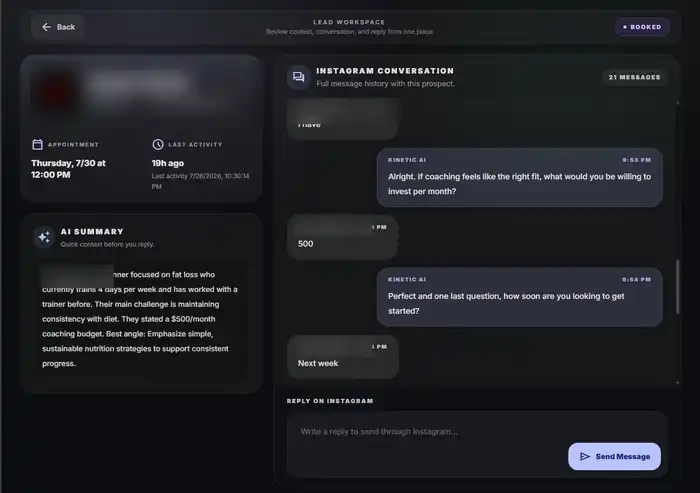
Getting more booked calls is not always a win.
If those calls are filled with people who cannot afford coaching, are not ready to start, only want free advice, or are a poor fit for your offer, your calendar gets busier without your business getting healthier.
That is why personal trainers need to filter unqualified fitness leads before they book.
What makes a lead unqualified?
Unqualified does not always mean bad. It usually means the lead is not a fit for this specific sales conversation right now.
The most common poor-fit patterns are easy to recognize once you know what to look for.
- ✓They want custom coaching but have no realistic budget
- ✓They are curious but not actively trying to solve the problem
- ✓They want free tips, not accountability or service
- ✓They have no urgency and no timeline
- ✓Their goal does not match what you actually offer
Why trainers accidentally invite poor-fit calls
Many trainers send booking links too early because they do not want to lose momentum.
That instinct makes sense, but it can create a worse problem: your calendar becomes the filter instead of the DM conversation.
A sales call should be where you explore fit more deeply and close the right person. It should not be the first time you find out they were never a serious prospect.
Question 1: What goal are they actually trying to solve?
Start with the goal because it immediately reveals whether the lead is relevant to your coaching.
Example: “What’s your main fitness goal right now?”
The answer gives you context, but it also exposes mismatch. A trainer who sells body recomposition coaching may not need a sales call with someone asking for a one-off meal plan or a quick free workout.
Question 2: What is making that goal hard right now?
This question distinguishes surface-level curiosity from a real problem.
Someone who says, “I just want to see what you charge,” may be less qualified than someone who says, “I have trained on and off for two years, but I keep falling off when work gets busy.”
Specific pain usually signals stronger intent than vague interest.
Question 3: How soon do they want to start?
Timeline matters because urgency affects booking quality.
A person who wants to start this month is usually different from someone saying, “Maybe later this year.”
You do not need to reject every low-urgency lead, but you should be careful about handing your calendar to people with no real near-term intent.
Question 4: Are they realistically open to coaching?
This is the question many trainers avoid because they think it feels awkward. It is actually respectful.
If your service costs money, it is better to understand whether investing in coaching is realistic before asking someone to book time on your calendar.
You can ask directly without sounding aggressive: “If coaching feels like the right fit, what would you be comfortable investing per month?”
Question 5: Do they fit the kind of help you provide?
A lead can be serious and still be wrong for your offer.
If someone wants contest prep and you coach lifestyle fat loss, or if someone needs in-person rehab support and you sell online training, that lead may not belong on your calendar.
Qualification protects both sides from a bad-fit call.
What to do with leads who do not qualify
Do not treat every unqualified lead like a rejection. Some can still be handled gracefully.
You can give a free resource, suggest a lower-friction next step, or invite them to return later when timing or budget changes.
The mistake is not having a softer off-ramp. Without one, trainers either ghost the lead or push them into a call they should never take.
- ✓Send a free guide or resource
- ✓Offer a simple next step that does not require a sales call
- ✓Encourage them to reconnect when timing improves
- ✓Keep the door open without clogging the calendar
Why this creates a better sales pipeline
Filtering before the booking link does not mean you want fewer opportunities. It means you want cleaner opportunities.
When you protect your calendar, booked calls become more meaningful. You spend more time with prospects who have a real problem, a real desire to solve it, and a realistic chance of becoming clients.
Final takeaway
If your calendar is full of poor-fit calls, the issue is not always your sales ability. Sometimes the issue is that the wrong people are getting to the call in the first place.
A stronger qualification flow helps personal trainers protect their time, create a better buying experience, and focus on calls worth taking.
Kinetic AI helps trainers filter for fit before the booking link is sent, so more of the calls that reach the calendar are the calls that actually deserve attention.
Related reading
Turn Instagram DMs into booked calls
Kinetic AI helps personal trainers reply to new leads, qualify them, send booking links, and track booked calls automatically.
Get 5 Booked Calls Free →